An Introduction to Nuclear Waste Immobilisation

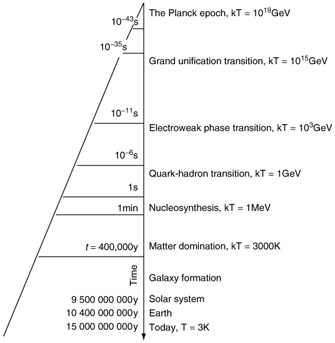
We are living in a naturally radioactive world. Our universe developed 1.5 10 10 years ago from a high energy density singularity, the so-called "Big Bang". It then expanded and was cooled by this expansion, the current 3-K background radiation being remnant radiation from the first seconds after the Big Bang (Fig. 1.1).
Everything we see around us is the substance from a supernova star which exploded 4.6 10 9 years ago. At that moment all possible isotopes of all elements entered the composition of the supernova. The shortest-lived radionuclides decayed quickly, still in the plasma and gaseous phase as revealed by the presence of these radionuclides in the radiation spectrum of newer super-novae. Cooled gas condensed and formed solid dust particles that agglomerated to form the first universal bodies, which collided with each other to form the first protoplanets. Long-lived radionuclides such as 99Tc, 239Pu and 242Pu, which became part of the composition of the protoplanets, gradually decayed although longer lived radionuclides such as 235U, 238U and 232Th did not decay completely. These are left as a reminder of the natural radioactivity evolution over the 4.6 billion year lifetime of the Earth.
Until the invention of the X-ray tube by Roentgen in 1885 natural radiation was the only ionising radiation in existence. In 1896 natural radioactivity was discovered by Becquerel...