An Introduction to Nuclear Waste Immobilisation

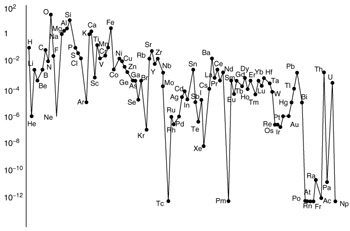
Ten elements O, Na, Mg, Al, Si, P, K, Ca, Ti and Fe constitute 99% of the Earth's crust although it is the minor and trace elements which are often key for living organisms. Figure 3.1 shows the relative abundance of the chemical elements.
Geochemical processes have concentrated some minor elements in specific deposits, so they are readily accessible by mining. On the other hand other elements that are relatively abundant may be widely dispersed in small amounts and they seldom or never occur in concentrated large deposits. A typical example is titanium, which is present in practically all igneous rocks in amounts ranging up to several per cent, but which, in spite of its useful properties as a metal has only recently become widely used. This is partly because of its dispersed nature and partly because of the technical difficulties in extracting the element from the minerals in which it occurs.
The distribution of minor and trace elements in igneous rocks is largely controlled by their ionic radii or size. Minor and trace elements with radii similar to those of major elements can substitute for these elements in the common minerals of the igneous rocks. The crystal structures of these minerals act as tiny filters, accepting those atoms of appropriate size and rejecting others. Thus, rubidium with a radius of 1.47 is incorporated in potassium feldspar, KAlSi 3O 8, because its...