Burn-In Testing: Its Quantification and Optimization
Burn-in data modeling and optimum burn-in time determination have been investigated extensively in this book. To facilitate the better understanding and appropriate application of the methodologies and mathematical models presented in this book, summarizing guidelines will be very helpful [1]. This chapter is developed to serve this purpose.
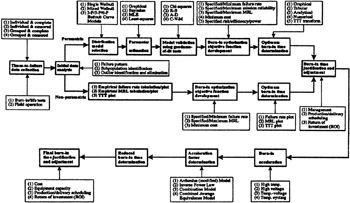
Typically, a general procedure for the quantification of a burn-in test and the optimum burn-in time determination consists of the following steps:
Step 1- Times-to-failure data collection for a component under study.
Step 2- Initial data analysis.
Step 3- Formal data analysis parametrically or non-parametrically.
Step 4- Burn-in optimization objective function development.
Step 5- Optimum burn-in time determination parametrically or non-parametrically.
Step 6- Burn-in time justification and adjustment.
The above 6-step procedure is illustrated in Fig. 14.1.
Figure 14.1: A flow diagram of the general procedure for burn-in quantification and optimization.
If a burn-in is to be conducted at a stress level that is different from that at which the times-to-failure data were collected, say a higher stress level, then the acceleration factor needs to be determined for converting a burn-in time at one stress level to that at another stress level. Steps 7 through 10 in Fig. 14.1 are provided for the accelerated burn-in time determination:
Step 7- Burn-in acceleration: stress selection.
Step 8- Acceleration factor determination.
Step 9- Reduced burn-in time determination.
Step 10- Final burn-in time justification and adjustment.
The more detailed guidelines for...