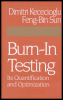
Burn-In Testing: Its Quantification and Optimization
In MIL-STD-883C [1], Method 1015.3, "Burn-in Test," burn-in is defined as follows:
Burn-in is a test performed for the purpose of screening or eliminating marginal devices, those with inherent defects or defects resulting from manufacturing aberrations which cause time and stress dependent failures.
Kuo and Kuo [2] define the burn-in as follows:
Burn-in is a stress operation that combines the appropriate electrical conditions with the appropriate thermal conditions to accelerate the aging of a component or device. In other words, burn-in is a process which operates the electronic components or systems under electrical and thermal conditions to demonstrate the real life of the components or systems in a compressed time.
There have been a lot of confusions both in the industry and in the literature about the terms "Burn-in" and "ESS." "Burn-in" and "ESS" have been used interchangeably by many people. In fact, they are two very relevant but different concepts.
Burn-in is a generally lengthy process of powering a product at a specified constant temperature.
ESS evolved from burn-in techniques but is a considerably advanced process. Generally, ESS is an accelerated process of stressing a product in continuous cycles between predetermined environmental extremes, primarily temperature cycling plus random vibration.
The misconception is due to the wrong assumption that historical "burn-in" procedures conducted on electronic equipment, currently in the inventory, are as cost effective as the ESS temperature cycling and random vibration screens. This...