Burn-In Testing: Its Quantification and Optimization
Chapter 10: Burn-in Quantification and Optimization Using the Bimodal Mixed-Exponential Life Distribution

10.1 INTRODUCTION

In the previous chapters, burn-in testing has been quantified and optimized using various life distributions, such as the mixed Weibull, various bathtub models, etc. As a special case of the mixed-Weibull distribution, the mixed-exponential life distribution has its unique mathematical features. It is simple and easy to manipulate. More importantly, it always has a decreasing failure rate ( DFR) function which makes it mathematically qualified to describe the times-to-failure behavior during burn-in.

10.2 THE MIXED-EXPONENTIAL LIFE DISTRIBUTION

The pdf of a general mixed-exponential life distribution is given by

(10.1)

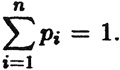
where

n

=

total number of subpopulations, n ? 2,

f i( T)

=

pdf of the ith subpopulation, i = 1, 2, , n,

f i( T)

=

? ie T ,

? i

=

failure rate of the ith subpopulation, i = 1, 2, , n,

? i

?

? j, for i ? j, i = l,2, ..., n, and j = 1, 2, , n,

p i

=

proportion of the i th subpopulation, i = 1, 2, , n,

and


The cdf and the reliability functions are given by

(10.2)

and

(10.3)

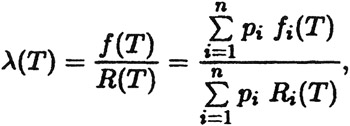
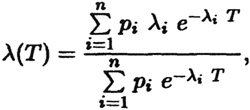
respectively. The failure rate function is given by


or

(10.4)

which is always a decreasing function of T, as shown next.

The first derivative of Eq. (10.4) with respect to T is

UNLIMITED FREE
ACCESS
TO THE WORLD'S BEST IDEAS

SUBMIT
Already a GlobalSpec user? Log in.

This is embarrasing...

An error occurred while processing the form. Please try again in a few minutes.

Customize Your GlobalSpec Experience

Category: I/Q Modulators and I/Q Demodulators
Finish!
Privacy Policy

This is embarrasing...

An error occurred while processing the form. Please try again in a few minutes.