Fundamentals of Industrial Instrumentation and Process Control

This chapter will introduce you to humidity, density, viscosity, and pH, and help you understand the units used in their measurement. This chapter will also familiarize you with standard definitions in use, and the instruments used for their measurement.
The salient points covered in this chapter are as follows:
Humidity ratio, relative humidity, dew point, and its measurement
Understanding and use of a psychrometric chart
Instruments for measuring humidity
Understand the difference between density, specific weight, and specific gravity
Instruments for measuring density and specific gravity
Definition of viscosity and measuring instruments
Defining and measuring pH values
Many industrial processes such as textiles, wood, chemical processing and the like, are very sensitive to humidity; consequently it is necessary to control the amount of water vapor present in these processes. This chapter discusses four physical parameters.
They are as follows:
Humidity
Density, specific weight, and specific gravity
Viscosity
pH values
Humidity is a measure of the relative amount of water vapor present in the air or a gas.
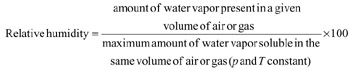
Relative humidity ( ?) is the percentage of water vapor by weight present in a given volume of air or gas compared to the weight of water vapor present in the same volume of air or gas saturated with water vapor, at the same temperature and pressure, i.e.,
| (9.1) | |
An alternative definition using vapor pressures is as follows:
| (9.2) | |
The term saturated means the maximum amount of water vapor that can be...