Fundamentals of Industrial Instrumentation and Process Control
| 1. | What is the difference between analog and digital circuits? |
|
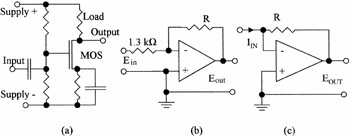
| 2. | What is the stage gain of the discrete amplifier shown in Fig. 4.15 a if the MOS device has an admittance of 5.8 mA/V and the load resistance is 8.2 k ?? Assume the capacitors have zero impedance. Figure 4.15: Circuits for use in ( a) Probs. 4.2 and 4.3, ( b) Probs. 4.4, 4.5, and 4.6, and ( c) Probs. 4.8 and 4.9. |
|
| 3. | What load must be used in the discrete amplifier shown in Fig. 4.15 a if a stage gain of 33 is required? Assume the capacitors have zero impedance. |
|
| 4. | What is the stage gain of the op-amp shown in Fig. 4.15 b if R = 285 k ?? |
|
| 5. | What is the value of the feedback resistor needed for the op-amp shown in Fig. 4.14 b to obtain a voltage gain of 533? |
|
| 6. | Redraw the inverting amplifier in Fig. 4.15 b as a noninverting amplifier with a voltage gain of 470. |
|
| 7. | What is the offset null in an op-amp used for? |
|
| 8. | If the amplitude of the input in the amplifier shown in Fig. 4.15 c is 14 A. What is the amplitude of the output if the feedback resistor R = 56 kQ? |
|
| 9. | What is the transfer ratio of the amplifier shown in Fig. 4.15 c, if the feedback resistor R =... |