Fundamentals of Industrial Instrumentation and Process Control
This chapter will help you understand the units used in level measurements and become familiar with the most common methods of using the various level standards.
Topics discussed in this chapter are as follows:
The formulas used in level measurements
The difference between direct and indirect level measuring devices
The difference between continuous and single-point measurements
The various types of instruments available for level measurements
Application of the various types of level sensing devices
Most industrial processes use liquids such as water, chemicals, fuel, and the like, as well as free flowing solids (powders and granular materials). These materials are stored in containers ready for on-demand use. It is, however, imperative to know the levels and remaining volumes of these materials so that the containers can be replenished on an as needed basis to avoid the cost of large volume storage.
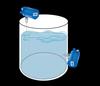
This chapter discusses the measurement of the level of liquids and free flowing solids in containers. The detector is normally sensing the interface between a liquid and a gas, a solid and a gas, a solid and a liquid, or possibly the interface between two liquids. Sensing liquid levels fall into two categories; firstly, single-point sensing and secondly, continuous level monitoring. In the case of single-point sensing the actual level of the material is detected when it reaches a predetermined level, so that the appropriate action can be taken to prevent overflowing or to refill the container.
Continuous level monitoring measures the level of the...