Microstrip and Printed Antenna Design

Written for practicing engineers new to the field, this book includes a succinct treatment of wireless designs with enough detail that CAD formulas may be implemented with relative ease.
 TABLE OF CONTENTS
 The antenna efficiency e relates the gain and directivity of an antenna:

G is the antenna gain and D is directivity.
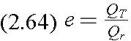
The efficiency of a rectangular microstrip antenna can be calculated from the cavity model in terms of the cavity Q's. [48] The radiated efficiency is the power radiated divided by the total power which is the sum of the radiated, surface wave, conductor loss and dielectric loss. The stored energy is identical for all the cavity Q's. This allows us to write:
expanded out:

When multiplied by 100% Equation 2.64 gives the antenna efficiency in percent as predicted by the cavity model. We can readily see from equation 2.65 that as Q sw, Q c and Q d become large compared with Q r, the antenna's efficiency approaches 100%. In other words, we desire to minimize the radiation Q and maximize Q S, Q C, and Q d the surface wave Q, conductor Q and dielectric Q respectively, for maximum efficiency.
It is instructive to calculate the losses from each of the mechanisms separately. We can calculate ? r = Q T/ Q r for radiation efficiency, ? r = Q T/ Q sw for the surface wave efficiency, ? c = Q T/ Q c for the conductor efficiency, and ? d = Q T/ Q d for the dielectric efficiency.