Microstrip and Printed Antenna Design

Written for practicing engineers new to the field, this book includes a succinct treatment of wireless designs with enough detail that CAD formulas may be implemented with relative ease.
 TABLE OF CONTENTS
There are many approaches for developing microstrip transmission line design and analysis equations. [1] [2] [3] [4] [5] [6] [7] Relationships presented by Kajfez and Tew have proven to be very flexible for the analysis of microstrip transmission line. [8] [9] The characteristic impedance of a microstrip line is given by:

Z 0 is the characteristic impedance of the microstrip transmission line
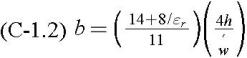

? is the corrected transmission line width
t is the thickness of the transmission line conductor (foil thickness) see Appendix A.
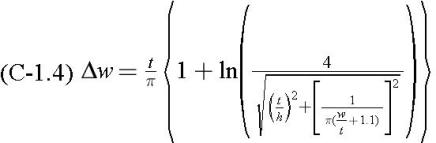
? w is the width correction factor
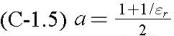
The use of a root finding method such as the Bisection Method (Appendix B) allows one to also use this set of equations for synthesis.
Dispersion is a very important property of microstrip lines which must be accounted for in order to expect a successful transmission line design realized using microstrip. The guide wavelength of microstrip transmission line varies with frequency:
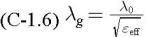
Where ? 0 is the free space wavelength at a given frequency.
The effective dielectric constant computation is undertaken with:



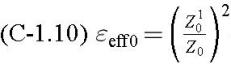
Where Z 1 0 is Z 0 computed with dielectric removed
Where Z 0 is computed with dielectric present
The computation of microstrip transmission line loss using the following relationships has the advantage that different microstrip and groundplane conductivities may be used:





The losses are evaluated using three computations of characteristic impedance with dielectric removed, Z 1 0