
Plastic Universal Joints
Description
Plastic universal joints are mechanical components designed to transmit rotational motion between two shafts that are not in a straight line. They allow for the transfer of torque and rotational movement while accommodating angular misalignment between the connected shafts.
Working Principle
Plastic universal joints operate on the principle of a spherical crank mechanism, which is a type of kinematic chain. This mechanism allows the joint to flex and accommodate angular misalignments between the shafts it connects. The design typically involves a cross-shaped component that fits into yokes attached to each shaft, allowing for rotational movement while maintaining the connection. This flexibility makes them particularly useful in applications where alignment cannot be guaranteed or where movement is required.
Applications
Plastic universal joints are used in a variety of applications where lightweight and corrosion-resistant properties are advantageous. Specific examples include:
- Medical Devices: Used in equipment where precise and flexible movement is required without the risk of corrosion.
- Consumer Electronics: Employed in devices where space constraints and the need for lightweight components are critical.
- Automotive: Utilized in certain non-load-bearing applications where weight reduction is beneficial.
Advantages over other Universal Joints
Plastic universal joints offer several advantages over their metal counterparts:
- Corrosion Resistance: Unlike metal joints, plastic joints do not corrode, making them ideal for use in environments where moisture or chemicals are present.
- Lightweight: Plastic joints are significantly lighter than metal ones, which can be beneficial in applications where weight is a critical factor.
- Cost-Effective: Generally, plastic materials can be less expensive than metals, reducing the overall cost of the joint.
Limitations
Plastic universal joints have some limitations that must be considered:
- Load Capacity: They typically have a lower load capacity compared to metal joints, which can limit their use in heavy-duty applications.
- Temperature Sensitivity: Plastic materials can be sensitive to high temperatures, which may affect their performance and durability.
- Wear and Tear: They may wear out more quickly than metal joints under certain conditions, requiring more frequent replacement.
Considerations
When selecting plastic universal joints, several factors should be considered:
- Initial Costs: While generally less expensive than metal joints, the cost can vary depending on the specific type of plastic used.
- Operating Expense: Consider the potential need for more frequent replacements due to wear and tear, which can increase operating expenses over time.
- Durability: Evaluate the environmental conditions, such as exposure to chemicals or extreme temperatures, which can affect the joint's lifespan.
- Accuracy: Ensure that the joint's flexibility does not compromise the precision required for the application.
- Replacement and Maintenance Costs: Factor in the ease of replacement and the potential need for regular maintenance to ensure optimal performance.

from Stock Drive Products & Sterling Instrument - SDP/SI
Couplings Types. Couplings can be divided into two categories: flexible and rigid. Both types are used to connect two rotating shafts driven by a motor and transmit torque and angular velocity; however, flexible couplings and shafts are designed to accommodate angular misalignment, angular offset,... [See More]
- Material: Plastic
- Hub O.D.: 0.25
- Joint Type: Single
- OAL: 0.75

from Stock Drive Products & Sterling Instrument - SDP/SI
Couplings Types. Couplings can be divided into two categories: flexible and rigid. Both types are used to connect two rotating shafts driven by a motor and transmit torque and angular velocity; however, flexible couplings and shafts are designed to accommodate angular misalignment, angular offset,... [See More]
- Material: Plastic
- Bore: 0.157
- Hub O.D.: 0.37
- Maximum Torque: 6.19

from Stock Drive Products & Sterling Instrument - SDP/SI
Couplings Types. Couplings can be divided into two categories: flexible and rigid. Both types are used to connect two rotating shafts driven by a motor and transmit torque and angular velocity; however, flexible couplings and shafts are designed to accommodate angular misalignment, angular offset,... [See More]
- Material: Plastic
- Hub O.D.: 0.25
- Joint Type: Single
- OAL: 0.75
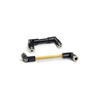
from Stock Drive Products & Sterling Instrument - SDP/SI
Couplings Types. Couplings can be divided into two categories: flexible and rigid. Both types are used to connect two rotating shafts driven by a motor and transmit torque and angular velocity; however, flexible couplings and shafts are designed to accommodate angular misalignment, angular offset,... [See More]
- Material: Plastic
- Bore: 0.188
- Hub O.D.: 0.50
- Bore Depth: 0.42

from Ondrives.US Corporation, formerly Rino Mechanical
Manufactured from lightweight, durable Delrin ™ engineered thermoplastic, Ondrives.US ’ Series 103 (single) and Series 111 (double) plastic universal joints deliver zero-backlash performance at speeds up to 1,000 RPM. Also known as a universal coupling, U-joints can accommodate up to 90... [See More]
- Material: Plastic; Brass Inserts
- Hub Bore: Round
- Joint Type: Single
- Bore: 0.118 to 0.394

from Huco Dynatork
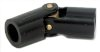
Materials & Finishes. Forked body members:Acetal (black).Cross pieces:Brass BS2874 CZ121. Chromate & passivate finish.Headed bore inserts (Ref. 103):Brass BS2874 CZ121. Chromate & passivate finish.Bore sleeves (Ref. 105):Al. Alloy 2011T3 or T8.Fasteners (Ref. 103):Alloy Steel, black... [See More]
- Material: Plastic
- Hub Bore: Round
- Joint Type: Single
- Hub O.D.: 0.28
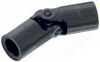
from Huco Dynatork
Materials & Finishes. Forked body members:Acetal (black).Cross pieces:Brass BS2874 CZ121. Chromate & passivate finish. Temperature Range. -20 °C to +60 °C [See More]
- Material: Plastic
- Hub Bore: Round
- Joint Type: Single
- Hub O.D.: 0.91
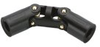
from Huco Dynatork
Materials & Finishes. Forked body members:Acetal (black).Cross pieces:Glass filled nylon. Temperature Range. -20 °C to +60 °C [See More]
- Material: Plastic
- Hub Bore: Round
- Joint Type: Single
- Hub O.D.: 1.12
from Huco Dynatork
Materials & Finishes. Forked body members:Acetal (black).Cross pieces & headed bore inserts:Brass BS2874 CZ121. Chromate & passivate finish.Fasteners:Alloy Steel, black oiled. Temperature Range. -20 °C to +60 °C [See More]
- Material: Plastic
- Hub Bore: Round
- Joint Type: Double
- Hub O.D.: 0.69
from Huco Dynatork
Materials & Finishes. Forked body members:Acetal (black).Cross pieces & headed bore inserts:Brass BS2874 CZ121. Chromate & passivate finish.Fasteners:Alloy Steel, black oiled. Temperature Range. -20 °C to +60 °C [See More]
- Material: Plastic
- Hub Bore: Round
- Joint Type: Double
- Hub O.D.: 0.28