
Class 1/1M Time of Flight Optical Sensors
Last Updated: April 1, 2025
Description
Class 1/1M Time of Flight (ToF) Optical Sensors are devices that measure the distance to a target object by calculating the time it takes for a light pulse to travel to the object and back to the sensor. These sensors are designed to provide precise distance measurements and are often used in environments where safety and accuracy are paramount.
Working Principle
Class 1/1M ToF Optical Sensors operate by emitting a light pulse, typically in the form of a laser, towards a target object. The sensor then detects the time it takes for the light to reflect off the object and return. This time of flight is used to calculate the distance to the object based on the speed of light. The technology is useful because it provides non-contact measurement, which is essential for applications requiring high precision and safety, such as in manufacturing and automation environments .
Applications
These sensors are widely used in various applications, including safety monitoring in manufacturing environments, where they can create detailed 3D maps of the area to detect objects and their movements . They are also employed in automation tasks, where precise measurement data is crucial for efficient operation .
Advantages over other Time of Flight Optical Sensors
Class 1/1M ToF Optical Sensors are compact and lightweight, making them suitable for use in confined spaces. They provide precise measurement data, which can eliminate the need for additional hardware components in automation tasks .
Limitations
One limitation of Class 1/1M ToF Optical Sensors is their dependency on ambient conditions, which can affect measurement accuracy and data repeatability . Additionally, the effective range of these sensors can be limited by factors such as the reflectivity of the target object and environmental conditions .
Considerations
When considering the use of Class 1/1M ToF Optical Sensors, it is important to evaluate initial costs, which can vary depending on the specific sensor model and its capabilities. Operating expenses may include maintenance and calibration to ensure accuracy over time. Durability is another factor, as these sensors need to withstand the environmental conditions of their intended application. Accuracy is a critical consideration, especially in applications requiring high precision. Replacement and maintenance costs should also be factored into the overall cost of ownership.
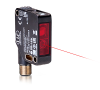
from Micro-Epsilon Group
The optoNCDT ILR104x laser distance sensors are designed for industrial distance measurements. These sensors achieve measuring ranges up to 10 meters without reflector film, 60 and 150 meters with reflector film. They feature a high protection class and resistance to ambient light. Due to their... [See More]
- Laser Safety: Class 1/1M
- Resolution: 1
- Measurement Range: 0.0012 to 394
- Sampling Frequency: 0.3330
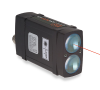
from Micro-Epsilon Group
The optoNCDT ILR1171 is a laser-based distance sensor for non-contact and precise distance and displacement measurements from 0.2 m up to 125 m. The measuring range can be extended to 270 m with a reflector film. The sensor is designed for very large measuring ranges, with and without reflector. Due... [See More]
- Laser Safety: Class 1/1M
- Resolution: 1
- Measurement Range: 7.87 to 10630
- Sampling Frequency: 40
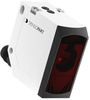
from SensoPart
Sensor with large range for anticollision and positioning applications. High flexibility thanks to adjustable analogue characteristic (QA). 4 distance positions with 2 switching outputs, adjustable via window function. Q1/Q2 switchable to Q1/Q1 as antivalent outputs. Compact design for an easy... [See More]
- Laser Safety: Class 1/1M
- Resolution: 1
- Measurement Range: 11.81 to 2756
- Operating Temperature: -22 to 140