
Current Time of Flight Optical Sensors
Last Updated: April 1, 2025
Description
Time of Flight (ToF) Optical Sensors are devices that measure the distance between the sensor and an object by calculating the time it takes for a light signal to travel to the object and back to the sensor. These sensors are capable of providing precise depth information by capturing the time delay of the reflected light.
Working Principle
Time of Flight Optical Sensors operate by emitting a light signal towards a target object. The sensor then measures the time it takes for the light to reflect off the object and return to the sensor. This time delay is used to calculate the distance to the object using the formula:
latex
d = \frac{c \Delta T}{2}
where ( d ) is the distance, ( c ) is the speed of light, and ( \Delta T ) is the time delay. This principle allows ToF sensors to provide accurate depth measurements, making them useful for applications requiring precise distance calculations.
Applications
Time of Flight Optical Sensors are used in a variety of applications. For example, they are employed in 3D scanning and mapping, where accurate depth information is crucial. They are also used in gesture recognition systems, such as those found in gaming consoles and smart devices, to detect and interpret user movements.
Advantages over other Time of Flight Optical Sensors
One advantage of certain ToF sensors is their ability to capture both RGB and depth data simultaneously, which enhances the richness of the data collected and can improve the performance of applications that rely on both color and depth information .
Limitations
A known limitation of Time of Flight Optical Sensors is multipath interference, which occurs when the emitted light signal reflects off multiple surfaces before returning to the sensor. This can lead to inaccuracies in distance measurements .
Considerations
When considering the use of Time of Flight Optical Sensors, it is important to evaluate factors such as initial costs, operating expenses, and maintenance requirements. These sensors can vary in durability and accuracy, which can impact their long-term cost-effectiveness. Additionally, replacement and maintenance costs should be considered to ensure the sensor remains functional and accurate over time.
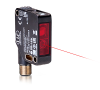
from Micro-Epsilon Group
The optoNCDT ILR104x laser distance sensors are designed for industrial distance measurements. These sensors achieve measuring ranges up to 10 meters without reflector film, 60 and 150 meters with reflector film. They feature a high protection class and resistance to ambient light. Due to their... [See More]
- Output: Current; Switched / Alarm
- Resolution: 1
- Measurement Range: 0.0012 to 394
- Sampling Frequency: 0.3330
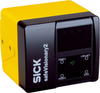
from SICK
Your Benefits. Solve your safety applications simply and efficiently – with the safe 3D environment perception. Use the precise 3D measurement data for automation tasks, e.g., contour-based navigation for your mobile vehicles. Benefit from the user-friendly configuration, commissioning and... [See More]
- Output: Voltage; Current
- Time of Flight Technique: Pulsed
- Operating Temperature: 14 to 122
- Source: Laser
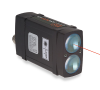
from Micro-Epsilon Group
The optoNCDT ILR1171 is a laser-based distance sensor for non-contact and precise distance and displacement measurements from 0.2 m up to 125 m. The measuring range can be extended to 270 m with a reflector film. The sensor is designed for very large measuring ranges, with and without reflector. Due... [See More]
- Output: Current; Switched / Alarm
- Resolution: 1
- Measurement Range: 7.87 to 10630
- Sampling Frequency: 40
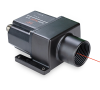
from Micro-Epsilon Group
With the optoNCDT ILR3800, Micro-Epsilon presents a new powerful laser distance sensor. The sensor is designed for operation with or without reflector film, which is used depending on the distance and ambient conditions. The sensor measures large distances up to 100 m without contact and provides... [See More]
- Output: Current
- Resolution: 0.1000
- Measurement Range: 1.97 to 5906
- Sampling Frequency: 0.0200

from Banner Engineering Corp.
Offered in retroreflective models with two discrete outputs (PNP) for extremely long ranges up to 250 m. Available in diffuse models with two discrete outputs (PNP) and one 4-20 mA output for long-range background suppression up to 10 m. Provides two alarm outputs with ongoing LCD display for easy... [See More]
- Output: Current; Switched / Alarm
- Operating Temperature: 14 to 122
- Measurement Range: 19.69 to 9843
- Interface: Serial
from SensoPart
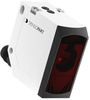
Sensor with large range for anticollision and positioning applications. High flexibility thanks to adjustable analogue characteristic (QA). 4 distance positions with 2 switching outputs, adjustable via window function. Q1/Q2 switchable to Q1/Q1 as antivalent outputs. Compact design for an easy... [See More]
- Output: Voltage; Current; Switched / Alarm
- Resolution: 1
- Measurement Range: 11.81 to 2756
- Operating Temperature: -22 to 140
from Banner Engineering Corp.
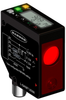
Ready to measure right out of the box. Easy adjustment with a two-line, eight-character intuitive display. Linear array provides repeatability and accuracy for challenging targets [See More]
- Output: Voltage; Current; Switched / Alarm
- Operating Temperature: -4 to 131
- Measurement Range: 3.94 to 39.37