
Residual Stress Measurement Diffractometers
Last Updated: April 1, 2025
Description
Residual Stress Measurement Diffractometers are specialized instruments used to measure the residual stress within materials. These devices utilize diffraction techniques to analyze the stress distribution by examining the interaction of beams, such as X-rays, with the material's crystal structure. The primary function of these diffractometers is to provide detailed insights into the stress profiles of materials, which is crucial for understanding their mechanical properties and performance.
Working Principle
Residual Stress Measurement Diffractometers operate based on the principles of diffraction. When beams such as X-rays, gamma rays, or neutrons interact with a material, they are diffracted at specific angles that depend on the material's crystal structure and the internal stresses present. By analyzing these diffraction patterns, the diffractometer can determine the residual stress within the material. This information is valuable because residual stresses can significantly affect the material's strength, fatigue life, and overall performance. The ability to accurately measure these stresses allows engineers to optimize material processing and ensure quality control.
Applications
Residual Stress Measurement Diffractometers are used in various industries to assess the stress profiles of materials. For example, in the aerospace industry, they are employed to evaluate the stress in critical components such as turbine blades and airframe structures. In the automotive sector, these diffractometers help in analyzing the stress in engine parts and body panels. Additionally, they are used in the construction industry to assess the stress in steel beams and other structural elements, ensuring safety and reliability.
Advantages over other Diffractometers
Residual Stress Measurement Diffractometers offer specific advantages over other types of diffractometers. They provide precise measurements of stress distribution within materials, which is essential for applications where mechanical performance is critical. Unlike some other diffractometers that may focus on general crystal structure analysis, these instruments are specifically designed to assess stress, making them more suitable for applications where understanding stress profiles is crucial.
Limitations
One limitation of Residual Stress Measurement Diffractometers is that they may require complex sample preparation and alignment to ensure accurate measurements. Additionally, the interpretation of diffraction patterns can be complex and may require specialized knowledge. These instruments may also have limitations in measuring stress in materials with complex geometries or inhomogeneous structures.
Considerations
When considering the use of Residual Stress Measurement Diffractometers, several factors should be taken into account. The initial cost of these instruments can be high, and they may require significant investment in terms of both purchase and setup. Operating expenses can also be considerable, as they may require regular calibration and maintenance to ensure accuracy. Durability and accuracy are generally high, but users should be prepared for potential replacement and maintenance costs over time. It is also important to consider the expertise required to operate these instruments and interpret the results accurately.

from Rigaku Corporation
A compact, fully integrated high-resolution, small molecule crystallography system, the Rigaku R-AXIS RAPID II is the latest member of the RAPID family of large-area curved image plate (IP) X-ray diffraction systems. The RAPID II combines every component needed for a high-performance X-ray... [See More]
- Features: Benchtop; Stress Measurement
- Detector: Plate/Foil
- Wave: X-Ray
- Diffraction Method: Powder
from Rigaku Corporation
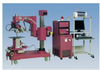
Uses X-rays to non-destructively measures the residual stress accumulated in a material during the manufacturing process. Different frame sizes accommodate small, medium and large samples. The position-sensitive proportional counter (PSPC) permits high-speed measurement. Compared with the... [See More]
- Features: Stress Measurement
- Detector: Position-Sensitive Proportional Counter
- Wave: X-Ray

from Rigaku Corporation
These analyzers use X-ray diffraction to nondestructively test residual stress in materials. Residual stress may be created during the manufacturing process of a material, or it may accumulate in a structure over many years in operation. In either case, this stress can have a serious negative effect... [See More]
- Features: Stress Measurement
- Wave: X-Ray