
Normally Closed (NC) Velocity Flow Switches
Last Updated: April 1, 2025
Description
Normally Closed (NC) Velocity Flow Switches are devices designed to monitor the flow of a fluid or air within a system. In their default state, these switches allow current to pass through, maintaining a closed circuit until a specific flow condition is met, at which point they open the circuit to signal a change.
Working Principle
NC Velocity Flow Switches operate by detecting the velocity of fluid or air flow through a system. When the flow reaches a predetermined setpoint, the switch activates by breaking the circuit. This mechanism is useful for maintaining system integrity by ensuring that flow conditions remain within specified limits, thereby preventing potential damage or inefficiencies in the system.
Applications
Specific applications for NC Velocity Flow Switches include their use in HVAC systems to monitor air flow, in cooling towers to protect against pump failures, and in refinery water/wastewater control systems to ensure proper fluid delivery and system operation.
Advantages over other Materials - Plastics and Polymers
While the documents do not provide specific advantages of NC Velocity Flow Switches over plastics and polymers, it is generally understood that metal components in flow switches offer superior durability and resistance to extreme temperatures and pressures compared to plastic materials.
Limitations
The documents do not provide specific limitations for NC Velocity Flow Switches. However, common limitations for flow switches can include sensitivity to wear and corrosion, especially in mechanical types, and potential accuracy issues at low flow rates for certain technologies like ultrasonic switches.
Considerations
When selecting NC Velocity Flow Switches, considerations should include initial costs, which can vary based on the complexity and materials of the switch. Operating expenses may be influenced by the need for regular maintenance to ensure accuracy and reliability. Durability is a key factor, as switches exposed to harsh environments may require more frequent replacement. Additionally, the accuracy of the switch is crucial for applications where precise flow monitoring is necessary, and this can affect both the choice of switch and its long-term operational costs.
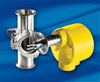
from Fluid Components Intl. (FCI)
The FLT93C insertion and inline type FlexSwitches for sanitary flow, level and temperature monitoring represents the first true technological breakthrough in thermal technology in over a decade. This product is specifically designed for sanitary 3A process applications. FCI is the only thermal... [See More]
- Normal State: Normally Open; Normally Closed
- Mounting: Insertion
- Meter Technology: Thermal
- End Fittings: In-line Flanged

from Sitron
The CF12RM Remote Mounted Thermal Dispersion Flow Switch is available in two versions: CF12RMDC (+/-24Vdc) or CF12RMAC (85 to 264Vac). Both of these models offer reliable liquid and gas flow detection ideally suited for just about any Flow/ No Flow application, with the flexibility of separate panel... [See More]
- Normal State: Normally Open; Normally Closed
- Mounting: Insertion
- Pipe Diameter: 0.50 to 2.00
- End Fittings: In-line Flanged; In-line Threaded

from Shanghai Yuanben Magnetoelectric Tech. Co., Ltd.
Particular Introductio. 1. Describtion. FSP series paddle flow switches is made of reed swiches, PP switches housing and brass body, SUS304 paddle, the flow switches can be adjustable in line, changed the switches from N.O. to N.C. also you may changed the setting flow ratting. FSP series paddle... [See More]
- Normal State: Normally Open; Normally Closed
- End Fittings: In-line Threaded
- Meter Technology: Paddlewheel
- Process Media Type: Liquid; Gas