
Products & Services
See also: Categories | Featured Products | Technical Articles | More Information-
Supplier: Güdel, Inc.
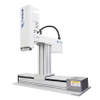
Description: rotary axes on the gantry robot. They have been developed as a standard robot line for easy integration in other automatic machining, welding, or robot assembly equipment.
- Industry / Application: Assembly, Welding
- Robot Type: Cartesian Robot, Gantry Robot
-
Supplier: KUKA
Description: KUKA offers a broad portfolio of linear robots with various travel lengths and additional options for efficient linking of work processes between machinesand systems. KUKA linear robots for maximum process efficiency and flexible work spaces. Linear robots from KUKA (also known
- Number of Axes: 3 #
- Load Capacity: 16 kg
- Reach: 0 mm
- Robot Type: Cartesian Robot, Gantry Robot
-
Supplier: Yamaha Corporation
Description: Yamaha's Gantry type robots are designed with a guide railing at the end of the Y-axis for additional support, providing greater stability and precision during operation. The gantry type robots are available in 2, 3, or 4 axes configurations, allowing for flexibility in
- Number of Axes: 4 #
- Load Capacity: 50 kg
- X-axis Travel: 2,050 mm
- Robot Type: Cartesian Robot, Gantry Robot
-
-
Supplier: TRAPO GmbH
Description: Powerful robots: high-performance portal systems High-performance portal systems from operate on two or three linear axes in cubic space. The gantry robots are designed and manufactured in the company’s own production facility in Gescher-Hochmoor. Portals show their strength,
- Number of Axes: 2 to 3 #
- Load Capacity: 100 kg
- Industry / Application: Automotive Testing, Medical / Pharmaceutical, Packaging
- Robot Type: Cartesian Robot, Gantry Robot
-
Supplier: Engel Machinery Inc.
Description: ENGEL has been building high-performance cartesian robots, also called gantry or linear robots, since 1980. Our viper robots are the perfect addition to your injection molding machine. The innovative and sturdy design offers increased payload capacity with low dead
- Number of Axes: 3 #
- Load Capacity: 6 kg
- Robot Type: Cartesian Robot, Gantry Robot
-
Supplier: MFP Automation Engineering
Description: MFP supplies Parker gantry robots in a number of muli-axis configurations.
-
Supplier: IMANPACK PACKAGING & ECO SOLUTIONS SPA
Description: Multi-function High Speed Pick & Place Robot suitable for automatic feeding for horizontal packaging machines, to load bags into cardboard boxes, to orientate and align the products and to control and reject faulty products. • 4 axis piece rotation. • Wide range of action. • Easy
- Number of Axes: 4 #
- Load Capacity: 3 kg
- Reach: 10.000000000000002 mm
- Industry / Application: Automotive Testing, Medical / Pharmaceutical
-
Supplier: Hirata Corporation of America
Description: High rigidity, high durability Maintenance free, weight capacity from 50 to 150 kg Abundant variations The stroke and number of axes can be freely configured and combined Extensive record Supports machine tools, transferring and stocking large or heavy items, and assembly Supports applications in
- Load Capacity: 50 kg
- Robot Type: Cartesian Robot
-
Supplier: HARMO Co., Ltd.
Description: payload performance ・Model 150 5kg to 7kg (largest payload in industry) ・Model 350 10kg to 12kg A complex EOAT for insert/multiple placement is adaptable. ●Shorten the Mold Changing Time ・Datalink Integration System (IMM⇔Robot⇔Auxiliaries) for centralized setup/power control/monitoring
- Number of Axes: 0.6 #
- Load Capacity: 5 kg
- Robot Type: Cartesian Robot, Gantry Robot
-
Supplier: KraussMaffei
Description: 100% compatibility with other injection molding machine manufacturers Attractive price/performance ratio Optimal equipment for pick-and-place applications Fast process adjustment Highlights Precision with rack-and-pinion drive Rack-and-pinion drive for high-precision robot positioning with
- Number of Axes: 3 to 4 #
- Load Capacity: 5 kg
- Robot Type: Cartesian Robot, Gantry Robot
-
Supplier: Wittmann Group
Description: The new pro series takes the WITTMANN W8 robot series to a whole new level of performance. – Countless improvements, guarantee the highest efficiencies. » Rugged design of the robot. » Modularity of the robot mechanics and of the drive and control system architecture. » The
- Number of Axes: 3 #
- Load Capacity: 20 kg
- Robot Type: Cartesian Robot, Gantry Robot
-
Description: Standard components to satisfy your system requirement Focussed system configurations enable robot applications to be specified easily using our carefully selected standard components, reducing the time and resources needed by the integrator to specify the system. Standard components ensure
- Number of Axes: 3 #
- Load Capacity: 50 kg
- X-axis Travel: 5,500 mm
- Y-axis Travel: 2,500.0000000000005 mm
-
Supplier: Weiss GmbH
Description: The LP 2D linear portal is an intelligent functional unit that combines mechanics, electronics and software. The main components of this versatile solution are the HN and HL linear motor axes, a modified control system and a wide range of different fieldbus interfaces, including OPC UA. All
- Number of Axes: 2 #
- Load Capacity: 8 kg
- Reach: 1 mm
- Robot Type: Cartesian Robot
-
Supplier: JAPAN UNIX Co., Ltd.
Description: Compact type ・Working area: 200mm×210mm ・New and improved heater ・LAN (Ethernet), COM port ・X,Y axis: 600mm/sec ・Z axis: 250mm/sec ・Separated soldering controller Features ・New heater improves heating and soldering mechanism. ・Productivity is highly improved by increasing rigidity and process
- Number of Axes: 3 #
- Robot Type: Cartesian Robot, Gantry Robot
- Features: Other / Specialty
-
Supplier: Isotech, Inc.
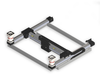
Description: Notes: Gantry systems do not include T-slot sensors, Gearboxes or Motor mounting adaptors. By checking the Give Me Options for boxes you may specify your requirements in the request for quote entry fields. Gantry systems include cable track. Please refer to the Product Specification
- Number of Axes: 2 #
- X-axis Travel: 1,000.0000000000001 to 5,250 mm
- Z-axis Travel: 250.00000000000003 to 1,000.0000000000001 mm
- Robot Type: Gantry Robot
-
Supplier: Ellsworth Adhesives
Description: The F5300N.2 robot is a compact and cost-effective gantry style robots with all moving axes above the work piece. The Unitop™ design is suitable for dispense applications requiring a configuration that provides open access under the robot. 300 mm x 300 mm work area,
- Robot Type: Gantry Robot
- Features: Other / Specialty
-
Supplier: Isotech, Inc.
Description: Notes: Gantry systems do not include T-slot sensors, Gearboxes or Motor mounting adaptors. By checking the Give Me Options for boxes you may specify your requirements in the request for quote entry fields. Gantry systems include cable track. Please refer to the Product Specification
-
Supplier: Isotech, Inc.
Description: Notes: Gantry systems do not include T-slot sensors, Gearboxes or Motor mounting adaptors. By checking the Give Me Options for boxes you may specify your requirements in the request for quote entry fields. Gantry systems include cable track. Please refer to the Product Specification
-
Supplier: ASG, Division of Jergens, Inc.
Description: High quality, affordable robotic solutions Ample I/O’s designed around the most complicated assembly operations COM ports for communications with PC software, vision systems, or other device Desktop, Scara and Gantry robots available
- Robot Type: Cartesian Robot, Gantry Robot, SCARA Robot
-
Supplier: RobotWorx
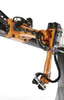
Description: The KUKA KR 30 JET gantry robot greatly extends the work envelope of the standard KR 30 while conserving floorspace. A linear gantry track offers several advantages, such as the ability for a single robot to handle a larger part or bigger process. For even faster
- Number of Axes: 6 #
- Load Capacity: 30 kg
- Reach: 2,002 mm
- Robot Type: Cartesian Robot, Gantry Robot
-
Supplier: Fisnar
Description: The F8000 series of robots are servo motor-driven, ball screw design, gantry robots. A heavy duty aluminum structure prevents flexing and vibration while maintaining functionality. Ideal for conveyorfed applications. Where applications require all moving axes to be above the
- Number of Axes: 3 to 4 #
- Load Capacity: 5 kg
- Industry / Application: Assembly
- Robot Type: Cartesian Robot, Gantry Robot
-
Supplier: RobotWorx
Description: The ABB IRB 6620LX is a gantry arm robot designed to revolutionize applications that include material handling, injection molding, and die casting. These customizable linear systems can cost-effectively perform these tasks and more. This system combines the advantages of a linear
- Number of Axes: 6 #
- Load Capacity: 150 kg
- Reach: 1,900 mm
- Robot Type: Cartesian Robot, Gantry Robot
-
Supplier: RobotWorx
Description: Extend your workspace with the KUKA KR 60 JET gantry robot. The ideal combination of linear and jointed-arm, this system gives two big advantages. First, the work envelope is radically widened as the robot can travel back and forth on a custom length track. Second, this
- Number of Axes: 6 #
- Load Capacity: 60 kg
- Reach: 2,002 mm
- Robot Type: Cartesian Robot, Gantry Robot
-
Supplier: Dixon Automatic Tool, Inc.
Description: This assembly system uses a Cartesian Robot to transport a Dixon Auto-Fed servo controlled Driver and Vision System to drive helical wire inserts into transmission housings. Due to casting variations, the Vision System pre-locates all of the driving points on the casting for the Robot.
- Number of Axes: 3 #
- Industry / Application: Assembly
- Robot Type: Cartesian Robot, Gantry Robot
-
Supplier: Cognibotics AB
Description: The low weight of SigmaTau's mechanics facilitates high-dynamic motions with 2g accelerations, reducing cycle times and enhancing overall efficiency. The SigmaTau robot fills the gap between CNC machine tools and traditional arm robots, offering in-line high-speed machining for
- Robot Type: Cartesian Robot, Gantry Robot, Robot System
-
Supplier: RobotWorx
Description: Ideal for medium to heavy material handling processes, the Fanuc M-710iB/45T has six axes, modular construction, and is an electric servo-driven articulated gantry robot. The overhead rail mounted design provides for precise, high speed operations and maximum reliability. This
- Number of Axes: 6 #
- Load Capacity: 70 kg
- Reach: 1,706 mm
- Robot Type: Articulated Robot, Cartesian Robot, Gantry Robot
-
Supplier: igus® inc.
Description: For loads up to 8.0 [kg] For precision requirements up to approx. 0.5 [mm] At speeds up to max. 1.5 [m/s] XY Gantry | Workspace 300 x 300 mm igus offers cartesian robots as XY Actuator (Single Rail), XY Gantries and XYZ Gantry robots for the most varied tasks. igus
- Number of Axes: 2 #
- Load Capacity: 8 kg
- X-axis Travel: 300.00000000000006 mm
- Y-axis Travel: 300.00000000000006 mm
-
Supplier: Isotech, Inc.
Description: Notes: Gantry systems do not include T-slot sensors, Gearboxes or Motor mounting adaptors. By checking the Give Me Options for boxes you may specify your requirements in the request for quote entry fields. Gantry systems include cable track. Please refer to the Product Specification
- Number of Axes: 3 #
- X-axis Travel: 1,000.0000000000001 to 5,250 mm
- Y-axis Travel: 1,000.0000000000001 to 2,000.0000000000002 mm
- Z-axis Travel: 250.00000000000003 to 1,000.0000000000001 mm
-
Supplier: Visumatic Industrial Products
Description: X-Y-Z cartesian robot Built in quality assurance with precise NST traceable axis Up to 2000mm robot work envelope Gantry support options for screwdriver tapping operations Visumatic's team of assembly engineers exhaustively tests and documents every system, ensuring the
- Number of Axes: 3 #
- Industry / Application: Assembly
- Robot Type: Cartesian Robot, Robot System
-
Supplier: ASG, Division of Jergens, Inc.
Description: Choice of Driver: ASG X-PAQ™ SD2500 or HIOS® driver Choice of tabletop robot size Screw presenter customized to screw dimensions
- Robot Type: Cartesian Robot, Gantry Robot
- Drive System: Electric
-
Supplier: igus® inc.
Description: For loads up to 8.0 [kg] For precision requirements up to approx. 0.5 [mm] At speeds up to max. 1.5 [m/s] XY Gantry igus offers cartesian robots as XY Actuator (Single Rail), XY Gantries and XYZ Gantry robots for the most varied tasks. igus gantries include pre-configured
- Number of Axes: 2 #
- Load Capacity: 8 kg
- X-axis Travel: 500.00000000000006 mm
- Y-axis Travel: 500.00000000000006 mm
-
Supplier: igus® inc.
Description: For loads up to 8.0[kg] for precision requirements up to approx. 0.5mm for speeds up to max. 1.5m/s XYZ Gantry | Workspace 1000 x 500 mm igus offers cartesian robots as XY Actuator (Single Rail), XY Gantries and XYZ Gantry robots for the most varied tasks. igus gantries
- Number of Axes: 3 to 2 #
- Load Capacity: 8 kg
- X-axis Travel: 1,000.0000000000001 mm
- Y-axis Travel: 500.00000000000006 mm
-
Supplier: ASG, Division of Jergens, Inc.
Description: The same robust features that are foundational to the AX-20, also reside in the AX-30; including steel base and Allen Bradley controls (unless specified otherwise). The AX-30 turntable system is designed for optimal efficiency. While the operator is loading the new components, the robot is
- Robot Type: Cartesian Robot, Gantry Robot, SCARA Robot
- Drive System: Electric
-
Supplier: igus® inc.
Description: For loads up to 8.0[kg] for precision requirements up to approx. 0.5mm for speeds up to max. 1.5m/s XY Gantry | Workspace 300 x 300mm | Encoder version igus offers cartesian robots as XY Actuator (Single Rail), XY Gantries and XYZ Gantry robots for the most varied tasks.
- Number of Axes: 2 #
- Load Capacity: 8 kg
- X-axis Travel: 300.00000000000006 mm
- Y-axis Travel: 300.00000000000006 mm
-
Supplier: Techcon
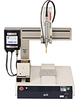
Description: Techcon Systems bench-top dispensing robots are easy to program, simple to operate and compatible with all valve types and controllers. Designed and configured specifically for fluid dispensing applications, Techcon Systems robots provide total control over fluid placement, from beads,
- Number of Axes: 3 #
- X-axis Travel: 200 mm
- Y-axis Travel: 200 mm
- Z-axis Travel: 100 mm












Find Suppliers by Category Top
Featured Products Top
-
 SCARA and articulating arm robots might be the most recognizable form of robot on the market today, but look to gantry robots for getting the big jobs done in the least amount of space. Gantry robots, also called Cartesian robots, are almost ubiquitous with automation but still are not (read more)
Browse Robots Datasheets for Isotech, Inc. -
The Handling Guide Online (HGO) is a unique sizing and selection web tool for Cartesian gantry systems. It offers you the following benefits: Efficiency - cuts your engineering time and effort to a minimum Intuitiveness - very easy to use and features structured (read more)
Browse Datasheets for Festo Corporation -
alignment, imaging system integration Gantry motion systems for semiconductor, optics, imaging and photonics applications Experience Our Systems You can look at a variety of performance automation, photonics, and nanopositioning (read more)
Browse Robots Datasheets for PI (Physik Instrumente) L.P. -
automation solutions for a broad range of industries, including automotive, medical, packaging, food processing, semiconductors, electronics and more. Isotech can be a single source automation or mechanical motion supplier or work with systems integrators, military and government contractors. Specializing in engineering multi-axis motion systems, gantries, and robot transport units built to customer specifications. (read more)
Browse Robots Datasheets for Isotech, Inc. -
mechanical motion supplier or work with systems integrators, military and government contractors. Specializing in engineering multi-axis motion systems, gantries, and cartesian robots built to customer specifications, Isotech can provide: Pick & Place Systems Cartesian Robotics (read more)
Browse Linear Slides and Linear Stages Datasheets for Isotech, Inc. -
contractors. Specializing in engineering multi-axis motion systems, gantries, and cartesian robots built to customer specifications, Isotech can provide: Pick & Place Systems Cartesian Robotics Video Production & Automation Systems Sorting Systems (read more)
Browse Datasheets for Isotech, Inc. -
automation or mechanical motion supplier or work with systems integrators, military and government contractors. Specializing in engineering multi-axis motion systems, gantries, and cartesian robots built to customer specifications, Isotech can provide: Pick & Place Systems (read more)
Browse Automation Equipment and System Integrators Datasheets for Isotech, Inc. -
consumable tips to gantry-style dispensing robots. Download the catalog today. (read more)
Browse Adhesive Dispensing Equipment Datasheets for Ellsworth Adhesives -
wrappers, case packers, pick-and-place robotics Backstop Gauging – Gantry systems, automated palletizers X-Y Positioning – Pick-and-place robotics, palletizers, case packers (read more)
Browse Linear Encoders Datasheets for Encoder Products Company -
Organization Units), providing the ideal automation development environment. MotionWorks IEC is an essential part of Yaskawa’s achievement of Singular Control: the ability to interchangeably operate articulated robots, gantry robots, servo axes and variable frequency drives (read more)
Browse Motion Control Software Datasheets for Yaskawa America, Inc. - Motion Division
Conduct Research Top
-
Cartesian Gantry Robots - Advantages and Applications
SCARA and articulating arm robots might be the most recognizable form of robot on the market today, but look to gantry robots for getting the big jobs done in the least amount of space.
-
When Do You Need a Gantry Robot?
Articulated robots like these are widely recognized, thanks to car company commercials and robot dance sequences. SCARA (Selective Compliance Articulated Robot Arm) robots are also well-recognized due to their adoption and proliferation in factories since the early 1980's. Both
-
What Is a Gantry Stage / Cartesian Robot?
A precision gantry stage or gantry system is sometimes called a linear robot or Cartesian robot. Gantry robots typically provide overhead motion in 2 or 3 linear degrees of freedom (X-Y and X-Y-Z) and are often used for pick and place applications, 3D printing or laser machining, precision handling
-
Gantry Systems: Working Outside the Envelope
The irregular work envelopes of traditional jointed articulating arms may require redesign of existing workspaces. SCARA and articulating arm robots might be the most recognizable form of robot on the market today but look to gantry robots for getting the big jobs done in the least amount of space
-
Gantry Systems: The Perfect Solution for Heavy Loads and Larger Work Areas
Automation in the manufacturing industry is continuing to grow in demand and can be applied to nearly every application from processing, assembly, inspection to packaging. Gantries and 6-axis industrial robots are widely used to achieve automation for applications such as palletizing, sorting
-
What is Linear Robotics?
; up and down, back and forth, as well as in and out. Linear robots with horizontal members supported at both ends are referred to as Gantry robots.
-
What You Should Know About Cartesian Robots
are boxy, open, and their primary X-Y directional motion is regulated from above by a rectangular gantry. A lead screw or other linear actuator controls movement in the vertical, Z-direction. All Cartesian robots have this rectangular configuration, and as a result, they are sometimes called
-
What is Racking in Gantry Systems?
Gantries differ from other types of multi-axis systems (such as Cartesian robots and XY tables) by using two base (X) axes in parallel, with a perpendicular (Y) axis connecting them. While this dual X-axis arrangement provides a wide, stable footprint and allows gantry systems to deliver high load
More Information Top
 Indicates content that may require registration and/or purchase.

-
Handbook of Industrial Robotics 2nd Edition Complete Document
Gantry robots are widely used for handling tasks such as palletizing, warehousing, and order picking or special machining tasks such as water jet or laser cutting where robot motions cover large surfaces.
-
Remote Pit Operation Enhancement System: Concept Selection Method and Evaluation Criteria
Six classes of potential solutions were developed: gantry robot , manipulator, and jib crane; telescoping boom with manipulator; stationary frame with long-reach manipulator; in-pit mobile platform with manipulator; crane-mounted platform with manipulator(s); and manipulator on stationary platform inside of …
-
A hybrid scheduling and control system architecture for warehouse management
The OAPS interacts with a finite scheduling system (FSS) whose primary function is to take the next day’s order sequence as well as pick plan and to convert them into a detailed scheduling plan for the gantry robots which reside within the …
-
International Encyclopedia of Robotics: Applications and Automation Volume 2 Complete Document
In one such system (26), registration is accomplished by having a gantry robot utilize LED sensors in its gripper to detect the position of a post on the cart in X, Y, and Z axes.
-
International Encyclopedia of Robotics: Applications and Automation Volume 3 Complete Document
Load line curves for Niko 600 Cartesian gantry robot are shown in Figure 15.
-
http://qspace.library.queensu.ca/jspui/bitstream/1974/1434/1/Abu%20Mallouh_Mohammed_AK_200809_PhD.pdf
thesis is the design and testing of a controller that regulates the normal contact force and tangential velocity of the end effector of a pneumatic gantry robot while tracking the contour of a planar workpiece.
-
Intelligent agent based framework for warehouse control
Order trays and gantry robots (picking devices) are modeled as intelligent agents that behave in a cooperative manner so as to achieve personal and system wide goals.
-
Development of multi-axis gantry type welding robot system using a PC-based controller
A gantry robot is controlled by PC based controller(cal1ed PC-RC;PC-based Robot Controller) and two welding robots are controlled by their controllers(cal1edRCsSobot Controllers), respectively.