
-
Supplier: OMEGA Engineering, Inc.
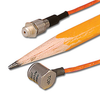
Description: OMEGA's model ACC104A laboratory accelerometer is ideal for use where accurate structural testing is required. The ACC104A is lightweight, very small and is recommended for applications where low accelerometer weight is critical. It has a 10 mV/g output which can measure vibrations up
- Acceleration: 10,000 g
- Frequency Range: 1 to 10,000 Hz
- Minimum Accuracy: 10 +/-% FS
- Maximum Shock: 500 g
-
Supplier: Kistler Group
Description: The Type 8316A... capacitive accelerometer family utilizes a silicon Micro-Electro Mechanical System (MEMS) variable capacitance sensing element. Each axis consists of a very small inertial mass and a flexure element cantilever positioned between two plates. As the mass
- Acceleration: 2 to 200 g
- Frequency Range: 0 to 7,000 Hz
- Maximum Shock: 6,000 g
- Maximum Vibration: 20 g
-
Supplier: Kistler Group
Description: Type 8764B... is an IEPE (Integrated Electronics Piezoelectric) triaxial accelerometer permitting vibration measurements in three mutually perpendicular axes: x, y and z. Type 8764B... uses Kistler shear element technology, assuring high immunity to base strain. The accelerometer uses
- Acceleration: 50 to 2,000 g
- Frequency Range: 0.3 to 15,000 Hz
- Maximum Shock: 5,000 g
- Operating Temperature: -65.2 to 212 F
-
-
Supplier: Kistler Group
Description: The sensing element contained within this shock accelerometer series features a unique, shear mode four quartz crystal configuration combined with an annular preload sleeve and seismic mass. The element design provides over 100 kHz resonance frequency ensuring accurate measurement
- Acceleration: 5,000 to 50,000 g
- Frequency Range: 1 to 10,000 Hz
- Maximum Shock: 50,000 to 100,000 g
- Operating Temperature: -67 to 248 F
-
Supplier: CSA Group
Description: mechanical mounting of accelerometer stated in ISO 5348 are fulfilled and that the mass of the reference shock ball exceeds at least three times the mass of the accelerometer under test. Phase response of the accelerometer under test
-
Supplier: Kistler Group
Description: Internal to the PiezoBeam accelerometer is a unique sensing element consisting of a ceramic beam supported by a center post that, when bending occurs as a result of being subjected to vibration, the cantilevered beam element yields an electrical charge. The charge signal is
- Acceleration: 5 to 50 g
- Frequency Range: 0.5 to 5,000 Hz
- Maximum Shock: 7,000 to 10,000 g
- Maximum Vibration: 50 to 100 g
-
Supplier: Rieker, Inc.
Description: The B1, B2, and B3 sensors are capacitive spring mass accelerometers with integrated sensor electronics. Requiring very low power consumption these are characterized by a high degree of longterm stability. Resonant peaks are minimised by means of a special gas-dynamic
- Acceleration: -10 to 10 g
- Frequency Range: 0 to 350 Hz
- Operating Temperature: -40 to 185 F
- Sensor Outputs: Acceleration
-
Supplier: Hottinger Brüel & Kjær A/S
Description: Expressly designed for use in Health and Usage Monitoring Systems (HUMS), the Dytran model 3079A is an IEPE piezoelectric accelerometer, featuring a sensitivity of 10 mV/g with a frequency response of 1.1 to 3,000 Hz, packaged in a highly rugged stainless steel housing weighing
- Acceleration: 500 g
- Frequency Range: 1.1 to 3,000 Hz
- Operating Temperature: -58 to 248 F
- Features: Other, Piezoelectric
-
Supplier: Columbia Research Labs, Inc.
Description: The Model 7001 and 7001HT Piezoelectric Accelerometers are excellent choices for general-purpose shock and vibration measurement work, and are especially well suited for testing of small specimens. They are designed for the measurement of medium frequency, moderate to high-level
- Acceleration: 1,000 g
- Frequency Range: 2 to 8,000 Hz
- Minimum Accuracy: 5 +/-% FS
- Maximum Shock: 5,000 g
-
Supplier: Sherborne Sensors
Description: The A600 range of Solid State Accelerometers measure vector acceleration with high accuracy using a micromachined (MEMS) silicon sensor incorporating an air damping feature. Unlike fluid damped devices the air damping employed is essentially independent of temperature. The
- Acceleration: -20 to 20 g
- Frequency Range: 0 to 600 Hz
- Maximum Shock: 200 g
- Operating Temperature: -40 to 185 F
-
Supplier: Columbia Research Labs, Inc.
Description: The Models 5004 and 5004-HT Piezoelectric Accelerometers are small, lightweight sensors with very low sensitivity of 0.1 picoCoulomb/g making them excellent selections for extremely high shock levels to 100,000 g. Its natural frequency of 100,000 Hz allows measurement of
- Acceleration: 1,000 g
- Frequency Range: 2 to 10,000 Hz
- Minimum Accuracy: 5 +/-% FS
- Maximum Shock: 20,000 g
-
Supplier: Sherborne Sensors
Description: The Sherborne Sensors' A200 range of Servo Accelerometers measure vector acceleration with high accuracy using a closed loop force balance torquer mechanism. A pendulous mass develops a torque proportional to the product of its mass unbalance and the applied
- Acceleration: -20 to 20 g
- Frequency Range: 90 to 150 Hz
- Maximum Shock: 100 g
- Operating Temperature: -67 to 203 F
-
Supplier: Hottinger Brüel & Kjær A/S
Description: The Dytran series 3220C is a low profile piezoelectric charge mode accelerometer with rugged titanium construction. The distinguishing feature of the series 3220C is its unique miniature thru hole mounting configuration, which allows the sensor to be turned a full 360° prior to
- Frequency Range: 4 to 10,000 Hz
- Operating Temperature: -58 to 500 F
- Features: Other, Piezoelectric
- Measurement Axes: Single Axis
-
Supplier: Hottinger Brüel & Kjær A/S
Description: The Dytran series 3232 is a biaxial IEPE piezoelectric accelerometer, designed for use in Health and Usage Monitoring Systems (HUMS) as well as Active Vibration Control (AVC) applications typically found on commercial and military aircraft. Units are offered with sensitivities ranging from
- Acceleration: 500 g
- Frequency Range: 0.33 to 2,500 Hz
- Operating Temperature: -58 to 248 F
- Measurement Axes: Biaxial
-
Description: Lays down detailed specifications for the instrumentation and procedure to be used for resonance frequency testing. It is a very limited method applicable exclusively to undamped accelerometers, mainly of the piezoelectric type, having a mass of less than 30 g. Is
-
Supplier: Columbia Research Labs, Inc.
Description: The Models 8301 and 8302 Piezoelectric Accelerometers are completely self-contained vibration measuring systems having a built-in amplifier within the housing. These units are offered in a range of sensitivities for the measurement of low to medium level broadband frequency
- Acceleration: 500 g
- Frequency Range: 2 to 7,000 Hz
- Minimum Accuracy: 5 +/-% FS
- Maximum Shock: 5,000 g
-
Supplier: Silicon Designs, Inc.
Description: 1527 MEMS DC Accelerometer combines two patented capacitive silicon sense elements and a precision, custom CMOS integrated circuit in a hermetically sealed LCC package. The differential output voltage of the MEMS accelerometer is converted on the PCB into a current proportional
- Acceleration: 10 to 50 g
- Frequency Range: 0 to 4,200 Hz
- Maximum Shock: 5,000 g
- Operating Temperature: -67 to 257 F
-
Supplier: Silicon Designs, Inc.
Description: MEMS DC accelerometer combines two patented capacitive silicon sense elements and a precision, custom CMOS integrated circuit in a hermetically sealed LCC package. The differential output voltage of the MEMS accelerometer is converted on the PCB into a current proportional to
- Acceleration: 2 to 50 g
- Maximum Shock: 5,000 g
- Operating Temperature: -67 to 257 F
- Sensor Outputs: Acceleration
-
Supplier: Hottinger Brüel & Kjær A/S
Description: The Dytran series 3274 is an ultra miniature high frequency IEPE accelerometer with TEDS capabilities. Units have an overall height of just 0.24-inches (6.1-millimeters), weigh just 2 grams, and are ideal for the measurement of shock and vibration of very small,
- Acceleration: 500 g
- Frequency Range: 1.5 to 10,000 Hz
- Operating Temperature: -58 to 248 F
- Sensor Mounting: Adhesive Base
-
Description: transportation vibration tester is used to test the anti-vibration capabilities of large pieces of furniture, household appliances, office furniture and other large objects, as well as the simulated transport vibration test of the packaged products, to assess the degree
- Frequency Range: 3 to 5 Hz
- Displacement: 0.9842525 inch
- Applications: Accelerometer Calibration, Mechanical Impedance Measurements, Product Qualification / Testing, R&D / Product Design Verification, Reliability / Durability Testing, Seismic Simulation, Semiconductors / Electronics Screening, Structural Fatigue Testing, Transportation / Aerospace Simulation
- Technology: Electrodynamic, Mechanical
-
Supplier: SAE International
Description: development and wider adoption of real-time load estimation, this paper assesses the accuracy and performance of four estimation methods that predict vehicle mass and/or road grade . These include recursive least squares (RLS) with multiple forgetting factors; extended Kalman
-
Description: This product is for a variety of packaging materials, PC boards,electrical products as well as the simulated transport vibrationtest of the packaged products, to assess the degree of vibration-resistance.... simulate the transport process Caused damage because of the
- Frequency Range: 3 to 5 Hz
- Displacement: 0.9842525 inch
- Applications: Accelerometer Calibration, Mechanical Impedance Measurements, Product Qualification / Testing, R&D / Product Design Verification, Reliability / Durability Testing, Seismic Simulation, Semiconductors / Electronics Screening, Structural Fatigue Testing, Transportation / Aerospace Simulation
- Technology: Electrodynamic, Mechanical
-
Description: not) violate (or interfere with) the agreement between customers and suppliers in terms of a new model or parameters for business. NOTE 1: This standard, although directed toward semiconductor accelerometers, may be applied in whole or in part to any mass produced type of
-
Supplier: CSA Group
Description: not) violate (or interfere with) the agreement between customers and suppliers in terms of a new model or parameters for business. NOTE 1: This standard, although directed toward semiconductor accelerometers, may be applied in whole or in part to any mass produced type of
-
Description: This product is for a variety of packaging materials, PC boards,electrical products .as well as the simulated transport vibrationtest of the packaged products, to assess the degree of vibration-resistance.... simulate the transport process Caused damage because of the
- Frequency Range: 3 to 5 Hz
- Displacement: 0.9842525 inch
- Applications: Accelerometer Calibration, Mechanical Impedance Measurements, Product Qualification / Testing, R&D / Product Design Verification, Reliability / Durability Testing, Seismic Simulation, Semiconductors / Electronics Screening, Structural Fatigue Testing, Transportation / Aerospace Simulation
- Technology: Electrodynamic, Mechanical
-
Description: force-rebalance accelerometers (pendulous or translational proof mass), vibrating beam accelerometers (VBAs), and micromechanical accelerometers that range from lesser accuracy to high accuracy devices.
-
Description: Transportation Simulator/Vibration Tester is applied to test the vibration-resistance of packed Toys, electronics, furniture, gift, ceramics,equipment,etc.,under simulated transport conditions, according to American and EU transport standard (ASTM,ISTA)
- Frequency Range: 3 to 5 Hz
- Displacement: 0.9842525 inch
- Applications: Accelerometer Calibration, Mechanical Impedance Measurements, Product Qualification / Testing, R&D / Product Design Verification, Reliability / Durability Testing, Seismic Simulation, Semiconductors / Electronics Screening, Structural Fatigue Testing, Transportation / Aerospace Simulation
- Technology: Electrodynamic, Mechanical
-
Supplier: CSA Group
Description: generally to be applied to a servo-type accelerometer with/without a velocity output, which usually has a mass position output in the category of a wide-band seismometer with a bandwidth from 0,003 Hz to 100 Hz. The method specified enables the user to obtain static sensitivity
-
Supplier: SAE International
Description: the turbocharger, in order to reproduce the conditions and cycles similar to the operation of the turbocharger in an IC engine (pressures, temperatures, mass flows, accelerations, etc..). Thermodynamic variables and mechanic variables measured in the tests help to identify some
-
Supplier: ASTM International
Description: geometry of the test specimen. The dynamic elastic properties of a material can therefore be computed if the geometry, mass, and mechanical resonant frequencies of a suitable (rectangular or cylindrical) test specimen of that material can be measured. Dynamic
-
Supplier: SAE International
Description: Commercial vehicles transport the majority of the inland freight in US and a significant number of passengers. They are large fuel consumers as they operate a large number of hours per day, pulling heavy loads. The increasing fuel price and the Green House Gas emission
-
Supplier: ValueTronics International, Inc.
Description: ISO 7096 Uses: Field measurement of human hand-arm vibrations Field measurement of human whole-body vibration Test and measurement of passenger/work vehicles The Bruel & Kjaer 4392 Hand-Arm Transducer Set includes an Accelerometer Type 4374 and two adapters, Handle
-
Supplier: SAE International
Description: The purpose of this document is to provide the user with the procedures needed to properly assemble and disassemble the 50 2x percentile male Hybrid III dummy, certify its components and verify its mass and dimensions. Also within this manual are guidelines for handling
-
Supplier: ASTM International
Description: 1.1 This test method covers determination of the dynamic elastic properties of advanced ceramics at ambient temperatures. Specimens of these materials possess specific mechanical resonant frequencies that are determined by the elastic modulus, mass, and geometry of










Find Suppliers by Category Top
Conduct Research Top
-
Miniature IEPE Triaxial Piezoelectric Accelerometer for Space Applications
There is a growing need for space-rated, high performance accelerometers with small physical dimensions, light weight, and low outgassing characteristics that has been unmet by the vibration sensor community until now. This paper describes the some of the important aspects of sensor design when
-
Low Outgassing Accelerometers and Cables for Thermal Vacuum and Vibration Test Environments
Exposure to the high vacuum level of a space environment induces material outgassing in ordinary accelerometers and cables. Any substance subjected to a vacuum has the potential to release trapped gasses. Contaminants from outgassing can condense onto nearby surfaces such as photo-optic devices
-
Acceleration measurement optimization: Mounting considerations and sensor mass effect
unwanted results. In the second part of this paper, there will be an exploration into the results of poorly mounted accelerometers; then a look in more detail at what the mass loading effect and stiffness are and how these can drastically change the measurement results.
-
Force Balance Sensor Technology
The servo force balance accelerometer offers significant performance and accuracy advantages. This fact is evident by their extensive use in applications requiring 0.1% or better overall accuracy. Unlike conventional accelerometers, the servo type contains a freely suspended mass constrained
More Information Top
 Indicates content that may require registration and/or purchase.

-
Microsystems and Nanotechnology
The detection circuits are identical for both the full proof mass and half proof mass accelerometers .
-
Handbook of Noise and Vibration Control Complete Document
The situation is similar for vibration measurements made with seismic mass accelerometers .
-
Implementation of a Monolithic Single Proof-Mass Tri-Axis Accelerometer Using CMOS-MEMS Technique
Multiproof- mass accelerometers have the advantages of less crosstalk between sensing axes and relatively easier to design; however, a larger chip size is required.
-
Special Topics in Structural Dynamics, Volume 6
Cubic mass Accelerometer .
-
Modelling and Control of Mini-Flying Machines
A spring- mass accelerometer has been attached to a table which is ex- hibiting vibration.
-
Strapdown Inertial Navigation Technology
Many mechanical devices commonly used in present day inertial navigation systems for the measurement of specific force operate in a manner analogous to the simple spring and mass accelerometer described above.
-
Electrostatic accelerometers for the equivalence principle test in space
As shown in figure 7 for the Pt test- mass accelerometer , the evaluated resolution is better than 10−14 m s−2 Hz−1/2 for frequencies < 2 × 10⁻³ Hz.
-
https://dspace.lib.cranfield.ac.uk/bitstream/1826/8002/1/Marco_Messina_Thesis_2013.pdf
Cross-beam Single- mass Accelerometer ............................................................205 .
-
Design and Implementation of a Novel CMOS-MEMS Single Proof-Mass Tri-Axis Accelerometer
The multi proof- mass accelerometer has the advantages of less cross-talk between sensing axes and relatively easier to design, however, larger chip size is required.
-
Design, fabrication and testing of a high performance silicon piezoresistive Z-axis accelerometer with proof mass-edge-aligned-flexures
1994) Fabrication and characterization of a twin- mass accelerometer .