
Tantalum Capacitors Information
Last revised: February 6, 2025
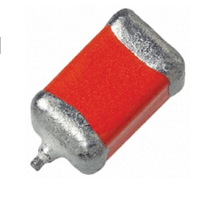
Tantalum capacitors are constructed using tantalum for at least the anode material. Capacitors in general consist of two polarized conductors separated by an insulating dielectric material. When the component is connected to a voltage source, its negative conductor becomes saturated with electrons, therefore charging the capacitor and allowing it to store electricity.
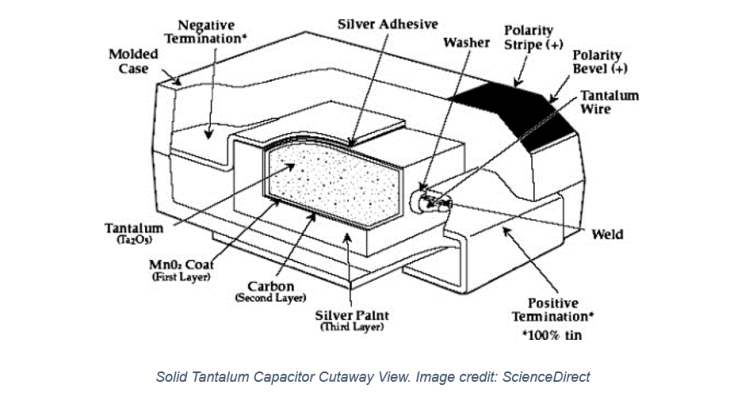
Tantalum capacitors rely on a unique characteristic of tantalum: the element tends to naturally form a non-conductive oxide surface layer which functions as the capacitor's dielectric. Because this layer is thinner and lighter than dielectric materials such as paper and plastic, tantalum capacitors can be manufactured as very small components with excellent capacitance to size ratios. Solid tantalum capacitors are typically comprised of a pellet-shaped anode, formed from tantalum powder, and a cathode constructed of manganese dioxide.
The image below shows a cutaway view of a solid tantalum capacitor. Note that the coatings around the tantalum core (manganese dioxide cathode, carbon, silver paint) are very thin.
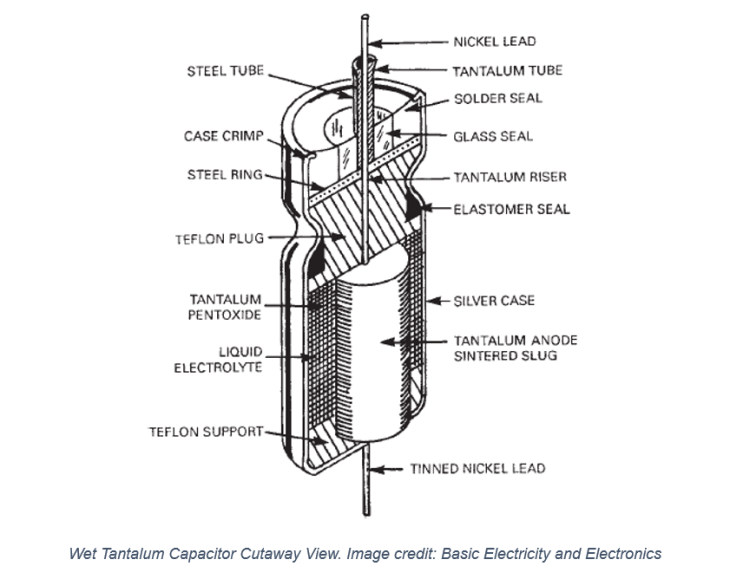
Wet tantalum (electrolytic) capacitors contrast with the solid variety, in that they feature a semi-liquid electrolyte paste as a second electrode; these devices are similar to aluminum electrolytic capacitors, which have solid aluminum anodes. Electrolytic capacitors in general are capable of very high capacitance values, but are generally unsuited to AC power applications due to their necessary polarity, but they are very frequently used in DC power supplies. When compared to aluminum electrolytic devices, tantalum capacitors feature longer shelf life, improved temperature resistance, and higher capacitance values, but are also more easily damaged by constant voltages as low as 1.5 V. The diagram below shows a cutaway view of a wet tantalum capacitor.
For general information about capacitors, including construction, applications, capacitance rating, and general specifications, please visit the Capacitors Selection Guide.
Specifications
Form Factor
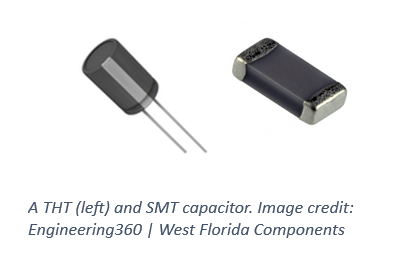
Tantalum capacitors are generally available in two different forms: leaded (or through-hole) and surface mount (SMT).
Leaded capacitors feature long wire leads which are soldered onto a PCB in order to make an electrical connection. These devices use through-hole technology (THT), which allows for strong mechanical connections. THT capacitors must be relatively large by necessity and have generally been replaced by surface mount products.
Surface mount (or chip) capacitors are mounted directly to the top of a PCB using very short leads, flat contacts, or other termination types. SMT devices are smaller and cheaper to manufacture than their older THT counterparts.
Standards
Tantalum capacitors may be manufactured to one or more various standards, including:
Tantalum Capacitors FAQs
What are the key advantages of using tantalum capacitors over other types of capacitors in electronic circuits?
Tantalum capacitors offer several key advantages over other types of capacitors in electronic circuits. Here are some of the notable benefits:
Volumetric Efficiency
Tantalum capacitors provide higher volumetric capacitance efficiency compared to other capacitor materials. This means they can store more charge in a smaller volume, which is particularly beneficial in compact electronic devices.
Temperature Stability
They exhibit excellent temperature stability, making them suitable for applications that experience a wide range of temperatures. This characteristic ensures reliable performance in varying environmental conditions.
Reliability
Tantalum capacitors are known for their high reliability. They are less prone to failure and have an unlimited shelf life, which makes them ideal for critical applications such as medical devices and aerospace electronics.
Low DC Leakage
Medical-grade tantalum capacitors feature ultra-low DC leakage, which is crucial for applications where minimal power loss is essential, such as in implantable and life support devices.
Power Dissipation
These capacitors have excellent power dissipation characteristics, which means they can efficiently handle power without significant losses, contributing to the overall efficiency of the electronic circuit.
Compatibility with Automated Assembly
Tantalum capacitors are compatible with all automated assembly systems, which facilitates their integration into modern manufacturing processes.
How do tantalum capacitors compare to aluminum electrolytic capacitors in terms of performance?
When comparing tantalum capacitors to aluminum electrolytic capacitors in terms of performance, several factors come into play.
Capacitance and Size
Tantalum capacitors offer higher volumetric capacitance efficiency, meaning they can store more charge in a smaller volume compared to aluminum electrolytic capacitors.
Aluminum electrolytic capacitors, particularly the newer prismatic and flat designs, provide space and weight savings over traditional wet tantalum banks, which can be advantageous in certain applications like military and aerospace.
Temperature Stability
Tantalum capacitors exhibit excellent temperature stability, making them suitable for applications with a wide range of temperatures.
Aluminum electrolytic capacitors have superior capacitance retention at low temperatures compared to wet tantalum capacitors, which is beneficial for military and aerospace applications that require operation at temperatures as low as -55° C.
Reliability and Lifespan
Tantalum capacitors are known for their high reliability and unlimited shelf life, making them ideal for critical applications such as medical devices and aerospace electronics.
Aluminum electrolytic capacitors, especially the hermetically sealed types, offer a long lifespan and can handle high levels of vibration, which increases reliability by reducing the number of components needed in a system.
Power Dissipation and Efficiency
Tantalum capacitors have excellent power dissipation characteristics, contributing to the overall efficiency of electronic circuits.
Aluminum electrolytic capacitors can replace multiple wet tantalum capacitors in designs, saving space, cost, and weight, which can also enhance system efficiency.
Applications
Tantalum capacitors are preferred in high-performance and space-constrained applications due to their efficiency and reliability.
Aluminum electrolytic capacitors are increasingly used in military and aerospace applications due to their ability to retain capacitance at low temperatures and their robust design.
What are the applications of tantalum capacitors in medical devices?
Tantalum capacitors are widely used in medical devices due to their unique properties and advantages. Here are some key points regarding their applications in this field:
High Reliability
Tantalum capacitors are known for their high reliability, which is crucial for medical devices where failure is not an option. They are less prone to failure and have an unlimited shelf life, making them ideal for critical applications such as pacemakers and hearing aids.
Ultra-Low DC Leakage
Medical-grade tantalum capacitors feature ultra-low DC leakage, which is essential for applications where minimal power loss is critical. This characteristic is particularly important in implantable and life support devices, ensuring that the devices operate efficiently and reliably over extended periods.
Temperature Stability
These capacitors exhibit excellent temperature stability, allowing them to perform reliably in the varying environmental conditions that medical devices may encounter.
Power Dissipation
Tantalum capacitors have excellent power dissipation characteristics, contributing to the overall efficiency of the electronic circuits within medical devices.
Applications in Specific Devices
Tantalum capacitors are used in a variety of medical devices, including hearing aids and pacemakers, due to their efficiency and reliability.
What is the manufacturing process of tantalum capacitors?
The manufacturing process of tantalum capacitors involves several key steps, each contributing to the unique properties and performance of these components.
Anode Formation
The process begins with high-purity tantalum powder, which is pressed into a pellet shape. This pellet acts as the anode of the capacitor. The shape of the pellet can vary depending on the capacitor style, such as cylindrical for axial and radial capacitors, and rectangular for surface-mounted capacitors.
Sintering
The pressed tantalum pellet undergoes a sintering process, where it is heated to temperatures up to 2000°C under a high vacuum or inert atmosphere. This step causes the tantalum powder particles to interconnect, forming a single electrode with an extremely high surface area in a small volume.
Dielectric Formation
Tantalum is a valve metal, and its surface is oxidized to form a thin layer of tantalum pentoxide (Ta2O5), which serves as the dielectric. This oxide layer is formed through electrolysis and is known for its uniform thickness and high dielectric constant.
Cathode Application
The dielectric-coated anode is then surrounded by a conductive manganese dioxide (MnO2) cathode. This structure is what makes tantalum capacitors unique, allowing for high capacitance levels in a compact size.
Assembly and Encapsulation
The capacitor is assembled with distinct positive and negative terminals, and it may be offered in various styles, including molded and conformal coated versions for different mounting configurations.
Quality Assurance
Manufacturers often employ rigorous quality processes to ensure the reliability and performance of tantalum capacitors. For example, the Q-Process is used to enhance reliability by screening out components that may experience parametric shifts or instability.
How does the sintering process affect the performance of tantalum capacitors?
The sintering process plays a crucial role in the performance of tantalum capacitors. Here's how it affects their performance:
Formation of the Anode
The sintering process involves heating the pressed tantalum powder pellet to temperatures up to 2000°C under a high vacuum or inert atmosphere. This step causes the individual tantalum powder particles to interconnect, forming a single electrode with an extremely high surface area in a small volume.
High Surface Area
The interconnected structure resulting from sintering provides a high surface area, which is essential for achieving high capacitance levels in a compact size. This high surface area allows for more charge storage, contributing to the volumetric efficiency of tantalum capacitors.
Uniformity and Reliability
The sintering process ensures that the tantalum particles are uniformly interconnected, which is critical for the reliability and stability of the capacitor. This uniformity helps in maintaining consistent performance over time and under various operating conditions.
Dielectric Formation
After sintering, the tantalum anode is oxidized to form a thin layer of tantalum pentoxide (Ta2O5), which serves as the dielectric. The quality of the sintered anode directly affects the uniformity and thickness of this dielectric layer, impacting the overall performance and reliability of the capacitor.
What are the dielectric properties of tantalum capacitors?
The dielectric properties of tantalum capacitors are a key factor in their performance and efficiency.
Dielectric Material
The dielectric in tantalum capacitors is formed by a thin layer of tantalum pentoxide (Ta2O5) on the surface of the tantalum anode. This oxide layer is created through an electrochemical process known as anodization.
Dielectric Constant
Tantalum pentoxide has a relatively high dielectric constant compared to other materials used in electrolytic capacitors. This contributes to the high capacitance values that can be achieved in a compact size.
Uniform Thickness
The dielectric layer is extremely uniform in thickness, which is crucial for the reliable performance of the capacitor. The uniformity ensures consistent electrical characteristics across the entire surface of the anode.
Thin Dielectric Layer
The dielectric layer is very thin, approximately 0.02 micrometers per volt. This thinness, combined with the high surface area of the sintered tantalum anode, results in highly volumetric-efficient devices.
Performance and Reliability
The quality of the dielectric layer directly impacts the performance and reliability of the capacitor. A well-formed dielectric layer ensures low leakage current and high breakdown voltage, which are essential for the capacitor's efficiency and longevity.
What are the limitations of tantalum capacitors compared to other types?
Tantalum capacitors, while offering several advantages, also have certain limitations compared to other types of capacitors.
Tantalum capacitors, particularly wet tantalum types, have poor capacitance retention at low temperatures. This can be a disadvantage in applications such as military and aerospace electronics, where operation at temperatures as low as -55°C is required. In such cases, aluminum electrolytic capacitors may be preferred due to their superior capacitance retention at low temperatures.
Although tantalum pentoxide has a relatively high dielectric constant for an electrolytic capacitor, it is lower than what can be achieved with ceramic technologies. This means that for applications requiring extremely high capacitance values in a small form factor, ceramic capacitors might be more suitable.
Tantalum capacitors can be more expensive than other types, such as aluminum electrolytic capacitors. This cost factor can be a limitation in applications where budget constraints are significant.
Tantalum capacitors typically offer voltage ratings from 2 V to 50 V, which may not be sufficient for applications requiring higher voltage ratings. In such cases, other capacitor types with higher voltage capabilities might be necessary.
Tantalum Capacitors Media Gallery
References
Electronics360—Why Military and Aerospace Designers Are Turning to Aluminum Electrolytic Capacitors
Electronics360—Not Your Father’s Aluminum Electrolytic Capacitor
Electronics360—Medical Grade Tantalum Capacitors Tailored for Implantable and Life Support Devices
Image credit:
RS Components