
Film Capacitors Information
Last revised: January 10, 2025
Reviewed by: Scott Orlosky, consulting engineer
Film capacitors are passive components that use an extremely thin plastic film as a dielectric insulator. They are constructed of two pieces of plastic film wound into a cylindrical shape. The winding is attached to two unpolarized terminals, which represent the plates of a basic capacitor, and it is then encapsulated for protection.
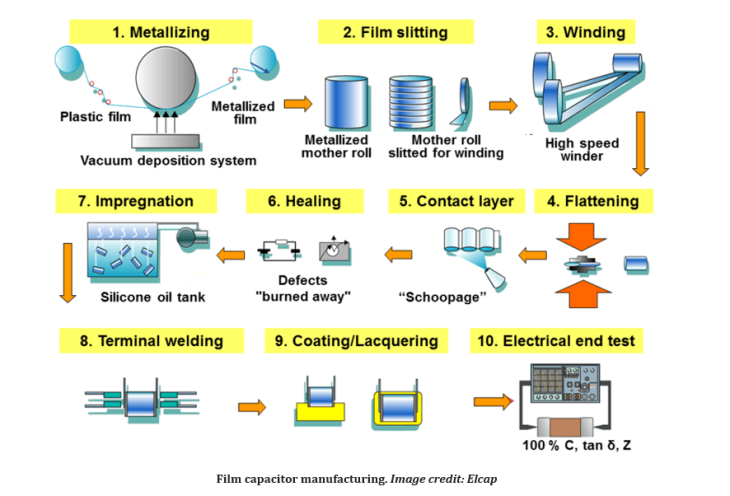
A film capacitor's dielectric determines many different attributes about the device, most importantly its rated voltage. Manufacturers are able to increase a capacitor's rated voltage by using thicker film and better quality, defect-free polymers. Other contributing factors include metallized films (discussed below), film arrangement, and frequency of use.
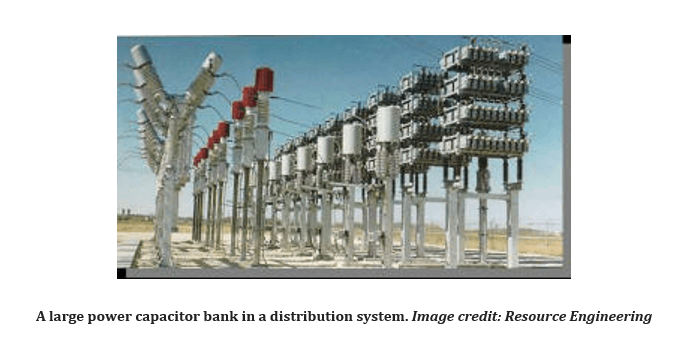
Film capacitors can be built as very large devices due to the simplicity inherent in the slitting and winding operations used to manufacture them. These power capacitors are widely used for energy storage in high voltage applications such as electrical power systems and power plants.
Film vs. Metallized Film
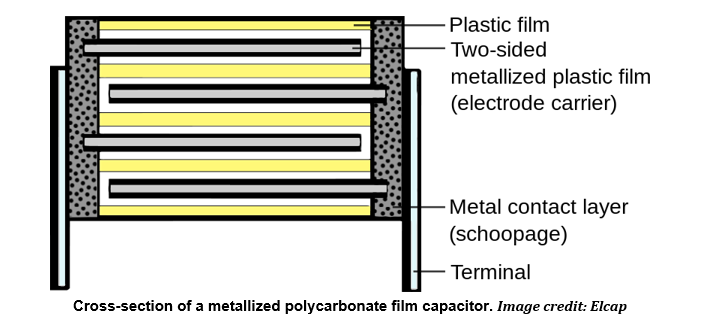
A film capacitor's plastic dielectric is covered with electrodes for making an electrical connection to the terminals. The dielectric may be referred to as metal foil or metallized film, depending on the electrode arrangement.
A metal foil dielectric consists of two plastic films layered with a thin metal (typically aluminum) foil, with the foil layers functioning as electrodes. Metal foil capacitors provide easy electrode connection and good surge resistance, but may easily sustain damage due to dielectric breakdown.
Metallized film capacitors use two plastic films which have been coated with a very thin layer of aluminum (metallized), which serves as the electrode. Metallized devices feature a greater resistance to component damage from short circuits, but are typically weaker against surge currents than metal foil capacitors.
Specifications
Form Factor
When selecting a film capacitor, it is important to distinguish between leaded and surface mount devices.
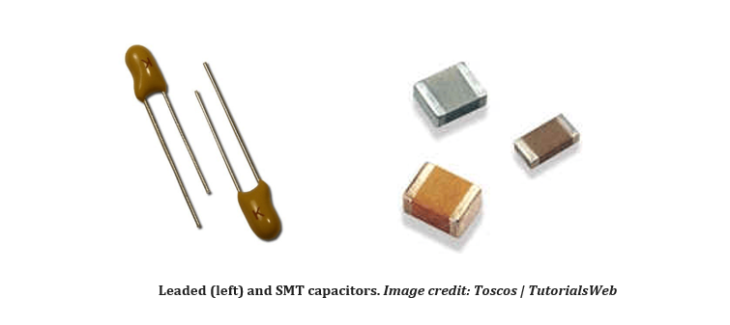
Leaded (or through hole) capacitors have wire leads which extend from the device. These wires must be soldered onto a circuit board or other device to make a connection. Leaded devices are capable of strong mechanical connections, are relatively large compared to other components, and are generally being supplanted by surface mount products.
Surface mount (SMT) or chip capacitors do not have leads and are designed to mount directly onto a printed circuit board (PCB) or other flat surface. SMT devices can be much smaller than their leaded counterparts, are cheaper to manufacture, and are generally easier to handle when used with standardized automation equipment.
Dielectric Material
A film capacitor's dielectric material largely determines the device's attributes or application.
Polyester capacitors, sometimes called polyethylene terephthalate (PET) or Mylar film capacitors, are generally used as replacements for obsolete impregnated paper capacitors. Polyester capacitors feature low moisture absorption and are acceptable for DC use up to 60 kV at operating temperatures less than 125° C. It is important to note that polyester capacitors are generally unsuited to all but the lowest frequency radio frequency (RF) applications. A typical minimum thickness for polymer dielectrics is 0.7 μm.
Polystyrene capacitors are very common general purpose film capacitors. Like polyester devices, they are stable and have low moisture pickup; polystyrene capacitors are better suited to low power RF applications, although their operating temperature is limited to less than 85° C and they tend to be larger than polyester capacitors.
Polycarbonate is a thermoplastic polymer also known by its trademarked names Lexan, Makrolon, and Makroclear. Polycarbonate film capacitors feature superior insulation resistance, dissipation factor, and improved dielectric absorption compared to polystyrene.
Polypropylene capacitors are extremely strong and reliable, and are often used in high voltage, high frequency, and high power applications. They do tend to be more susceptible to damage from surges or pulses.
Standards
There are many different standards related to film capacitors. The Electronics Industries Alliance (EIA) in particular publishes many standards specific to certain devices or applications. A smattering of standards, both comprehensive/general and specific, is listed below.
- BSI — BS EN 60384-2 (Film capacitors in electronic equipment [film dielectric]; 23 parts)
- ECIA — EIA-376 (Fixed film capacitors in DC applications)
- ECIA — EIA-456 (Film capacitors in AC applications)
- ECIA — EIA-580A000 (Fixed metallized PET film capacitors — DC radial leaded)
Film Capacitors FAQs
What are the key advantages of using film capacitors over other types of capacitors in circuit design?
Here are some of the notable benefits:
Stability and Reliability
Film capacitors provide excellent stability and reliability, which makes for consistent performance in electronic circuits.
Low Equivalent Series Resistance (ESR) and Self-Inductance (ESL)
They have low ESR and ESL, which contribute to their efficiency and make them suitable for high-frequency applications.
Non-Polarized Nature
Unlike electrolytic capacitors, film capacitors are non-polarized. This means they can be used in AC applications without worrying about the polarity of the voltage connected to their terminals.
High Dielectric Strength and Insulation Resistance
Film capacitors are known for their high dielectric strengths and insulation resistance, which enhance their performance in various applications.
Self-Healing Capability
Metallized film capacitors have a self-healing property that allows them to recover from local breakdowns by isolating the fault area, thus improving their reliability and service life.
Wide Range of Applications
They are versatile and can be used in applications such as power supply filtering, signal coupling, and radio frequency circuits due to their high efficiency and stability.
Resistance to Humid Environments
Newer film capacitors, such as metalized polypropylene AC film capacitors, are designed to maintain stable capacitance and ESR values even in humid environments, making them suitable for harsh conditions.
What is the self-healing capability of metallized film capacitors?
Here's how self-healing works:
Mechanism of Self-Healing
When a local breakdown occurs within the capacitor, the metallized film automatically vaporizes the thin metal in the fault area. This effectively cuts off the defective section from the rest of the capacitor.
Benefits
Improved Reliability: By isolating the fault area, the capacitor prevents further damage and maintaining its overall reliability.
Extended Service Life: The ability to self-heal allows the capacitor to continue functioning effectively even after experiencing minor faults, thus extending its service life.
Applications
Metallized film capacitors are widely used in various applications such as power supply filtering, signal coupling, and radio frequency circuits. Their self-healing capability makes them particularly suitable for these applications, where high efficiency, stability, and durability are required.
What is the working principle of metallized film capacitors?
Dielectric Material
Metallized film capacitors use thin plastic films as their dielectric material. Common materials include polyester, polypropylene, and polystyrene.
Metallization
The film is metallized, through a vapor-deposition process. This keeps the capacitor very compact while maintaining high efficiency and stability.
How do film capacitors compare to electrolytic capacitors in terms of performance?
Film capacitors and electrolytic capacitors have distinct characteristics that make them suitable for different applications in terms of performance.
Dielectric Material and Construction
Film Capacitors: Use thin plastic films as their dielectric material, which can be metallized with vapor-deposited metal electrodes. Common materials include polyester, polypropylene, and polystyrene.
Electrolytic Capacitors: Typically use an electrolyte as one of their plates, with aluminum or tantalum as the dielectric material.
Polarization
Film Capacitors: Non-polarized, meaning they can be used in AC applications without concern for voltage polarity.
Electrolytic Capacitors: Polarized, requiring correct polarity in DC applications to avoid damage.
Stability and Reliability
Film Capacitors: Known for excellent stability, reliability, and self-healing capabilities, which enhance their service life and performance in various applications.
Electrolytic Capacitors: Generally have higher capacitance values but may suffer from issues like leakage current and limited lifespan compared to film capacitors.
Equivalent Series Resistance (ESR) and Self-Inductance (ESL)
Film Capacitors: Have low ESR and ESL, making them suitable for high-frequency applications.
Electrolytic Capacitors: Typically have higher ESR, which can limit their performance in high-frequency applications.
Applications
Film Capacitors: Versatile and used in power supply filtering, signal coupling, and radio frequency circuits due to their high efficiency and stability.
Electrolytic Capacitors: Often used in applications requiring large capacitance values, such as power supply smoothing and energy storage.
What are the recent trends in film capacitor technology?
Recent trends in film capacitor technology reflect advancements aimed at enhancing performance, reliability, and adaptability to various applications.
Enhanced Environmental Resistance
New metalized polypropylene AC film capacitors have been developed to maintain stable capacitance and ESR values even in humid environments, ensuring a long shelf life in harsh conditions.
Higher Voltage
With the rise of new energy applications, such as electric vehicles, there is a demand for film capacitors with higher voltage capabilities. These capacitors are being adapted to electrical systems in these applications.
Supply Chain Stability
The stability of the supply chain has become a key focus to ensure the sustainable supply of high-voltage film capacitors. Manufacturers are emphasizing production scale, technical strength, and quality management to provide reliable and consistent products.
Innovative Dielectric Materials
Novel dielectric films have been commercialized, offering improved ripple current handling and capacitance density. This innovation is particularly targeting high-reliability applications such as power converters for mobile and airborne systems.
Application-Specific Designs
Film capacitors are being tailored for specific applications, such as uninterruptible power supplies (UPS), where they are used as output filter capacitors. These capacitors are designed to meet demanding requirements, offering low dissipation factors and non-polar characteristics. Some advancements are aimed at reducing the environmental effects.
How do film capacitors contribute to the stability of power supply systems?
Low Equivalent Series Resistance (ESR) and Self-Inductance (ESL)
Film capacitors have low ESR and ESL, which enhance their efficiency and make them suitable for high-frequency applications. This low resistance and inductance help in reducing energy losses and improving the overall stability of power supply systems.
Non-Polarized Nature
Being non-polarized, film capacitors can be used in AC applications without concern for voltage polarity. This flexibility allows them to be integrated into various parts of power supply systems, contributing to their stability and reliability.
High Dielectric Strength and Insulation Resistance
Film capacitors are known for their high dielectric strengths and insulation resistance, which help maintain stable performance in power supply systems. These properties help in preventing breakdowns and ensuring consistent operation.
Self-Healing Capability
The self-healing feature of metallized film capacitors allows them to recover from local breakdowns by isolating the fault area. This helps maintain the stability of power supply systems.
Environmental Resistance
Recent advancements have led to the development of film capacitors that maintain stable capacitance and ESR values even in humid environments. This makes them suitable for use in harsh conditions, further contributing to the stability of power supply systems.
What are the benefits of using novel dielectric materials in film capacitors?
Improved Ripple Current Handling
Novel dielectric films have been commercialized to offer improved ripple current handling capabilities. This is particularly beneficial for high-reliability applications, such as power converters for mobile and airborne systems.
Increased Capacitance Density
These new dielectric materials contribute to higher capacitance density, allowing for more compact capacitor designs without compromising performance. This is advantageous in applications where space is limited.
Enhanced Environmental Resistance
Some novel dielectric materials are designed to maintain stable capacitance and ESR values even in harsh environments, such as high humidity. This ensures a long shelf life and reliable performance in challenging environments.
Application-Specific Designs
The development of novel dielectric materials allows for the tailoring of film capacitors to meet specific application requirements, such as those in uninterruptible power supplies (UPS). These capacitors can offer low dissipation factors and non-polar characteristics, making them suitable for demanding applications.
Film Capacitors Media Gallery
References
GlobalSpec—Trends in the design and application of different capacitor types
- Aerospace
- Automotive
- Axial Leads
- Bolt Mounted
- Bracket Mount
- Bulk Pack
- Bypass Capacitors
- Fixed
- Flying Leads
- General Purpose
- Gull Wing Leads
- High Current
- High Frequency
- High Voltage Capacitor
- J-Leads
- Leaded Capacitor
- Lighting
- Metallized Dielectric
- Motors / Motor Starting
- Polarized
- Polycarbonate
- Polyester
- Polypropylene
- Polystyrene
- Power Capacitors
- Power Factor Correction
- Power Supply
- RF / Microwave Capacitors
- Radial Leads
- RoHS Compliant
- Screw Leads
- Self-healing
- Shipping Tube / Stick Magazine
- Surface Mount / Chip Capacitor
- Surface Mount Technology (SMT)
- Surface Mount Technology (SMT)
- Tab Leads
- Tape Reel
- Telecom
- Through Hole Technology (THT)
- Tray / Rail
- Variable