
Relay Sockets Information
Last revised: December 3, 2024
Reviewed by: Scott Orlosky, consulting engineer
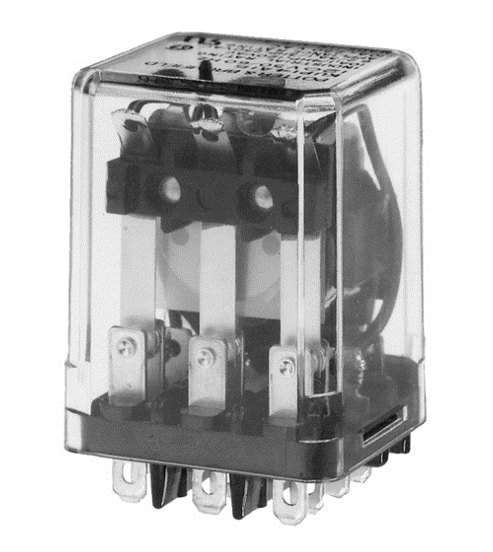
Relay sockets accept electromechanical switches in which the variation of current in one electric circuit controls the flow of electricity in another circuit. Relay sockets are made of metal or composite materials and available in a variety of shapes, sizes, and colors.
Relay sockets differ in terms of terminal type, the number of pins per blade, and socket receptacle style. Terminals are devices that terminate a conductor. They attach to posts, studs or other conductors in order to establish an electrical connection. Typically, these connections are made using screws or by soldering wires or pins. Crimp terminals use the physical compression (deformation) of a contact wire barrel around a conductor to make an electrical and mechanical connection to the conductor. Quick connect / disconnect terminals do not require the use of tools. Most relay sockets use 5, 7, 8, 10, 11, 14, or 16 pins per blade. There are many different socket receptacle styles. Examples include octal or circular sockets, blade or lug sockets, and square or cube sockets. Miniature pin/blade sockets are often called “midgets.” PCB sockets are commonly available.
Specifications
Performance specifications include number of poles, maximum voltage, and maximum current.
- Single-pole (SP) sockets are used with relays that control one line with each throw.
- Double-pole (DP) devices are used with relays that control two lines with each throw. Typically, the first line is hot and the second line is neutral.
- Triple-pole (TP) sockets that accept three pairs of contacts.
- Four-pole devices (4P) receive four pairs of contacts.
Additional considerations when selecting relay sockets include electrical rating, dielectric strength, insulation resistance, and temperature range. Some products are flame retardant, shatterproof, or designed for demanding applications. Others include electrical or mechanical on/off indicators.
Mounting Styles
There are several mounting styles for relay sockets.
- Through hole technology (THT) mounts components on a printed circuit board (PCB) by inserting component leads through holes in the board and then soldering the leads in place on the opposite side of the board.
- Surface mount technology (SMT) adds components by soldering component leads or terminals to the top surface of the board. Typically, the PCB pad is coated with a paste-like formulation of solder and flux.
- Some relay sockets have mounting holes or are designed for placement within an existing panel or structure.
- Others mount on a standard DIN rail.
Relay Sockets FAQs
How do the maximum voltage and current ratings affect the performance of relay sockets?
The maximum voltage rating indicates the highest voltage that the relay socket can handle safely without breaking down or causing insulation failure. It ensures that the insulation within the relay socket can withstand the specified voltage without degrading. It also prevents electrical arcing and potential hazards, ensuring safe operation within the specified voltage limits. Operating within the maximum voltage rating ensures the longevity and reliability of the relay socket, preventing premature failure.
The maximum current rating specifies the highest current that the relay socket can carry without overheating or causing damage to the contacts. Heat dissipation ensures that the relay socket can dissipate heat generated by the current flow, preventing overheating and potential damage. Operating within the maximum current rating minimizes damage to the contacts, specifically wear, arcing, and oxidation maintaining a stable and reliable connection.
What are the advantages of using quick connect/disconnect terminals?
Quick connect/disconnect terminals allow for easy connection and disconnection without the need for tools. This makes them very convenient for applications where components need to be frequently replaced or serviced.
The tab and slot mechanism used in quick connect/disconnect terminals enables rapid assembly and disassembly. This significantly reduces the time required for installation and maintenance, making them ideal for high-volume or time-sensitive applications.
These terminals can be used in a wide range of applications, from consumer electronics to industrial machinery. Their versatility makes them a popular choice across various industries, including consumer electronics, appliances, and automotive sectors.
The ease of connection and disconnection facilitates regular maintenance and inspection. This ensures that the system remains in optimal working condition and reduces downtime due to maintenance.
What factors should be considered when selecting the number of pins per blade for a relay socket?
When selecting the number of pins per blade for a relay socket, several factors should be considered to ensure optimal performance and compatibility with an application.
Ensure that the relay socket can handle the maximum voltage and current required by your application. The number of pins can affect the current-carrying capacity and voltage isolation.
The number of pins often correlates with the number of poles in the relay. More pins may be needed for multi-pole relays.
Different socket styles (e.g., octal, blade, square) may require a specific number of pins. Ensure the relay socket matches the physical configuration of the relay.
Consider how the relay socket will be mounted (e.g., PCB, panel) and ensure the pin configuration is compatible with the mounting method.
Depending on whether you need normally open (NO), normally closed (NC), or changeover contacts, the number of pins may vary.
In environments with high vibration or temperature variations, the number of pins and their secure connection can impact reliability.
If frequent maintenance or replacement is required, choosing a relay socket with a suitable number of pins that allows for quick connect/disconnect can be beneficial.
How do safety relays differ from conventional relays in terms of design and application?
Safety relays feature force-guided or positive-driven contacts. This design ensures that if one contact welds or sticks, the other contacts will maintain their position, providing a fail-safe mechanism
Conventional relays typically do not have force-guided or positive-driven contacts. They are designed to switch circuits based on the variation of current in one electric circuit to control the flow of electricity in another circuit.
Safety relays often include multiple redundant circuits and are designed to meet stringent safety standards. This ensures that even if one part fails, the relay can still perform its safety function.
Conventional relays are generally simpler in construction and are designed for general-purpose switching applications without the need for redundancy or fail-safe mechanisms.
Safety relays are primarily used in safety-critical applications where ensuring the safe operation of machinery and systems is paramount. Examples include emergency stop circuits, safety interlocks, and monitoring of safety devices.
They must comply with specific safety standards and regulations, often required in industrial automation and machinery to ensure operator safety.
Although conventional relays are used in a wide range of applications where general switching is required, such as in automotive, telecommunications, and consumer electronics. They do not provide the same level of safety assurance as safety relays.
What are the design considerations for relay sockets in circuit design?
Relay designs must match the intended voltage and current, both in level and type of power. They may include multiple contacts or on/off configurations similar to those in switches.
How do relay sockets facilitate the replacement of relays?
Relay sockets allow for the easy replacement of relays without disturbing the existing wiring. This is particularly important in applications where minimizing downtime is critical to maintaining continuous service.
By facilitating quick and straightforward relay swaps, relay sockets ensure that maintenance tasks can be and are more likely to be performed regularly, reducing the risk of prolonged outages.
The use of relay sockets helps prevent connection failures that could occur due to loose or faulty wiring, thereby enhancing the overall reliability of the equipment.
Relay sockets are designed to accommodate various types of relays, including those used for signal switching in telecommunications equipment. This adaptability ensures that the right type of relay can be used for specific applications, contributing to the system's reliability.
The design options available for relay sockets allow them to be tailored to the specific voltage and current requirements of the equipment, ensuring optimal performance and reliability.
Relay sockets can be used with safety relays that have force-guided or positive-driven contacts, providing an additional layer of safety and reliability in critical applications.
What are reed relays and how are they used with relay sockets?
Reed relays are electrically-operated switching devices consisting of two thin magnetic strips encapsulated in a glass envelope, used to switch industrial components such as solenoids, contactors, and starter motors
Relay Sockets Media Gallery
References
Electronics360—The Role of the Relay Switch in Circuit Design
Image Credit: