
Press Brakes Information
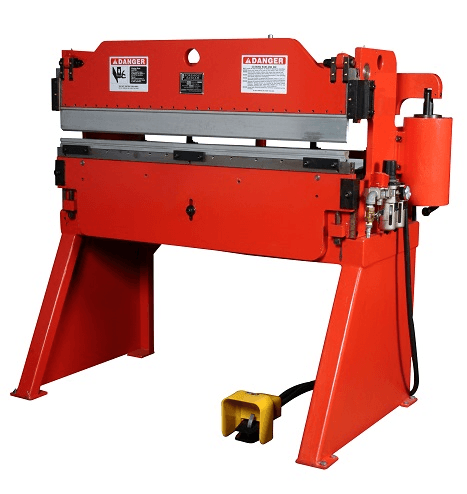
Press brakes are metal forming machines used to bend and fold sheet and plate metal by pressing it between tooling referred to as a punch and a die. Folds and lips help to stiffen sheet metal panels. In order to complete the bending operation, it is necessary to bend the material slightly beyond the desired shape to overcome the material springing back due to residual tensile and compressive stresses.
Types of Press Brakes
The primary classification of press brakes is by their method of applying force — hydraulic, mechanical, servo, and pneumatic.
Hydraulic press brakes have become the most common press brake in use since the 1970s. They are designed for both specialized sheet metal work and continuous industrial production jobs from single-cycle operations to automated cell components. Driven by two synchronized hydraulic cylinders, hydraulic press brakes are safer and less expensive than mechanical press brakes and offer advantages such as variable speed control, quick retraction, and the capability to reverse the stroke at any time.
Mechanical press brakes use an electric motor to power a flywheel that stores kinetic energy and releases it through one of several different drive transmission configurations. Mechanical presses are accurate, high-speed machines with relatively low maintenance costs.
Servo press brakes, also referred to as CNC press brakes, supply the pressing force via two synchronized servomotors used to power a belt and pulley mechanism. The servomotor replaces the flywheel and clutch in mechanical press brakes. Servo-driven presses are highly flexible machines due to the ability to precisely control the stroke and speed of the ram with the servomotors. Mechanical press brakes are still a better option for high-volume applications, while servo presses are better for low-volume specialty or custom applications.
Pneumatic press brakes deliver the pressing action from a compressed air pressure source. Applications for pneumatic presses include bending, shearing, punching, forming, drawing, extruding, and assembly. Pneumatic presses cannot supply the same force as hydraulic press brakes, but they do provide a fast, clean operation.
Features
Press brakes can bend many different shapes depending on the tooling used, including:
- V-shape
- Rib
- Channel
- Open hat channel
- Closing
- Single and double form
- Radius
- Offset
- Custom shape
The video below, courtesy of Cincinnati Incorporated, provides an introduction to the fundamentals of bending metal with press brakes.
Techniques
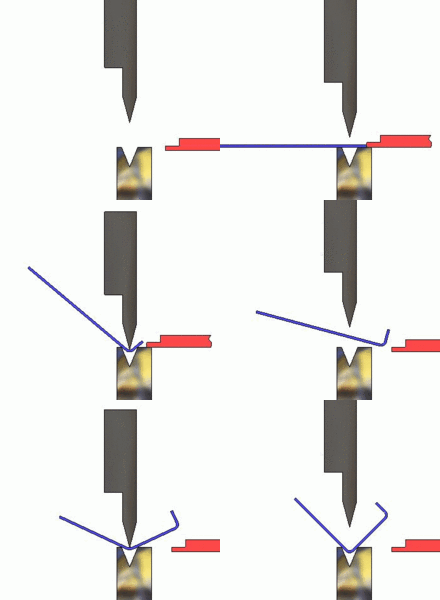 Bottoming refers to the point during bending where the tooling bottoms out and the punch, material and die come together with no air gap separating them. Bottoming does not produce accurate bends, as the metal attempts to spring back to its original shape when the tooling withdraws and the force is removed.
Bottoming with penetration, also referred to as coining, is a method used to compensate for material springback. During bottoming with penetration, the tool bottoms out and then the nose penetrates the material. This creates a high enough stress to create plastic material flow, eliminating the results of springback. The drawback to this method is that the forces required are much higher than needed for bottoming, which is taxing on the tooling.
General-purpose air bending is the process of bending in air, where there are only three points of contact between the punch, material and die — two points with the die and one with the tip of the tool. The air bending process is used for material of thickness gauges 10 gauges and higher. General-purpose air bending does not produce precise bends and is used in applications that can tolerate angle variations of 1 to 2 degrees.
Precision air bending is used in applications needing tighter tolerances, however, a CNC press brake and precision-ground tooling are required. Precision air bending can produce bends with accuracy within +/- ½ degree.
Applications
Press brakes are common machine tools in any industry or application that requires folding or bending metal sheet or strips. Some common examples include:
- Electrical — enclosures
- Machine tool — machine enclosures and doors, coolant, lubrication or hydraulic tanks
- Building and construction — cabinets, ductwork, grilles
- Automotive and aerospace — large panel fabrication
Image Credits:
- hydraulic bending press
- aluminum bending machines
- clicker cutting press
- plastic bending machines
- aluminum press machine
- a0 paper folding machines
- atom die cutting press
- busbar multi punch press machines
- illuma press machines
- linen napkin folding machines
- manesty tablet press machines
- portable truss plate press machines
- screw conveyor flight bending machines
- spiral stair handrail bending machines
- steam wood bending machines
- storefront aluminum bending machines
- superior muffler bending machines
- tobacco press machines
- truss plate press machines