Understanding the characteristics of different fiber types aids in understanding the
applications for which they are used. Operating a fiber-optic system properly relies
on knowing what type of fiber is being used and why. There are two basic types of
fiber: multimode and single-mode. Multimode fiber is best designed for short transmission distances, and is suited for use in local
area network (LAN) systems and video surveillance. Single-mode fiber is best
designed for longer transmission distances, making it suitable for long-distance
telephony and multichannel television broadcast systems [2].
TYPES OF OPTICAL FIBERS
There are two parameters used to distinguish fiber types, mode and index. The
term “mode” relates to the use of optical fibers as dielectric waveguides. Optical
fibers operate under the principle of total internal reflection. As optical radiation
passes through the fiber, it is constantly reflected back through the center core of
the fiber. The resulting energy fields in the fiber can be described as discrete sets
of electromagnetic waves. These discrete fields are the modes of the fiber. Modes
that propagate axially down the fiber are called guided modes. Modes that carry
energy out of the core to dissipate are called radiation modes.
The number of modes allowed in a given fiber is determined by a relationship
between the wavelength of the light passing through the fiber, the core diameter
of the fiber, and the material of the fiber. This relationship is known as the normalized
frequency parameter or V number.
For any fiber diameter, some wavelengths will propagate only in a single mode.
This single-mode condition arises when the V number works out to <2.405. For
the purposes of this discussion, let us consider that there are two mode conditions
for optical fibers, single- and multimode. The exact number of modes in a multimode
fiber is usually irrelevant.
A single-mode fiber has a V number that is <2.405, for most optical wavelengths. It will propagate light only in a single guided mode.
A multimode fiber has a V number that is >2.405 for most optical wavelengths.
Therefore, it will propagate light in many paths through the fiber.
The term “index” refers to the refractive index of the core material. As illustrated in Figure 4.2, a step-index fiber refracts the light sharply at the point where the cladding meets the core material [3]. A graded-index fiber refracts the light more gradually, increasing the refraction as the ray moves further away from the center core of the fiber.
Mode and index are used to classify optical fibers into three distinct groups. These are shown in Figure 4.2 [3]. Currently, there are no commercial singlemode/ graded-index fibers. A brief description of the advantages and disadvantages of each type follows.
Multimode/Step Index
These fibers have the greatest range of core sizes (50–1500 μm), and are available
in the most efficient core-to-cladding ratios. As a result, they can accept
light from a broader range of angles. However, the broader the acceptance angle,
the longer the light path for a given ray. The existence of many different paths
through the fiber causes “smearing” of signal pulses, making this type of fiber
unsuitable for telecommunications. Because of their large core diameters, these
fibers are the best choice for illumination, collection, and use in bundles as light
guides.
MultiMode/Graded Index
These fibers have the next largest range of core size (50–100 μm). The gradedindex
core has a tendency to bend rays from wider incoming angles through a
sharper curve. This results in less pulse smearing than with step-index fibers, so
they are often used in short-range communication. They are usually not bundled
due to difficulties in obtaining them in appropriate protective buffers.
Single-Mode/Step Index
These fibers have the smallest range of core sizes (5–10 μm). They are difficult to
handle owing to this small size, and hence given thicker cladding. They only operate
in a single guided mode, with very low attenuation, and with very little pulse
broadening at a predetermined wavelength (usually in the near-IR). This makes
them ideal for long-distance communications since they require fewer repeating
stations. They have inherently small acceptance angles, so they are not generally
used in applications requiring the collection of light [3].
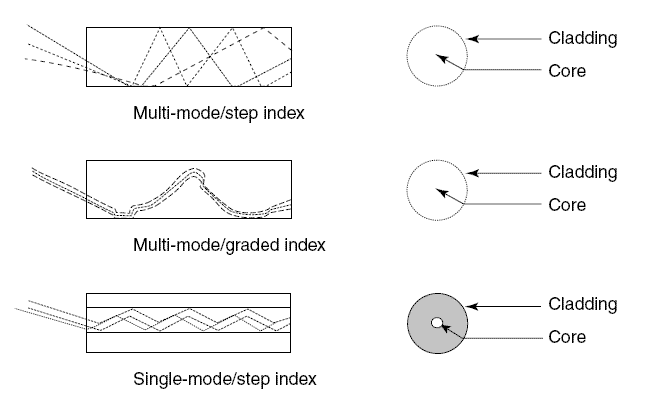
Figure 4.2 Optical fiber types.
© 2026 John Wiley & Sons, Inc.

 TABLE OF CONTENTS