Absorption: The portion of optical attenuation in an optical fiber resulting from the conversion of optical power to heat; caused by impurities such as hydroxyl ions in the fiber.
A/B Switch: A device that accepts inputs (optical or electrical) from a primary path and a secondary path to provide automatic or manual switching in the event that the primary path signal is broken or otherwise disrupted. In optical A/B switches, optical signal power thresholds dictate whether the primary path is functioning and signals a switch to the secondary path until optical power is restored to the primary path.
AC: Alternating current. An electric current that reverses its direction at regularly recurring intervals.
Acceptance Angle: The half-angle of the cone within which incident light is totally internally reflected by the fiber core. It is equal to sin–1(NA), where NA is the numerical aperture.
Active Device: A device that requires a source of energy for its operation and has an output that is a function of present and past input signals. Examples include controlled power supplies, transistors, LEDs, amplifiers, and transmitters.
A/D or ADC: Analog-to-digital converter. A device used to convert analog signals to digital signals.
Add/Drop Multiplexing: A multiplexing function offered in connection with SONET that allows lower-level signals to be added or dropped from a high-speed optical carrier in a wire center. The connection to the add/drop multiplexer is via a channel to a central office port at a specific digital speed (DS3, DS1, etc.).
ADM: Add/drop multiplexer. A device that adds or drops signals from a communications network.
ADSL: Asynchronous digital subscriber line.
Aerial Plant: Cable that is suspended in the air on telephone or electric utility poles.
AGC: Automatic gain control. A process or means by which gain is automatically adjusted in a specified manner as a function of input level or another specified parameter.
AM: Amplitude modulation. A transmission technique in which the amplitude of the carrier varies in accordance with the signal.
Amplified Spontaneous Emission (ASE): A background noise mechanism common to all types of erbium-doped fiber amplifiers (EDFAs). It contributes to the noise figure of the EDFA, which causes the signal-to-noise ratio (SNR) loss.
Amplifier: A device that boosts the strength of an electronic or optical signal when inserted in the transmission path. Amplifiers may be placed just after the transmitter (power booster), at a distance between the transmitter and the receiver (in-line amplifier), or just before the receiver (preamplifier).
Analog: A continuously variable signal (opposite of digital).
Angular Misalignment: Loss at a connector due to fiber end face angles being misaligned.
ANSI: American National Standards Institute. An organization that administers and coordinates the U.S. voluntary standardization and conformity assessment system.
APC: Angled physical contact. A style of fiber-optic connector with a 5–15° angle on the connector tip for the minimum possible back-reflection.
APD: Avalanche photodiode.
APL: Average picture level. A video quality parameter.
AR Coating: Antireflection coating. A thin, dielectric or metallic film applied to an ooptical surface to reduce its reflectance and thereby increase its transmittance.
Armor: A protective layer, usually metal, wrapped around a cable.
ASCII: American standard code for information interchange. An encoding scheme used to interface between data processing systems, data communication systems, and associated equipment.
ASIC: Application-specific integrated circuit. A custom-designed integrated circuit.
ASTM: American Society for Testing and Materials. An organization that provides a forum for the development and publication of voluntary consensus standards for materials, products, systems, and services that serve as a basis for manufacturing, procurement, and regulatory activities.
Asynchronous: Data that are transmitted without an associated clock signal. The time spacing between data characters or blocks may be of arbitrary duration (opposite of synchronous).
Asynchronous Transfer Mode (ATM): A transmission standard widely used by the telecom industry. A digital transmission-switching format with cells containing 5 bytes of header information followed by 48 data bytes. Part of the B-ISDN standard.
ATE: Automatic test equipment. A test-equipment computer programmed to perform a number of test measurements on a device without the need for changing the test setup. Especially useful in testing components and PCB assemblies.
ATSC: Advanced Television Systems Committee. Formed to establish technical standards for advanced television systems, including digital high-definition television (HDTV).
Attenuation: The decrease in signal strength along a fiber-optic waveguide caused by absorption and scattering. Attenuation is usually expressed in decibels per kilometer (dB/km).
Attenuation-Limited Operation: The condition in a fiber-optic link when operation is limited by the power of the received signal (rather than by bandwidth or distortion).
Attenuator: In electrical systems, a usually passive network for reducing the amplitude of a signal without appreciably distorting the waveform. In optical systems, a passive device for reducing the amplitude of a signal without appreciably distorting the waveform.
Avalanche Photodiode (APD): A photodiode that exhibits internal amplification of photocurrent through avalanche multiplication of carriers in the junction region.
Average Power: The average level of power in a signal that varies with time.
AWG (Arrayed Waveguide Grating): A device built with silicon planar light-wave circuits (PLC), which allows multiple wavelengths to be combined and separated in a dense wavelength division multiplexing (DWDM) system.
Axial Propagation Constant: For an optical fiber, the propagation constant evaluated along the axis of a fiber in the direction of transmission.
Axis: The center of an optical fiber.
Back Channel: A means of communication from users to content providers. Examples include a connection between the central office and the end user, an Internet connection using a modem, or systems where content providers transmit interactive television (analog or digital) to users while users can connect through a back channel to a web site, for example.
BB-I: Broadband interactive services. The delivery of all types of interactive video, data, and voice services over a broadband communications network.
Back-reflection (BR): A term applied to any process in the cable plant that causes light to change directions in a fiber and return to the source. Occurs most often at connector interfaces where a glass–air interface causes a reflection.
Back-scattering: The return of a portion of scattered light to the input end of a fiber; the scattering of light in the direction opposite to its original propagation.
Bandwidth (BW): The range of frequencies within which a fiber-optic waveguide or terminal device can transmit data or information.
Bandwidth Distance Product: A figure of merit equal to the product of an optical fiber’s length and the 3-dB bandwidth of the optical signal, under specified launching and cabling conditions, at a specified wavelength. The bandwidth distance product is usually stated in megahertz kilometer (MHz km) or gigahertz kilometer (GHz km). It is a useful figure of merit for predicting the effective fiber bandwidth for other lengths, and for concatenated fibers.
Bandwidth-limited Operation: The condition in a fiber-optic link when bandwidth, rather than received optical power, limits performance. This condition is reached when the signal becomes distorted, principally by dispersion, beyond specified limits.
Baseband: A method of communication in which a signal is transmitted at its original frequency without being impressed on a carrier.
Baud: A unit of signaling speed equal to the number of signal symbols per second, which may or may not be equal to the data rate in bits per second.
Beamsplitter: An optical device, such as a partially reflecting mirror, that splits a beam of light into two or more beams. Used in fiber optics for directional couplers.
Bel (B): The logarithm to the base 10 of a power ratio, expressed as B = log10 (P1/P2), where P1 and P2 are distinct powers. The decibel, equal to one-tenth bel, is a more commonly used unit.
Bending Loss: Attenuation caused by high-order modes radiating from the outside of a fiber-optic waveguide, which occurs when the fiber is bent around a small radius.
Bend Radius: The smallest radius an optical fiber or fiber cable can bend before excessive attenuation or breakage occurs.
BER (Bit Error Rate): The fraction of bits transmitted that are received incorrectly. The bit error rate of a system can be estimated as follows: where N0 = Noise power spectral density (A2/Hz); IMIN = Minimum effective signal amplitude (amps); B = Bandwidth (Hz); Q(x) = Cumulative distribution function (Gaussian distribution).
BIDI: Abbreviation for bidirectional transceiver, a device that sends information in one direction and receives information from the opposite direction.
Bidirectional: Operating in both directions. Bidirectional couplers operate the same way regardless of the direction in which light passes through them. Bidirectional transmission sends signals in both directions, sometimes through the same fiber.
Binary: Base two numbers with only two possible values, 0, or 1. Primarily used by communication and computer systems.
Birefringent: Having a refractive index that differs for light of different polarizations.
Bit: The smallest unit of information upon which digital communications are based; also an electrical or optical pulse that carries this information.
Bit Depth: The number of levels that a pixel might have, such as 256 with an 8-bit depth or 1024 with a 10-bit depth.
BITE: Built-in test equipment. Features that allow on-line diagnosis of failures and operating status, designed into a piece of equipment. Status LEDs are one example.
Bit Period (T): The amount of time required to transmit a logical 1 or a logical 0.
BNC: Popular coax bayonet-style connector. Often used for baseband video.
Bragg Grating: A technique for building optical filtering functions directly into a piece of optical fiber based on interferometric techniques. Usually, this is accomplished by making the fiber photosensitive and exposing the fiber to deep UV light through a grating. This forms regions of higher and lower refractive indices in the fiber core.
Broadband: A method of communication where the signal is transmitted by being impressed on a high-frequency carrier.
Buffer: (1) In an optical fiber, a protective coating applied directly to the fiber. (2) A routine or storage used to compensate for a difference in rate of flow of data, or time of occurrence of events, when transferring data from one device to another.
Bus Network: A network topology in which all terminals are attached to a transmission medium serving as a bus. Also called a daisy-chain configuration.
Butt Splice: A joining of two fibers, without optical connectors, arranged end-toend by means of a coupling. Fusion splicing is an example.
Bypass: The ability of a station to isolate itself optically from a network while maintaining the continuity of the cable plant.
Byte: A unit of eight bits.
c: Abbreviation for the speed of light. 299,792.5 km/s in a vacuum.
C: Celsius. Measure of temperature where pure water freezes at 0º and boils at 100º.
Cable: One or more optical fibers enclosed, with strength members, in a protective covering.
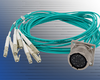
Cable Assembly: A cable that is connector-terminated and ready for installation.
Cable Plant: The cable plant consists of all the optical elements including fiber, connectors, splices, etc. between a transmitter and a receiver.
Cable Television: Communications system that distributes broadcast and nonbroadcast signals as well as a multiplicity of satellite signals, original programming and other signals by means of a coaxial cable and/or optical fiber.
Carrier-to-Noise Ratio (CNR): The ratio in decibels of the level of the carrier to that of the noise in a receiver’s IF bandwidth before any nonlinear process such as amplitude limiting and detection takes place.
CATV: Originally an abbreviation for community antenna television; the term now typically refers to cable television.
C-Band: The wavelength range between 1530 and 1562 nm used in some CWDM and DWDM applications.
CCIR: Consultative Committee on Radio. Replaced by ITU-R.
CCITT: Consultative Committee on Telephony and Telegraphy. Replaced by ITU-T.
CCTV: Closed-circuit television. An arrangement in which programs are directly transmitted to specific users and not broadcast to the general public.
CD: Compact disk. Often used to describe high-quality audio, CD-quality audio, or short-wavelength lasers; CD Laser.
CDMA: Code-division multiple access. A coding scheme in which multiple channels are independently coded for transmission over a single wideband channel using an individual modulation scheme for each channel.
Center Wavelength: In a laser, the nominal value central operating wavelength. It is the wavelength defined by a peak mode measurement where the effective optical power resides. In an LED, the average of the two wavelengths measured at the half amplitude points of the power spectrum.
Central Office (CO): A common carrier switching office in which users’ lines terminate. The nerve center of a communications system.
CGA: Color graphics adapter. A low-resolution color standard for computer monitors.
Channel: A communications path or the signal sent over that path. Through multiplexing several channels, voice channels can be transmitted over an optical channel.
Channel Capacity: Maximum number of channels that a cable system can carry simultaneously.
Channel Coding: Data encoding and error-correction techniques used to protect the integrity of data. Typically used in channels with high bit error rates such as terrestrial and satellite broadcast and videotape recording.
Chirp: In laser diodes, the shift of the laser’s center wavelength during single pulse durations.
Chromatic Dispersion: Reduced fiber bandwidth caused by different wavelengths of light traveling at different speeds down the optical fiber. Chromatic dispersion occurs because the speed at which an optical pulse travels depends on its wavelength, a property inherent to all optical fiber. May be caused by material dispersion, waveguide dispersion, and profile dispersion.
Circulator: Passive three-port devices that couple light from Port 1 to 2 and Port 2 to 3 and have high isolation in other directions.
Cladding: Material that surrounds the core of an optical fiber. Its lower index of refraction, compared with that of the core, causes the transmitted light to travel down the core.
Cladding Mode: A mode confined to the cladding; a light ray that propagates in the cladding.
Cleave: The process of separating an optical fiber by a controlled fracture of the glass, for the purpose of obtaining a fiber end, which is flat, smooth, and perpendicular to the fiber axis.
cm: centimeter. Approximately 0.4 inches.
CMOS: Complementary metal oxide semiconductor. A family of ICs. Particularly useful for low-speed or low-power applications.
CMTS: Cable modem termination system.
Coarse Wavelength-division Multiplexing (CWDM): CWDM allows eight or fewer channels to be stacked in the 1550-nm region of optical fiber, the C-Band.
Coating: The material surrounding the cladding of a fiber. Generally, a soft plastic material that protects the fiber from damage.
Coaxial Cable: (1) A cable consisting of a center conductor surrounded by an insulating material and a concentric outer conductor and optional protective covering. (2) A cable consisting of multiple tubes under a single protective sheath. This type of cable is typically used for CATV, wideband, video, or RF applications.
Coder: A device, also called an encoder, that converts data by the use of a code, frequently one consisting of binary numbers, in such a manner that reconversion to the original form is possible.
Coherent Communications: In fiber optics, a communication system where the output of a local laser oscillator is mixed optically with a received signal, and the difference frequency is detected and amplified.
Color Subcarrier: The 3.58-MHz signal that carries color information in a TV signal.
Composite Second Order (CSO): An important distortion measure of analog CATV systems. It is mainly caused by second-order distortion in the transmission system.
Composite Sync: A signal consisting of horizontal sync pulses, vertical sync pulses, and equalizing pulses only, with a no-signal reference level.
Composite Triple Beat (CTB): An important distortion measure of analog CATV systems. It is mainly caused by third-order distortion in the transmission system.
Composite Video: A signal that consists of the luminance (black and white), chrominance (color), blanking pulses, sync pulses, and color burst.
Compression: A process in which the dynamic range or data rate of a signal is reduced by controlling it as a function of the inverse relationship of its instantaneous value relative to a specified reference level. Compression is usually accomplished by separate devices called compressors and is used for many purposes such as improving signal-to-noise ratios, preventing overload of succeeding elements of a system, or matching the dynamic ranges of two devices. Compression can introduce distortion, but it is usually not objectionable.
Concatenation: The process of connecting pieces of fiber together.
Concentrator: (1) A functional unit that permits a common path to handle more data sources than there are channels currently available within the path. Usually provides communication capability between many low-speed, asynchronous channels and one or more high-speed, synchronous channels. (2) A device that connects a number of circuits, which are not all used at once, to a smaller group of circuits for economy.
Concentricity: The measurement of how well-centered the core is within the cladding.
Connector: A mechanical or optical device that provides a demountable connection between two fibers or a fiber and a source or detector.
Connector Plug: A device used to terminate an electrical or optical cable.
Connector Receptacle: The fixed or stationary half of a connection that is mounted on a panel/bulkhead. Receptacles mate with plugs.
Connector Variation: The maximum value in dB of the difference in insertion loss between mating optical connectors (with remating, temperature cycling, etc.). Also called optical connector variation.
Constructive Interference: Any interference that increases the amplitude of the resultant signal. For example, when the waveforms are in phase, they can create a resultant wave equal to the sum of multiple light waves.
Converter: Device that is attached between the television set and the cable system, which can increase the number of channels available on the TV set, enabling it to accommodate the multiplicity of channels offered by cable TV. Converter boxes are becoming obsolete as old model televisions requiring a converter are replaced by modern televisions, which incorporate a converter into the television directly. Also called a set-top box.
Core: The light-conducting central portion of an optical fiber, composed of material with a higher index of refraction than the cladding, which transmits light.
Counter-Rotating: An arrangement whereby two signal paths, one in each direction, exist in a ring topology.
Coupler: An optical device that combines or splits power from optical fibers.
Coupling Ratio/Loss (CR, CL): The ratio/loss of optical power from one output port to the total output power, expressed as a percent. For a 1 X 2 WDM or coupler with output powers O1 and O2, and Oi representing both output powers: CR(%) = (Oi/(O1 + O2)) X 100% and CR(%) = -10 log10 (Oi/(O1 + O2)).
Critical Angle: In geometric optics, at a refractive boundary, the smallest angle of incidence at which total internal reflection occurs.
Cross-connect: Connections between terminal blocks on the two sides of a distribution frame or between terminals on a terminal block (also called straps). Also called cross-connection or jumper.
Cross-gain Modulation (XGM): A technique used in wavelength converters where gain saturation effects in an active optical device, such as a semiconductor optical amplifier (SOA), allow the conversion of the optical wavelength. Better at shorter wavelengths (e.g., 780 or 850 nm).
Cross-phase Modulation (XPM): A fiber nonlinearity caused by the nonlinear index of refraction of glass. The index of refraction varies with optical power level, which causes different optical signals to interact.
Cross talk (XT): (1) Undesired coupling from one circuit, part of a circuit, or channel to another. (2) Any phenomenon by which a signal transmitted on one circuit or channel of a transmission system creates an undesired effect in another circuit or channel.
CSMA/CD: Carrier sense multiple access with collision detection. A network control protocol in which (1) a carrier sensing is used, and (2) when a transmitting data station that detects another signal while transmitting a frame stops transmitting that frame, waits for a jam signal, and then waits for a random time interval before trying to send that frame again.
CTS: Clear to send. In a communications network, a signal from a remote receiver to a transmitter that it is ready to receive a transmission.
Customer Premises Equipment (CPE): Terminal, associated equipment, and inside wiring located at a subscriber’s premises and connected with a carrier’s communication channel(s) at the demarcation point (demarc), a point established in a building or complex to separate customer equipment from telephone company equipment.
Cutback Method: A technique of measuring optical-fiber attenuation by measuring the optical power at two points at different distances from the test source.
Cutoff Wavelength: The wavelength below which the single-mode fiber ceases to be single-mode.
CW: Continuous wave. Usually refers to the constant optical output from an optical source when it is biased (turned on) but not modulated with a signal.
CWDM: Coarse wavelength division multiplexing.
D1: A format for component digital video tape recording working to the ITU-R 601, 4:2:2 standard using 8-bit sampling.
D2: The VTR standard for digital composite (coded) NTSC or PAL signals that uses data conforming to SMPTE 244M.
D3: A composite digital video recording format that uses data conforming to SMPTE 244M.
D5: An uncompressed tape format for component digital video, which has provisions for HDTV recording by use of 4:1 compression.
D/A or DAC: Digital-to-analog converter. A device used to convert digital signals to analog signals.
Dark Current: The induced current that exists in a reverse-biased photodiode in the absence of incident optical power. It is better understood as caused by the shunt resistance of the photodiode. A bias voltage across the diode (and the shunt resistance) causes current to flow in the absence of light.
Data-Dependent Jitter: Also called data-dependent distortion. Jitter related to the transmitted symbol sequence. DDJ is caused by the limited bandwidth characteristics, nonideal individual pulse responses, and imperfections in the optical channel components.
Data Rate: The number of bits of information in a transmission system, expressed in bits per second (bps), and which may or may not be equal to the signal or baud rate.
dBc: Abbreviation for decibel relative to a carrier level.
dBµ: Abbreviation for decibel relative to microwatt.
dBm: Abbreviation for decibel relative to milliwatt.
DBS: Digital broadcast system. An alternative to cable and analog satellite reception that uses a fixed 18-in. dish focused on one or more geostationary satellites. DBS units receive multiple channels of multiplexed video and audio signals as well as programming information, and related data. Also known as digital satellite system.
DC: Direct current. An electric current flowing in one direction only and substantially constant in value.
DCE: Data circuit-terminating equipment. (1) In a data station, the equipment that performs functions such as signal conversion and coding, at the network end of the line between the data terminal equipment (DTE) and the line, and may be a separate or an integral part of the DTE or of intermediate equipment. (2) The interfacing equipment that may be required to couple the data terminal equipment (DTE) into a transmission circuit or channel and from a transmission circuit of a channel into the DTE.
DCD: Duty cycle distortion jitter.
DCT: Discrete-cosine transform.
DDJ: Data-dependent jitter.
Decibel (dB): A unit of measurement indicating relative power on a logarithmic scale. Often expressed in reference to a fixed value, such as dBm or dBµ. dB = 10 log10 (P1/P2)
Decoder: A device used to convert data by reversing the effect of previous coding.
Demultiplexer: A module that separates two or more signals previously combined by compatible multiplexing equipment.
Dense Wavelength Division Multiplexing (DWDM): The transmission of many of closely spaced wavelengths in the 1550-nm region over a single optical fiber. Wavelength spacings are usually 100 GHz or 200 GHz, which corresponds to 0.8 or 1.6 nm. DWDM bands include the C-band, the S-band, and the L-band.
Destructive Interference: Any interference that decreases the desired signal. For example, two light waves that are equal in amplitude and frequency, and out of phase by 180º, will negate one another.
Detector: An optoelectric transducer used to convert optical power to electrical current. Usually referred to as a photodiode.
DFB: Distributed feedback laser.
Diameter-Mismatch Loss: The loss of power at a joint that occurs when the transmitting fiber has a diameter greater than the diameter of the receiving fiber. The loss occurs when coupling light from a source to fiber, from fiber to fiber, or from fiber to detector.
Dichroic Filter: An optical filter that transmits light according to wavelength. Dichroic filters reflect light that they do not transmit. Used in bulk optics WDMs.
Dielectric: Any substance in which an electric field may be maintained with zero or near-zero power dissipation. This term usually refers to nonmetallic materials.
Differential Gain (DG): A type of distortion in a video signal that causes the brightness information to be incorrectly interpreted.
Differential Phase (DP): A type of distortion in a video signal that causes the color information to be incorrectly interpreted.
Diffraction Grating: An array of fine, parallel, equally spaced reflecting or transmitting lines that mutually enhance the effects of diffraction to concentrate the diffracted light in a few directions determined by the spacing of the lines and by the wavelength of the light.
Digital: A signal that consists of discrete states. A binary signal has only two states, 0 and 1. Opposite of analog.
Digital Compression: A technique for converting digital video to a lower data rate by eliminating redundant information.
Diode: An electronic device that lets current flow in only one direction. Semiconductor diodes used in fiber optics contain a junction between regions of different doping. They include light emitters (LEDs and laser diodes) and detectors (photodiodes).
Diode Laser: Synonymous with injection laser diode.
DIP: Dual in-line package. An electronic package with a rectangular housing and a row of pins along each of two opposite sides.
Diplexer: A device that combines two or more types of signals into a single output. Usually incorporates a multiplexer at the transmit end and a demultiplexer at the receiver end.
Directional Coupler: A coupling device for separately sampling (through a known coupling loss) either the forward (incident) or the backward (reflected) wave in a transmission line.
Directivity: Near-end cross talk.
Discrete-Cosine Transform (DCT): A widely used method of data compression of digital video pictures that resolves blocks of the picture (usually 8 x 8 pixels) into frequencies, amplitudes, and colors. JPEG and DV depend on DCT.
Dispersion: The temporal spreading of a light signal in an optical waveguide caused by light signals traveling at different speeds through a fiber either due to modal or chromatic effects.
Dispersion-Compensating Fiber (DCF): A fiber that has the opposite dispersion of the fiber being used in a transmission system. It is used to nullify the dispersion caused by that fiber.
Dispersion-Compensating Module (DCM): This module has the opposite dispersion of the fiber being used in a transmission system. It is used to nullify the dispersion caused by that fiber. It can be either a spool of a special fiber or a grating-based module.
Dispersion-Shifted Fiber (DSF): A type of single-mode fiber designed to have zero dispersion near 1550 nm. This fiber type works very poorly for DWDM applications because of high fiber nonlinearity at the zero-dispersion wavelength.
Dispersion Management: A technique used in a fiber-optic system design to cope with the dispersion introduced by the optical fiber. A dispersion slope compensator is a dispersion management technique.
Dispersion Penalty: The result of dispersion in which pulses and edges smear, making it difficult for the receiver to distinguish between 1s and 0s. This results in a loss of receiver sensitivity compared with a short fiber, and is measured in decibels. The equations for calculating dispersion penalty are as follows: Where ? = Laser spectral width (nm), D? = Fiber dispersion (ps/nm/km), ? = System dispersion (ps/km), f = Bandwidth-distance product of the fiber (Hz • km), L = Fiber length (km), FF = Fiber bandwidth (Hz), C = A constant equal to 0.5, FR = Receiver data rate (bps), and dBL = Dispersion penalty (dB).
Distortion: Nonlinearities in a unit that cause harmonics and beat products to be generated.
Distortion-Limited Operation: Generally synonymous with bandwidth-limited operation.
Distributed Feedback Laser (DFB): An injection laser diode that has a Bragg reflection grating in the active region to suppress multiple longitudinal modes and enhance a single longitudinal mode.
Distribution System: Part of a cable system consisting of trunk and feeder cables used to carry signals from headend to customer terminals.
Dominant Mode: The mode in an optical device spectrum with the most power.
Dope: Thick liquid or paste used to prepare a surface or a varnish-like substance used for waterproofing or strengthening a material.
Dopant: An impurity added to an optical medium to change its optical properties. EDFAs use erbium as a dopant for optical fiber.
Double-Window Fiber: (1) Multimode fibers optimized for 850 and 1310 nm operation. (2) Single-mode fibers optimized for 1310 and 1550 nm operation.
DSL: Digital subscriber line. In an integrated systems digital network (ISDN), equipment that provides full-duplex service on a single twisted metallic pair at a rate sufficient to support ISDN basic access and additional framing, timing recovery, and operational functions.
DSR: Data signaling rate. The aggregate rate at which data pass a point in the transmission path of a data transmission system expressed in bits per second (bps or b/s).
DST: Dispersion supported transmission. In electrical TDM systems, a transmission system that would allow data rates at 40 Gbps by incorporating devices such as SOAs.
DSx: A transmission rate in the North American digital telephone hierarchy. Also called T-carrier.
DTE: Data terminal equipment. (1) An end instrument that converts user information into signals for transmission or reconverts the received signals into user information. (2) The functional unit of a data station that serves as a data source or sink and provides for the data communication control function to be performed in accordance with link protocol.
DTR: Data terminal ready. In a communications network, a signal from a remote transmitter that the transmitter is clear to receive data.
DTV: Digital television. Any technology, using any of several digital encoding schemes, used in connection with the transmission and reception of television signals. Depending on the transmission medium, DTV often uses some type of digital compression to reduce the required digital data rate. Except for artifacts of the compression, DTV is more immune (than analog television) to degradation in transmission, resulting in a higher quality of both audio and video, to the limits of signal reception.
Dual Attachment Concentrator: A concentrator that offers two attachments to the FDDI network, which are capable of accommodating a dual (counter-rotating) ring.
Dual Attachment Station: A station that offers two attachments to the FDDI network, which are capable of accommodating a dual (counter-rotating) ring.
Dual Ring (FDDI Dual Ring): A pair of counter-rotating logical rings.
Duplex Cable: A two-fiber cable suitable for duplex transmission.
Duplex Transmission: Transmission in both directions, either one direction at a time (half-duplex) or both directions simultaneously (full-duplex).
Duty Cycle: In a digital transmission, the fraction of time a signal is at the high level.
Duty Cycle Distortion Jitter: Distortion usually caused by propagation delay differences between low-to-high and high-to-low transitions. DCD is manifested as a pulse-width distortion of the nominal baud time.
DVB-ASI: Abbreviation for Digital video broadcast–asynchronous serial interface. An interface used to transport MPEG-2 files. The interface consolidates multiple MPEG-2 data streams onto a single circuit and transmits them at a data rate of 270 Mbps.
DWDM: Dense wavelength division multiplexing.
ECL: Emitter-coupled logic. A high-speed logic family capable of GHz rates.
EDFA: Erbium-doped fiber amplifier.
Edge-Emitting Diode: An LED that emits light from its edge, producing more directional output than surface-emitting LED’s that emit from their top surface.
Effective Area: The area of a single-mode fiber that carries the light.
EGA: Enhanced graphics adapter. A medium-resolution color standard for computer monitors.
EIA: Electronic Industries Association. An organization that sets video and audio standards.
EMI (Electromagnetic Interference): Any electrical or electromagnetic interference that causes undesirable response, degradation, or failure in electronic equipment. Optical fibers neither emit nor receive EMI.
EMP (Electromagnetic Pulse): A burst of electromagnetic radiation that creates electric and magnetic fields that may couple with electrical/electronic systems to produce damaging current and voltage surges.
EMR (Electromagnetic Radiation): Radiation made up of oscillating electric and magnetic fields and propagated with the speed of light. Includes gamma radiation, X-rays, ultraviolet, visible, and infrared radiation, and radar and radio waves.
Electromagnetic Spectrum: The range of frequencies of electromagnetic radiation from zero to infinity.
ELED: Edge-emitting diode.
Ellipticity: Describes the fact that the core or cladding may be elliptical rather than circular.
EM: Electromagnetic.
Endoscope: A fiber-optic bundle used for imaging and viewing inside the human body.
E/O: Abbreviation for electrical-to-optical converter. A device that converts electrical signals to optical signals, such as a laser diode.
Equilibrium Mode Distribution (EMD): The steady modal state of a multimode fiber in which the relative power distribution among modes is independent of fiber length.
Erbium-doped Fiber Amplifier (EDFA): Optical fibers doped with the rare-earth element, erbium, which can amplify light in the 1550-nm region when pumped by an external light source.
Error Correction: In digital transmission systems, a scheme that adds overhead to the data to permit a certain level of errors to be detected and corrected.
Error Detection: Checking for errors in data transmission. A calculation based on the data being sent; the results of the calculation are sent along with the data. The receiver then performs the same calculation and compares its results with those sent. If the receiver detects an error, it can be corrected, or it can simply be reported.
ESCON: Enterprise systems connection. A duplex optical connector used for computer-to-computer data exchange.
Ethernet: A standard protocol (IEEE 802.3) for a 10-Mbps baseband local area network (LAN) bus using carrier sense multiple access with collision detection (CSMA/CD) as the access method. Ethernet is a standard for using various transmission media, such as coaxial cables, unshielded twisted pairs, and optical fibers.
Evanescent Wave: Light guided in the inner part of an optical fiber’s cladding rather than in the core (the portion of the light wave in the core that penetrates into the cladding).
Excess Loss: In a fiber-optic coupler, the optical loss from the portion of light that does not emerge from the nominal operation ports of the device.
External Modulation: Modulation of a light source by an external device that acts like an electronic shutter.
Extinction Ratio: The ratio of the low, or OFF optical power level (PL) to the high, or ON optical power level (PH): extinction ratio (%) = (PL/PH) = 100
Extrinsic Loss: In a fiber interconnection, that portion of loss not intrinsic to the fiber but related to imperfect joining of a connector or splice.
Eye Pattern: A diagram that shows the proper function of a digital system. The “openness” of the eye relates to the BER that can be achieved.
F: Fahrenheit. Measure of temperature where pure water freezes at 32° and boils at 212°.
Fabry–Perot: FP.
Failure Rate: FIT rate.
Fall Time: Also called turn-off time. The time required for the trailing edge of a pulse to fall from 90% to 10% of its amplitude; the time required for a component to produce such a result. Typically measured between the 90% and 10% points or alternately the 80% and 20% points.
FAR: Federal acquisition regulation. The guidelines by which the U.S. government purchases goods and services. Also, the criteria that must be met by the vendor in order to be considered as a source for goods and services purchased by the U.S. government.
Faraday Effect: A phenomenon that causes some materials to rotate the polarization of light in the presence of a magnetic field parallel to the direction of propagation. Also called magnetooptic effect.
Far-End Cross Talk: Wavelength isolation.
FBG: Fiber Bragg gratings.
FCC: Federal Communications Commission. The U.S. government board, of five presidential appointees, that has the authority to regulate all non-Federal Government interstate telecommunications as well as all international communications that originate or terminate in the United States.
FC/PC: FC. A threaded optical connector that uses a special curved polish on the connector for very low back-reflection. Good for single- or multimode fiber.
FCS: Abbreviation for frame check sequence. An error-detection scheme that (1) uses parity bits generated by polynomial encoding of digital signals, (2) appends those parity bits to a digital signal, and (3) uses decoding algorithms that detect errors in the received digital signal.
FDA: Food and Drug Administration. Organization responsible for, among other things, laser safety.
FDDI: Fiber distributed data interface. (1) A dual counter-rotating ring LAN. (2) A connector used in a dual counter-rotating ring LAN.
FDM: Frequency-division multiplexing.
FEC: Forward error correcting.
Feeder: (1) Supplies the input of a system, subsystem, or equipment, such as a transmission line or antennae. (2) A coupling device between an antenna and its transmission line. (3) A transmission facility between either the point of origin of the signal or at the head-end of a distribution facility.
Ferrule: A rigid tube that confines or holds a fiber as part of a connector assembly.
FET: Field-effect transistor. A semiconductor so named because a weak electrical signal coming in through one electrode creates an electrical field through the rest of the transistor. This field flips from positive to negative when the incoming signal does, and controls a second current traveling through the rest of the transistor. The field modulates the second current to mimic the first one, but it can be substantially larger.
Fiber Fuse: A mechanism whereby the core of a single-mode fiber can be destroyed at high optical power levels.
Fiber Grating: An optical fiber in which the refractive index of the core varies periodically along its length, scattering light in a way similar to a diffraction grating, and transmitting or reflecting certain wavelengths selectively.
Fiber-in-the-Loop (FITL): Fiber-optic service to a node that is located in a neighborhood.
Fiber-Optic Attenuator: A component installed in a fiber-optic transmission system that reduces the power in the optical signal. It is often used to limit the optical power received by the photodetector to within the limits of the optical receiver. A fiber-optic attenuator may be an external device, separate from the receiver, or incorporated into the receiver design.
Fiber-Optic Cable: A cable containing one or more optical fibers.
Fiber-Optic Communication System: The transfer of modulated or unmodulated optical energy through optical fiber media, which terminates in the same or different media.
Fiber-Optic Link: A transmitter, receiver, and cable assembly that can transmit information between two points.
Fiber-Optic Span: An optical fiber/cable terminated at both ends, which may include devices that add, subtract, or attenuate optical signals.
Fiber-Optic Subsystem: A functional entity with defined bounds and interfaces which is part of a system. It contains solid-state and/or other components and is specified as a subsystem for the purpose of trade and commerce.
Fiber-to-the-Curb (FTTC): Fiber-optic service to a node connected by wires to several nearby homes, typically on a block.
Fiber-to-the-Home (FTTH): Fiber-optic service to a node located inside an individual home.
Fibre Channel: An industry-standard specification that originated in Great Britain, which details computer channel communications over fiber optics at transmission speeds from 132–1062.5 Mbps at distances of up to 10 km.
Filter: A device that transmits only part of the incident energy and may thereby change the spectral distribution of energy.
FIT Rate: Number of device failures in one billion device hours.
Fluoride Glasses: Materials that have the amorphous structure of glass but are made of fluoride compounds (zirconium fluoride) rather than oxide compounds (silica). Suitable for very long wavelength transmission. This material tends to be destroyed by water, limiting its use.
FM (Frequency Modulation): A method of transmission in which the carrier frequency varies in accordance with the signal.
Forward Error Correcting (FEC): A communication technique used to compensate for a noisy transmission channel. Extra information is sent along with the primary data payload to correct for errors that occur in transmission.
FOTP (Fiber-Optic Test Procedure): Standards developed and published by the Electronic Industries Association (EIA) under the EIA-RS-455 series of standards.
Four-Wave Mixing (FWM): A nonlinearity common in DWDM systems where multiple wavelengths mix together to form new wavelengths, called interfering products. Interfering products that fall on the original signal wavelength become mixed with the signal, mudding the signal, and causing attenuation. Interfering products on either side of the original wavelength can be filtered out. FWM is most prevalent near the zero-dispersion wavelength and at close wavelength spacings.
FP: Fabry–Perot. Generally refers to any device, such as a type of laser diode, that uses mirrors in an internal cavity to produce multiple reflections.
Free-Space Optics: Also called free-space photonics. The transmission of modulated visible or infrared (IR) beams through the atmosphere via lasers, LEDs, or IR-emitting diodes (IREDs) to obtain broadband communications.
Frequency-Division Multiplexing (FDM): A method of deriving two or more simultaneous, continuous channels from a transmission medium by assigning separate portions of the available frequency spectrum to each of the individual channels.
Frequency-Shift Keying (FSK): Frequency modulation in which the modulating signal shifts the output frequency between predetermined values. Also called frequency-shift modulation, frequency-shift signaling.
Frequency Stacking: The process that allows two identical frequency bands to be sent over a single cable by up converting one of the frequencies and “stacking” it with the other.
Fresnel Reflection Loss: Reflection losses at the ends of fibers caused by differences in the refractive index between glass and air. The maximum reflection caused by a perpendicular air–glass interface is about 4% or about –14 dB.
FSAN: Full service access network. A forum for the world’s largest telecommunications services providers and equipment suppliers to work to define broadband access networks based primarily on the ATM passive optical network structure.
Full-Duplex Transmission: Simultaneous bidirectional transfer of data.
Fused Coupler: A method of making a multi- or single-mode coupler by wrapping fibers together, heating them, and pulling them to form a central unified mass so that light on any input fiber is coupled to all output fibers.
Fused Fiber: A bundle of fibers fused together so that they maintain a fixed alignment with respect to each other in a rigid rod.
Fusion Splicer: An instrument that permanently bonds two fibers together by heating and fusing them.
FUT: Fiber under test. Refers to the fiber being measured by some type of test equipment.
FWHM: Full width half maximum. Used to describe the width of a spectral emission at the 50% amplitude points. Also known as FWHP (full width half power).
FWM: Four-wave mixing.
G: Abbreviation for giga. One billion or 109.
GaAlAs: Gallium aluminum arsenide. Generally used for short-wavelength-light emitters.
GaAs: Gallium arsenide. Used in light emitters.
GaInAsP: Gallium indium arsenide phosphide. Generally used for long wave length-light emitters.
Gap Loss: Loss resulting from the end separation of two axially aligned fibers.
Gate: (1) A device having one output channel and one or more input channels, such that the output channel state is completely determined by the input channel states, except during switching transients. (2) One of the many types of combinational logic elements having at least two inputs.
Gaussian Beam: A beam pattern used to approximate the distribution of energy in a fiber core. It can also be used to describe emission patterns from surface-emitting LEDs. Most people would recognize it as the bell curve. The Gaussian beam is defined by the equation: E(x) � E(0)e-x2/w02
GBaud: One billion bits of data per second or 109 bits. Equivalent to 1 for binary signals.
Ge: Germanium. Generally used in detectors. Good for most fiber-optic wavelengths (800–1600 nm). Performance is inferior to InGaAs.
Genlock: A process of sync generator locking. This is usually performed by introducing a composite video signal from a master source to the subject sync generator. The generator to be locked has circuits to isolate vertical drive, horizontal drive, and subcarrier. The process then involves locking the subject generator to the master subcarrier, horizontal, and vertical drives so that the result is that both sync generators are running at the same frequency and phase.
GHz: Gigahertz. One billion Hertz (cycles per second) or 109 Hertz.
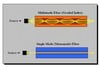
Graded-Index Fiber: Optical fiber in which the refractive index of the core is in the form of a parabolic curve, decreasing toward the cladding.
GRIN: Gradient index. Generally refers to the SELFOC lens often used in fiber optics.
Ground Loop Noise: Noise that results when equipment is grounded at points having different potentials, thereby creating an unintended current path. The dielectric properties of optical fiber provide electrical isolation that eliminates ground loops.
Group Index: Also called group refractive index. In fiber optics, for a given mode propagating in a medium of refractive index n, the group index N is the velocity of light in a vacuum c, divided by the group velocity of the mode.
Group Velocity: (1) The velocity of propagation of an envelope produced when an electromagnetic wave is modulated by, or mixed with, other waves of different frequencies. (2) For a particular mode, the reciprocal of the rate of change of the phase constant with respect to angular frequency. (3) The velocity of the modulated optical power.
Half-Duplex Transmission: A bidirectional link that is limited to one-way transfer of data (data cannot be sent both ways at the same time). Also referred to as simplex transmission.
Hard-Clad Silica Fiber: An optical fiber having a silica core and a hard polymeric plastic cladding intimately bounded to the core.
HBT: Heterojunction bipolar transistors. A very high-performance transistor structure built using more than one semiconductor material. Used in high-performance wireless telecommunications circuits such as those used in digital cell phone handsets and high-bandwidth fiber-optic systems.
HDSL: Abbreviation for high data-rate digital subscriber line. A DSL operating at a high data rate compared to the data rates specified for ISDN.
HDTV: Abbreviation for high-definition television. Television that has approximately twice the horizontal and twice the vertical emitted resolution specified by the NTSC standard.
Headend: (1) A central control device required within some LAN and MAN systems to provide centralized functions such as remodulation, retiming, message accountability, contention control, diagnostic control, and access to a gateway. (2) A central control device within CATV systems to provide centralized functions such as remodulation.
Hero Experiments: Experiments performed in a laboratory environment to test the limits of a given technology.
Hertz (Hz): One cycle per second.
HFC (Hybrid Fiber Coax): A transmission system or cable construction that incorporates both fiber-optic transmission components and copper coax transmission components.
HFC Network: A telecommunication technology in which optical fiber and coaxial cable are used in different sections of the network to carry broadband content. The network allows a CATV company to install fiber from the cable headend to serve nodes located close to business and homes, and then from these fiber nodes, allows use of the coaxial cable to individual businesses and homes.
HIPPI: High-performance parallel interface as defined by the ANSI X3T9.3 document, a standard technology for physically connecting devices at short distances and high speeds. Primarily to connect supercomputers and to provide high-speed backbones for LANs.
Hot Swap: In an electronic device subassembly or component, the act or process of removing and replacing the subassembly or component without first powering down the device.
HP: Homes passed. Homes that could easily and inexpensively be connected to a cable network because the feeder cable is nearby.
Hydrogen Losses: Increases in fiber connector attenuation that occur when hydrogen diffuses into the glass matrix and absorbs some light.
IC: Integrated circuit.
ICEA: Insulated Cable Engineers Association. A technical professional organization that contributes to the standards of insulated cable in these four areas: power cables, communication cables, portable cables, and control and instrumentation. Within this organization, there are subcommittees that concentrate on one of the four areas.
IDP: Integrated detector/preamplifier.
IEEE: Institute of Electrical and Electronic Engineers. A technical professional association that contributes to voluntary standards in technical areas ranging from computer engineering, biomedical technology, and telecommunications, to electric power, aerospace, and consumer electronics, among others.
IIN: Interferometric intensity noise.
Impedance: The total passive opposition offered to the flow of electric current. Determined by the particular combination of resistance, inductive reactance, and capacitive reactance in a given circuit. A function of frequency, except when in a purely resistive network.
Impedance Matching: The connection of an additional impedance to an existing one to achieve a specific effect, such as to balance a circuit or to reduce reflection in a transmission line.
Index-Matching Fluid: A fluid whose index of refraction nearly equals that of the fibers core. Used to reduce Fresnel reflection loss at fiber ends. Also known as index-matching gel.
Index of Refraction: The ratio of the velocity of light in free space to the velocity of light in a fiber material. Always > 1. Also called refractive index n = c/V where c is the speed of light in a vacuum and v the speed of the same wavelength in the fiber material.
Infrared (IR): The region of the electromagnetic spectrum bounded by the long-wavelength extreme of the visible spectrum (about 0.7 µm) and the shortest microwaves (about 0.1 µm).
Infrared Emitting Diodes: LEDs that emit infrared energy (830 nm or longer).
Infrared Fiber: Colloquially, optical fibers with best transmission at wavelengths of 2 mm or longer, made of materials other than silica glass.
InGaAs: Indium gallium arsenide. Generally used to make high-performance long-wavelength detectors.
InGaAsP: Indium gallium arsenide phosphide. Generally used for long-wavelength-light emitters.
Injection Laser Diode (ILD): A laser employing a forward-biased semiconductor junction as the active medium. Stimulated emission of coherent light occurs at a PIN junction where electrons and holes are driven into the junction.
In-Line Amplifier: An EDFA or other type of amplifier placed in a transmission line to strengthen the attenuated signal for transmission onto the next, distant site. In-line amplifiers are all-optical devices.
InP: Indium phosphide. A semiconductor material used to make optical amplifiers and HBTs.
Insertion Loss: The loss of power that results from inserting a component, such as a connector, coupler, or splice, into a previously continuous path.
Integrated Circuit (IC): An electronic circuit that consists of many individual circuit elements, such as transistors, diodes, resistors, capacitors, inductors, and other passive and active semiconductor devices, formed on a single chip of semiconducting material and mounted on a single piece of substrate material.
Integrated Detector/Preamplifier (IDP): A detector package containing a PIN photodiode and transimpedance amplifier.
Integrated Systems Digital Network (ISDN): An integrated digital network in which the same time-division switches and digital transmission paths are used to establish connections for services such as telephone, data, electronic mail, and facsimile. How a connection is accomplished is often specified as a switched connection, non-switched connection, exchange connection, ISDN connection, and so on.
Intensity: The square of the electric field strength of an electromagnetic wave. Intensity is proportional to irradiance and may get used in place of the term “irradiance” when only relative values are important.
Intensity Modulation (IM): In optical communications, a form of modulation in which the optical power output of a source varies in accordance with some characteristic of the modulating signal.
Interchannel Isolation: The ability to prevent undesired optical energy from appearing in one signal path as a result of coupling from another signal path. Also called cross talk.
Interference: Any extraneous energy, from natural or manmade sources, that impedes the reception of desired signals. The interference may be constructive or destructive, resulting in increased or decreased amplitude, respectively.
Interferometer: An instrument that uses the principle of interference of electromagnetic waves for purposes of measurement. Used to measure a variety of physical variables, such as displacement (distance), temperature, pressure, and strain.
Interferometric Intensity Noise (IIN): Noise generated in optical fiber caused by the distributed backreflection that all fiber generates mainly due to Rayleigh scattering. OTDRs make use of this scattering power to deduce the fiber loss over distance.
Interferometric Sensors: Fiber optic sensors that rely on interferometric detection.
Inter-LATA: (1) Between local access and transport areas (LATAs). (2) Services, revenues, and functions related to telecommunications that begin in one LATA and terminate in another or that terminate outside the LATA.
Intermodulation (Mixing): A fiber nonlinearity mechanism caused by the power-dependant refractive index of glass. Causes signals to beat together and generate interfering components at different frequencies. Very similar to four-wave mixing.
International Telecommunications Union (ITU): A civil international organization, headquartered in Geneva, Switzerland, established to promote standardized telecommunications on a worldwide basis. The ITU-R and the ITU-T are committees under the ITU, which is recognized by the United Nations as the specialized agency for telecommunications.
Internet: A worldwide collection of millions of computers that consists mainly of the World Wide Web and e-mail.
Intersymbol Interference: (1) In a digital transmission system, distortion of the received signal, manifested in the temporal spreading and consequent overlap of individual pulses to the degree that the receiver cannot reliably distinguish between changes of state (between individual signal elements). At a certain threshold, intersymbol interference will compromise the integrity of the received data. Intersymbol interference may be measured by eye patterns.
Intrinsic Losses: Splice losses arising from differences in the fibers being spliced.
IP: Internet protocol. A standard protocol developed by the DOD for use in interconnected systems of packet-switched computer communications networks.
IPI: Intelligent peripheral interface as defined by ANSI X3T9.3 document.
IR: Infrared.
IRE Unit: An arbitrary unit created by the Institute of Radio Engineers to describe the amplitude characteristic of a video signal, where pure white is defined as 100 IRE with a corresponding voltage of 0.714 V and the blanking level is 0 IRE with a corresponding voltage of 0.286 V.
Irradiance: Power per unit area.
ISA: Instrumentation, Systems, and Automation Society. An international, nonprofit, technical organization. The society fosters advancement of the use of sensors, instruments, computers, and systems for measurement and control in a variety of applications.
ISDN: Integrated services digital network.
ISO: International Standards Organization. Established in 1947, ISO is a worldwide federation of national standards committees from 140 countries. The organization promotes the development of standardization throughout the world with a focus on facilitating the international exchange of goods and services, and developing the cooperation of intellectual, scientific, technological, and economical activities.
ISP: Abbreviation for Internet service provider. A company or organization that provides Internet connections to individuals or companies via dial-up, ISDN, T1, or some other connection.
ITU: International Telecommunications Union.
Jacket: The outer, protective covering of the cable. Also called the cable sheath.
Jitter: Small and rapid variations in the timing of a waveform due to noise, changes
in component characteristics, supply voltages, imperfect synchronizing circuits, and so on.
JPEG: Joint photographers expert group. International standard for compressing still photography.
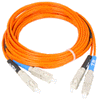
Jumper: A short fiber-optic cable with connectors on both ends.
k: Kilo. One thousand or 103.
K: Kelvin. Measure of temperature where pure water freezes at 273º and boils at 373º.
kBaud: One thousand symbols of data per second. Equivalent to 1 kbps for binary signaling.
Kevlar®: A very strong, very light, synthetic compound developed by DuPont, which is used to strengthen optical cables.
Keying: Generating signals by the interruption or modulation of a steady signal or carrier.
kg: Kilogram. Approximately 2.2 pounds.
kHz: One thousand cycles per second.
km: Kilometer. 1 km = 3280 ft or 0.62 mi.
Lambertian Emitter: An emitter that radiates according to Lambert’s cosine law, which states that the radiance of certain idealized surfaces depends on the viewing angle of the surface. The radiant intensity of such a surface is maximum normal to the surface and decreases in proportion to the cosine of the angle from the normal. Given by: N = N0 cos A, where N is the radiant intensity, N0 is the radiance normal to an emitting surface, and A is the angle between the viewing direction and the normal to the surface.
LAN (Local Area Network): A communication link between two or more points within a small geographic area, such as between buildings. Smaller than a metropolitan area network (MAN) or a wide area network (WAN).
Large Core Fiber: Usually, a fiber with a core of 200 µm or more.
Large Effective Area Fiber (LEAF): An optical fiber, developed by Corning, designed to have a large area in the core, which carries the light.
Laser: Light amplification by stimulated emission of radiation. A light source that produces, through stimulated emission, coherent, near monochromatic light.
Laser Diode (LD): A semiconductor that emits coherent light when forward-biased.
LED: Light-emitting diode.
Light: In a strict sense, the region of the electromagnetic spectrum that can be perceived by human vision, designated the visible spectrum, and nominally covering the wavelength range 0.4–0.7 µm. In the laser and optical communication fields, custom and practice have extended usage of the term to include the much broader portion of the electromagnetic spectrum that can be handled by the basic optical techniques used for the visible spectrum. This region has not been clearly defined, but, as employed by most workers in the field, may be considered to extend from the near-ultraviolet region of approximately 0.3 µm, through the visible region, and into the mid-infrared region to 30 µm.
Light-Emitting Diode (LED): A semiconductor that emits incoherent light when forward-biased. Two types of LEDs include edge- and surface-emitting LEDs.
Light Piping: Use of optical fibers to illuminate.
Lightguide: Synonym for optical fiber.
Light wave: The path of a point on a wavefront. The direction of the light wave is generally normal (perpendicular) to the wavefront.
m: Meter. 39.37 in.
M: Mega. One million or 106.
mA: Milliampere. One thousandth of an ampere or 10-3 A.
MAC: Multiplexed analog components. A video standard developed by the European community. An enhanced version, HD-MAC delivers 1250 lines at 50 frames/s, HDTV quality.
Macrobending: In a fiber, all macroscopic deviations of the fiber’s axis from a straight line, which will cause light to leak out of the fiber, causing signal attenuation.
MAN (Metropolitan Area Network): A network covering an area larger than a LAN. A series of LANs, usually two or more, which cover a metropolitan area.
n: Nano. One billionth or 10-9.
N: Newtons. Measure of force generally used to specify fiber-optic cable tensile strength.
nA: Nanoampere. One billionth of an ampere or 10-9 A.
NA: Numerical aperture.
NAB: National Association of Broadcasters. A trade association that promotes and protects the interests of radio and television broadcasters before Congress, federal agencies, and the Courts.
OADM: Optical add/drop multiplexer.
OAM: Operation, administration, and maintenance. Refers to telecommunications networks.
OAN: Optical access network. A network technology, based on passive optical networks (PONs), that includes an optical switch at the central office, an intelligent optical terminal at the customer’s premises, and a passive optical network between the two, allowing services providers to deliver fiber-to-the-home while eliminating the expensive electronics located outside the central office.
OCH: Optical channel.
OC: Optical carrier. A carrier rate specified in the SONET standard.
Optical Add/Drop Multiplexer (OADM): A device that adds or drops individual wavelengths from a DWDM system.
Optical Amplifier: A device that amplifies an input optical signal without converting it into electrical form. The best developed are optical fibers doped with the rare-earth element erbium.
Optical Bandpass: The range of optical wavelengths that can be transmitted through a component.
Optical Channel: An optical wavelength band for WDM optical communications.
Optical Channel Spacing: The wavelength separation between adjacent WDM channels.
Optical Channel Width: The optical wavelength range of a channel.
Optical Continuous Wave Reflectometer (OCWR): An instrument used to characterize a fiber optic link wherein an unmodulated signal is transmitted through the link, and the resulting light scattered and reflected back to the input is measured. Useful in estimating component reflectance and link optical return loss.
Optical Directional Coupler (ODC): A component used to combine and separate optical power.
Optical Fall Time: The time interval for the falling edge of an optical pulse to transition from 90% to 10% of the pulse amplitude. Alternatively, values of 80% and 20% may be used.
Optical Fiber: A glass or plastic fiber that has the ability to guide light along its axis. The three parts of an optical fiber are the core, cladding, and coating or buffer.
Optical Isolator: A component used to block out reflected and unwanted light. Also called an isolator.
Optical Link Loss Budget: The range of optical loss over which a fiber-optic link will operate and meet all specifications. The loss is relative to the transmitter output power and affects the required receiver input power.
Optical Path Power Penalty: The additional loss budget required to account for degradations due to reflections, and the combined effects of dispersion resulting from intersymbol interference, mode-partition noise, and laser chirp.
Optical Power Meter: An instrument that measures the amount of optical power present at the end of a fiber or cable.
Optical Pump Laser: A shorter-wavelength laser used to pump a length of fiber with energy to provide amplification at one or more longer wavelengths.
Optical Return Loss (ORL): The ratio (expressed in dB) of optical power reflected by a component or an assembly to the optical power incident on a component port when that component or assembly is introduced into a link or system.
Optical Rise Time: The time interval for the rising edge of an optical pulse to transition from 10% to 90% of the pulse amplitude. Alternatively, values of 20% and 80% may be used.
Optical Signal-to-Noise-Ratio (OSNR): The optical equivalent of SNR.
Optical Spectrum Analyzer (OSA): A device that allows the details of a region of an optical spectrum to be resolved. Commonly used to diagnose DWDM systems.
OTDR (Optical Time Domain Reflectometer): An instrument that locates faults in optical fibers or infers attenuation by backscattered light measurements.
Optical Waveguide: Another name for optical fiber.
OSA: Optical spectrum analyzer.
OSNR: Optical signal-to-noise ratio.
p: Pico. One trillionth or 10–12.
pA: Picoampere. One trillionth of an ampere or 10–12 A.
PABX: Private automatic branch exchange.
Packet: In data communications, a sequence of binary digits, including data and control signals, that is transmitted and switched as a composite whole. The packet contains data, control signals, and possibly error-control information, arranged in a specific format.
Packet Switching: The process of routing and transferring data by means of addressed packets so that a channel is occupied during the transmission of the packet only, and upon completion of the transmission the channel is made available for the transfer of other traffic.
Photoconductive: Losing an electrical charge on exposure to light.
Photodetector: An optoelectronic transducer such as a PIN photodiode or avalanche photodiode. In the case of the PIN diode, it is so named because it is constructed from materials layered by their positive, intrinsic, and negative electron regions.
Photodiode (PD): A semiconductor device that converts light to electrical current.
Photon: A quantum of electromagnetic energy. A particle of light.
Photonic: A term coined for devices that work using photons, analogous to the electronic for devices working with electrons.
Photovoltaic: Providing an electric current under the influence of light or similar radiation.
QAM: Quadrature amplitude modulation.
QDST: Quaternary dispersion-supported transmission.
QoS: Quality of service.
QPSK: Quadrature phase-shift keying.
Quadrature Amplitude Modulation (QAM): A coding technique that uses many discrete digital levels to transmit data with minimum bandwidth. QAM256 uses 256 discrete levels to transmit digitized video.
Radiation-Hardened Fiber: An optical fiber made with core and cladding materials that are designed to recover their intrinsic value of attenuation coefficient, within an acceptable time period, after exposure to a radiation pulse.
Radiometry: The science of radiation measurement.
Random Jitter (RJ): Random jitter is due to thermal noise and may be modeled as a Gaussian process. The peak-to-peak value of RJ is of a probabilistic nature, and
thus any specific value requires an associated probability.
Rays: Lines that represent the path taken by light.
Receiver Overload: The maximum acceptable value of average received power for an acceptable BER or performance.
s: Second.
SAP (Secondary Audio Programming): Secondary audio signal that is broadcast along with a television signal and its primary audio. SAP may be enabled through either the television, stereo VCR equipped to receive SAP signals, or an SAP receiver. SAPs may be used for a variety of enhanced programming, including providing a “video description” of a program’s key visual elements, inserted in natural pauses, that describes actions not otherwise reflected in the dialog, used by visually impaired viewers. This service also allows television stations to broadcast programs in a language other than English, and may be used to receiver weather information, or other forms of “real-time” information.
SAN (Storage Area Network): Connects a group of computers to high-capacity storage devices. May be incorporated into LANs, MANs, and WANs.
S-Band: The wavelength region between 1485 and 1520 nm used in some CWDM and DWDM applications.
SC: Subscription channel connector. A push–pull type of optical connector that features high packing density, low loss, low back-reflection, and low cost.
T: Tera. One trillion or 1012.
Tap Loss: In a fiber-optic coupler, the ratio of power at the tap port to the power at the input port.
T-Carrier: Generic designator for any of several digitally multiplexed telecommunications carrier systems.
TDM: Time-division multiplexing.
TEC: Thermoelectric cooler. A device used to dissipate heat in electronic assemblies.
UHF: Abbreviation for ultra-high frequency. The frequencies, ranging from 300–3000 MHz, in the electromagnetic spectrum. Contains off-air television channels 21–68.
Unidirectional: Operating in one direction only.
Unity Gain: A concept in which all the amplifiers in a cascade are in balance with their power inputs and outputs. Unity gain can be achieved by adjusting the receiver output, either by padding or attenuation in the node, to the proper level determined by the RF input.
UV: Ultraviolet. The portion of the electromagnetic spectrum in which the longest wavelength is just below the visible spectrum, extending from approximately 4 – 400 nm.
V: Volt. A unit of electrical force or potential, equal to the force that will cause a current of 1 A to flow through a conductor with a resistance of 1Ω.
VCSEL: Vertical cavity surface-emitting laser.
VDSL: Very high data rate digital subscriber line. A DSL operating at a data rate higher than that of HDSL.
Vertical Cavity Surface-Emitting Laser: Lasers that emit light perpendicular to the plane of the wafer they are grown on. They have very small dimensions compared with conventional lasers and are very efficient.
VGA: Video graphics array. A high-resolution color standard for computer monitors.
W: Watt. A linear measurement of optical power, usually expressed in milliwatts, microwatts, and nanowatts.
Waveguide: A material medium that confines and guides a propagating electromagnetic wave. In the microwave regime, a waveguide normally consists of a hollow metallic conductor, generally rectangular, elliptical, or circular in cross section. This type of waveguide may, under certain conditions, contain a solid or gaseous dielectric material. In the optical regime, a waveguide used as a long transmission line consists of a solid dielectric filament (fiber), usually circular in cross section. In integrated optical circuits an optical waveguide may consist of a thin dielectric film. In the RF regime, ionized layers of the stratosphere and the refractive surfaces of the troposphere may also serve as a waveguide.
Waveguide Coupler: A coupler in which light gets transferred between planar waveguides.
Waveguide Dispersion: The part of chromatic dispersion arising from the different speeds at which light travels in the core and cladding of a single-mode fiber (from the fiber’s waveguide structure).
Wavelength: The distance between points of corresponding phase of two consecutive cycles of a wave. The wavelength relates to the propagation velocity, and the frequency, by wavelength = propagation velocity/frequency.
X-Band: The frequency range between 8.0 and 8.4 GHz.
XC: Cross-connect.
XGM: Cross-gain modulation.
XPM: Cross-phase modulation.
X-Series Recommendations: Sets of data telecommunications protocols and interfaces defined by the ITU.
Y Coupler: A variation on the tee coupler in which input light is split between two channels (typically planar waveguide) that branch out like a Y from the input.
Zero-dispersion Slope: In single-mode fiber, the rate of change of dispersion with respect to wavelength, at the fiber’s zero-dispersion wavelength.
Zero-dispersion Wavelength (l0): In a single-mode optical fiber, the wavelength at which material and waveguide dispersion cancel one another. The wavelength of maximum bandwidth in the fiber. Also called zero-dispersion point.
Zipcord: A two-fiber cable consisting of two single fiber cables having conjoined jackets. A zipcord cable can be easily divided by slitting and pulling the conjoined jackets apart.

 TABLE OF CONTENTS