Communications technology has seen many advances. Telephony is still here (albeit
now mostly digital), but it is apparent that with the advent of the Internet, a large portion
of traffic now consists of data rather than voice. Still, the concepts of the “old”
telephony world are still in use. In essence, classical telephony is a circuit-switched
concept: communication between two parties is realized by establishing a connection,
which is reserved for only their use throughout the duration of their conversation.
Prior to communication, signaling takes place through the exchange of
messages to set up the connection through the various switches on the path between
the two parties. This same idea of connection-oriented communications prevails
today, and a circuit-switched approach is also taken in so-called backbone networks
to provide high-bandwidth interconnections between, for example, telephone private
branch exchanges (PBXs). However, in the Internet world, a packet-switched concept
dominates. Instead of reserving a certain amount of bandwidth (a circuit) for a
certain period of time, data are sent in packets. These packets have a header containing
the information necessary for the switching nodes to be able to route them
correctly, quite similar to postal services [1].
To provide the bandwidth necessary to fulfill the ever-increasing demand (Internet
growth), the copper networks have been upgraded and nowadays to a great extent
replaced with optical fiber networks. Since the advent of optical amplifiers (erbiumdoped
fiber amplifiers, EDFAs) allowed the deployment of dense wavelength division
multiplexing (DWDM), the bandwidth available on a single fiber has grown
significantly. Whereas at first these high-capacity links were mainly deployed as
point-to-point interconnections, real optical networking using optical switches is
possible today. The resulting optical communication network is still exploited in a
circuit-switched manner: so-called lightpaths (making up an entire wavelength) are
provisioned [1]. Optical cross-connects (OXCs) switch wavelengths from their input
to output ports. To the client layer of the optical network, the connections realized by
the network of OXCs are seen as a virtual topology, possibly different from the physical
topology (containing WDM link,), as indicated in Figure 11.1 [1]. These links in
the logical plane thus have wavelength capacity. To set up the connections, as in the
old telephony world, a so-called control plane is necessary to allow for signaling.
Enabling automatic setup of connections through such a control plane is the focus of the work in the automatically switched optical network (ASON) framework. Since
the lightpaths that have to be set up in such an ASON will have a relatively long lifetime
(typically in the range of hours to days), the switching time requirements on
OXCs are not very demanding.
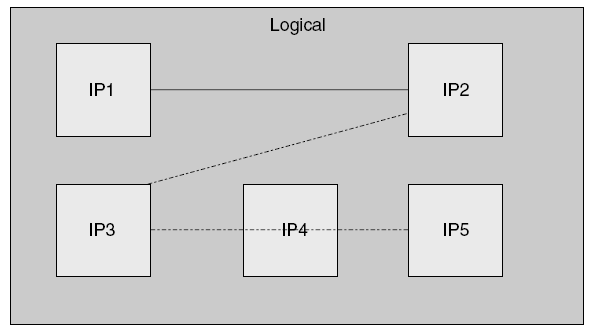
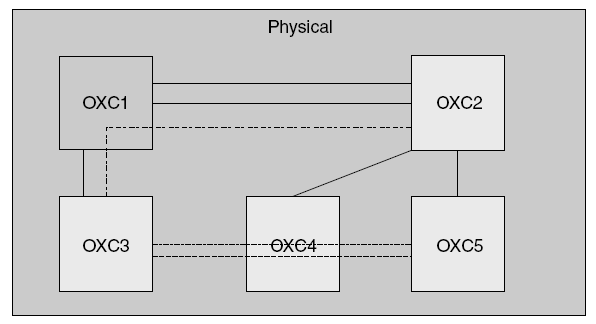
Figure 11.1 WDM, logical links consist of wavelength(s) on these fibers interconnected via OXCs, such as logical circuit switching with OXCs. Physical links (black lines) carry multiple wavelengths in (D)link IP2–IP3 using OXC1 (dotted).
It is clear that the main disadvantage of such circuit-switched networks is that they
are not able to adequately cope with highly variable traffic. Since the capacity offered
by a single wavelength ranges up to a few tens of gigabits per second, poor utilization
of the available bandwidth is likely. A packet-switched concept, where bandwidth
is only effectively consumed when data are being sent, clearly allows more
efficient handling of traffic that greatly varies in both volume and communication
endpoints, such as in currently dominant Internet traffic [1].

Figure 11.2 Optical packet switching: a network with packets rather than the circuits shown in Figure 11.1.
Therefore, during the past decade, various research groups have focused on optical
packet switching (OPS), aimed at more efficiently using the huge bandwidths
offered by WDM networks. The idea is to use optical fiber to transport optical packets
rather than continuous streams of light as sketched in Figure 11.2 [1]. Optical packets consist of a header and a payload. In an OPS node, the transported data
(payload) are kept in the optical domain, but the header information is extracted and
processed using mature control electronics, as optical processing is still in its
infancy. To limit the amount of header processing, client-layer traffic (IP traffic) will
be aggregated into fairly large packets. To unlock the possibilities of OPS, several
issues arise and are being solved today. A major issue is the lack of optical random
access memory (RAM), which would be very welcome to assist in a contention resolution
that arises when two or more packets simultaneously want to use the same
outgoing switch port. Still, workarounds for the contention resolution problems have
been found in optics [1]. Since the timescales at which a switch fabric needs to be
reconfigured in OPS are much smaller than in, say, the ASON case, other switching
technologies have been devised to unlock the possibilities of OPS. These packetswitched
networks can be operated in two different modes: synchronous, in which
packets can start at only certain discrete moments in time, and in each timeslot packets
on different channels are aligned; and asynchronous, in which packets can arrive
at any moment in time, without any alignment.
The major architectures for OPS switches will be discussed shortly. To be competitive
with other solutions (electronic or ASON-like), the OPS node cost needs to
be limited, and the architectures should be future-proof (scalable). In this context, the
driving factors that lead to multistage architectures were reducing switch complexity
(thus cost) and circumventing technological constraints [1].
© 2026 John Wiley & Sons, Inc.

 TABLE OF CONTENTS