Preface
Although the widespread use of personal computers is often
cited as one of the factors contributing to the crisis of human
relations manifested by estrangement and lack of interpersonal
communication, the Internet has brought people together in
unprecedented and unforeseen ways. This truly global and
ubiquitous network has enabled communication in various forms
between individuals, regardless of distance or other potentially
limiting factors. The Internet is currently considered an
indispensable source of information and knowledge, and a reference for every
topic imaginable. From a business perspective, the Internet is a powerful advertising
tool that offers new ways in which a company can interact with its customers.
Additionally, the use of the Internet for connections between remote company
locations can replace expensive and inflexible private leased lines and facilitate
communication with employees working outside the office. Other areas of application
include government, medicine, entertainment, and almost every aspect of
our lives. Indeed, one can devote an entire book to the ways in which the Internet
has affected the way things are done and its impact on our societies.
Naturally, specialists and researchers are constantly seeking ways in which the
capabilities offered by the Internet can be extended and existing services improved.
Increases in capacity (or decreases in the latency experienced) enable new demanding
applications such as on-demand transfers of large volumes of data in real or nonreal
time (e.g., live video conferencing or movie downloading, respectively). Another
trend is that users remain connected anywhere and at any time without necessarily
being in front of a computer. As a result, research has focused on two objectives:
(1) to increase the speed at which online services and applications can be accessed;
and (2) to enable seamless connectivity, even when users are mobile. The first
objective translates to an increase in capacity of the optical-fiber-based networks
that form the Internet infrastructure, and the second is related to improved (in terms
of undisrupted functionality, data and error rates, and other factors) wireless networks.
As a result of its amazing physical properties, optical fiber is considered to
be an almost perfect transmission medium (or a medium as perfect as we can
manufacture it), and has been firmly established as the medium of choice for broad-
band, wired networking for almost all network sizes (wide area, metropolitan,
and premium local area networks). One approach for increasing the capacity of a
network that utilizes optical fiber as a transmission medium is to improve
the medium itself or the equipment used for transmission or reception of
signals; research in these directions is ongoing and considerable progress is
continuously made.
The most important breakthrough in this direction has been the wavelength division
multiplexing (WDM) technique, which allows many signals to travel concurrently
on a single fiber using different wavelengths. This shifted the focus from
increasing the data rate at which signals travel inside an optical fiber to increasing
the number of channels available simultaneously at potentially lower data rates.
Constant advances in this area have unlocked a significant portion of the bandwidth
that optical fibers offer; this has, however, not yet been fully exploited. This means
that only a fraction of the usable capacity is actually used to carry data. One of the
reasons for this mismatch between the potential capacity and the one achieved in
practice is that optical fiber is merely used as a transmission medium and not as a
networking medium; that is, the resulting networks are not actually optical.
Optical networks implement at least a part of their functionality (e.g., routing,
forwarding, switching) in the optical domain.
Currently, optical signals that arrive at a switching node are converted to
electrical form before switching. In the case of a multiwavelength signal, separate
electronic equipment will have to be used in order to handle each wavelength.
Following the switching of signals, transit traffic (along with locally generated
traffic) will have to be converted back to the optical form for further transmission.
This approach has several disadvantages, because the switching speed of electronics
cannot keep up with the potential capacity of optics. Furthermore, electronic switching
equipment is configured to work for specified data rates and formats, and
any changes in these parameters result in addition, reconfiguration, or replacement
of expensive equipment; this degrades network scalability. These observations
suggest that an approach where optoelectronic conversions are avoided and
signals remain in the optical domain during switching might be preferable.
Optical switching promises the transparent switching of data entirely in the
optical domain without optoelectronic conversion (for switching purposes, that
is). Although the recent overly optimistic projections regarding vast increases in
traffic volume and imminent migration to optical switching have proven to be
unrealistic (and contributed to overall market turmoil), the general consensus is
that significant benefits in terms of capacity and cost will arise from optical switching
that will almost definitely be implemented in the future. Differences of opinion
revolve around the time horizon of the implementation, as optical switching will
have to be both technologically mature and cost-effective compared to electronic
switching. Although many feel that network improvements should for the present
be based on existing equipment and avoid extensive investment (in light of the
recent economic slowdown), the general consensus is that the migration to optical
switching is unavoidable in the near (or not so near) future. This justifies both the
volume of research in this area and the interest of industries in optical switching
products.
Switching signals in optical form essentially involves the ability to redirect light
at will. Therefore, an integral part of an optical switching node is a device that can
redirect optical signals according to instructions that it receives from the switch
control unit. These devices are referred to as optical switch fabrics. Several,
rather exotic technologies have been presented, with some being commercially
available and others still under research. Issues surrounding optical switch fabrics
are presented in Chapter 2 and include the parameters taken into account when comparing
or evaluating optical switching technologies, the potential applications of
optical switches in networks, the most popular optical switching technologies, and
the manufacturing of switches with large port counts.
Although the use of an optical switch fabric is necessary for signals to be transparently
switched, it does not suffice as the overall node and network operation
needs to be adapted to the fact that switching is performed in the optical domain.
This means that the network will have to adopt one of the proposed optical switching
paradigms. Chapters 3, 4, and 5 present the three optical switching paradigms that
have attracted the most attention.
Chapter 3 discusses optical packet switching (OPS), the equivalent of electronic
packet switching, which is the preferred switching method in the electronic domain.
Despite the fact that optical packet switching retains the advantages of its electronic
counterpart in flexibility and efficient management of resources, it faces significant
technological challenges. As a result, the application of OPS is not likely in the
immediate future and rather it is viewed as an ultimate goal. Nevertheless, OPS networks
have been (and continue to be) studied extensively. The issues discussed
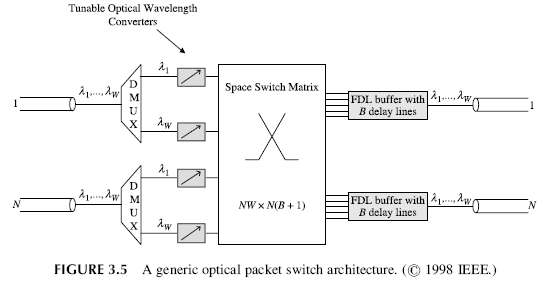
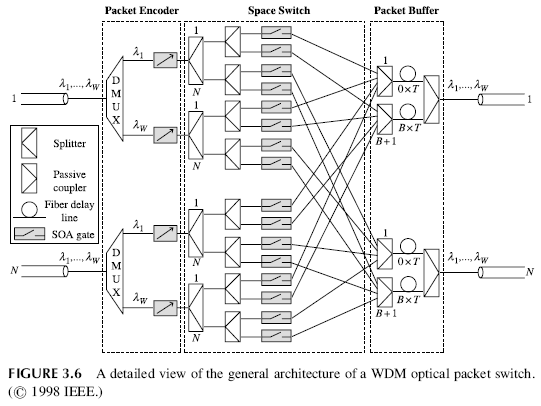
include the design alternatives and the enabling technologies for OPS nodes, as
well as the approaches for contention resolution. Several switch architectures are
presented, including a generic architecture, architectures with various configurations
of wavelength converters, and switches proposed in the context of research projects
or testbeds. Additionally, Chapter 2 contains an overview of OPS in the metropolitan
area, including the description of three metro packet switched testbeds.
Chapter 4 presents an optical switching paradigm that seems to be more readily
applicable as it can be based on existing optical technologies and previously applied
techniques. Generalized multiprotocol label switching (GMPLS) extends multiprotocol
label switching (MPLS) to encompass optical switching devices and suggests a
common control plane for optical and Internet Protocol (IP) layers. This closer interaction
between these two layers is expected to reduce the bandwidth provisioning
timescales and increases network flexibility. Bandwidth provisioning is performed
on demand via the setup and teardown of switched paths. Chapter 4 does not
assume any previous knowledge on MPLS, as it begins with an extensive overview
of the technique, including the benefits it offers for networks based on IP. Following
this overview, the basic features of GMPLS are presented, and particular attention is
paid to those related to optical networks. Furthermore, the necessary extensions to
MPLS protocols are described. The chapter also includes an overview of an alternative
(not necessarily competing) approach, namely the Automatically Switched
Optical Network (ASON) proposed by the ITU. Apart from the basic features of
ASON, the issues pertaining to the implementation of an ASON using GMPLS
are presented, which include the necessary extensions to routing and signaling
protocols.
Chapter 5 presents a third optical switching paradigm, which combines features
of OPS and wavelength routing. Optical burst switching (OBS) attempts to address
the shortcomings of both techniques by suggesting data transmission without bandwidth
reservation (for reduced end-to-end latency) and a basic transport unit with an
intermediate granularity (that falls between wavelength routing and OPS). As a
result, OBS faces fewer technological challenges compared to OPS and is more
likely to be implemented in the short term. Chapter 5 attempts to cover all fundamental
issues relating to OBS, including the network and node architecture and
operation, the creation, routing, and wavelength assignment of data bursts, the
signaling for resources, the scheduling of bursts and the resolution of contentions
that may arise between them, the support for service differentiation, protection,
and restoration, as well as multicast communication.
Although coherence and lack of overlap and repetition were important considerations
when writing the book, we tried to ensure that all chapters are self-sufficient
and can be read independently of each other to provide a thorough and complete
overview of each subject. Selected illustrations have been used to highlight important
points and clarify our text, which the reader will likely find helpful.
We feel that our book is a good starting point for someone who is getting
involved in the field and wants to gain up-to-date background knowledge on
optical switching. We hope our book will serve as a valuable reference (and time-
saver!) for students, researchers and professionals interested in optical switching,
who need to be informed of the latest developments in the field from a single,
complete, well-structured, and comprehensive resource.
 TABLE OF CONTENTS