Achieving Inventory Accuracy: A Guide to Sustainable Class A Excellence in 120 Days

Day 15
On day 15, activity should be well developed. Begin documentation of the procedures as soon as processes are determined, even before day 15. Some procedures should already be confirmed by day 15, thus allowing training to start.
Successful training is usually the difference between excessive variability and consistency in the inventory control process. Of course, that statement assumes the process design is appropriate. Training, like education, is non-negotiable in the pursuit of data accuracy. In most organizations attacking data accuracy, there is a need to change not only procedures but also the culture within the walls of the business. Training is one of the best ways to affect culture quickly.
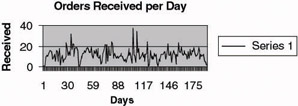
Employees should be trained on different topics depending on their duties and responsibilities. This includes cycle counting, transaction discipline, and different work areas such as receiving, put-away, or delivery. Flexibility obviously increases as employees are cross-trained and can be involved in other responsibilities as work fluctuates with customer demand shifts. Orders are hardly ever consistent day to day (Figure 8-1). Customers in almost every market are somewhat unruly. Well-designed training can create an awareness of this flexibility expectation if it is a component of each training session.
Education and training are the best and quickest levers to affect company culture.
When focusing on data accuracy, there are often specific transactions required for certain job functions. People working in a production or distribution warehouse, for example,...