Building a Values-Driven Organization: A Whole System Approach to Cultural Transformation
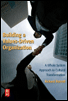
This concluding chapter describes an example of a whole-system approach to organizational transformation developed by the Centre for Integral Excellence at Sheffield Hallam University in the United Kingdom. The approach brings together the European Foundation for Quality Management Excellence model (EFQM) and the seven levels of consciousness model in an integral, whole-system, evaluation process.
The European Foundation for Quality Management is a not-for-profit foundation set up in 1989 by chief executive officers (CEOs) of 14 prominent European companies including British Telecomm, Dassault Aviation, AB Electrolux, Fiat, KLM, Nestl , Philips Electronics NV, and Renault. The foundation was set up to promote the use of total quality management and best-management practices as a way of improving the global competitiveness and effectiveness of European businesses. The foundation launched the European Quality Award in 1991. This annual award is given to companies that best meet the EFQM criteria of management excellence.
The EFQM excellence model has evolved considerably since its conception by benchmarking against other organizational quality frameworks such as the Malcolm Baldrige National Quality Award in the United States, the South African and Australian Quality Award schemes, and the Japanese Deming Prize.
The EFQM excellence model is now widely recognized across Europe as an effective way of improving organizational performance. The model is applied and monitored through self-assessment and can be administered internally. Qualified external facilitators can also be called on to validate the self-assessment. The framework can be applied to any type or size of organization,...