Chemical Process Equipment: Selection and Design, Second Edition

The transfer of fluids through piping and equipment is accompanied by friction and may result in changes in pressure, velocity, and elevation. These effects require input of energy to maintain flow at desired rates. In this chapter, the concepts and theory of fluid mechanics bearing on these topics will be reviewed briefly and practical and empirical methods of sizing lines and auxiliary equipment will be emphasized.
The basis of flow relations is Newton's relation between force, mass, and acceleration, which is
| (6.1) | |
When F and m are in lb units, the numerical value of the coefficient is g c = 32.174 lb ft/lbf sec 2. In some other units,
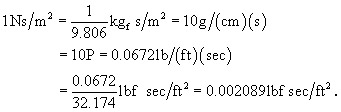
Since the common engineering units for both mass and force are 1 lb, it is essential to retain g c in all force-mass relations. The interconversions may be illustrated with the example of viscosity whose basic definition is force/(velocity)(distance). Accordingly the viscosity in various units relative to that in SI units is
In data books, viscosity is given either in force or mass units. The particular merit of SI units (kg, m, s, N) is that g c = 1 and much confusion can be avoided by consistent use of that system. Some numbers of frequent use in fluid flow problems are
Viscosity: 1cPoise = 0.001 N s/m 2 = 0.4134 lb/(ft)(hr).
Density: 1 g m/cm 3 = 1000 kg/m 3 =...