Chemical Process Equipment: Selection and Design, Second Edition
The problems of interest are finding the conditions for onset of vaporization, the bubble-point; for the onset of condensation, the dewpoint; and the compositions and the relative amounts of vapor and liquid phases at equilibrium under specified conditions of temperature and pressure or enthalpy and pressure. The first cases examined will take the K i to be independent of composition. These problems usually must be solved by iteration, for which the Newton-Raphson method is suitable. The dependence of K on temperature may be represented adequately by
| (13.24) | |
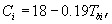
An approximate relation for the third constant is
| (13.25) | |
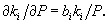
where T bi is the normal boiling point in K. The dependence of K on pressure may be written simply as
| (13.26) | |
Linear expressions for the enthalpies of the two phases are
| (13.27) | |
| (13.28) | |
assuming negligible heats of mixing. The coefficients are evaluated from tabulations of pure component enthalpies. First derivatives are needed for application of the Newton-Raphson method:
| (13.29) | |
| (13.30) | |
The temperature at which a liquid of known composition first begins to boil is found from the equation
| (13.31) | |
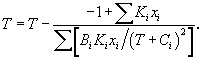
where the K i are known functions of the temperature. In terms of Eq. (13.24) the Newton-Raphson algorithm is
| (13.32) | |
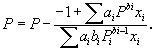
Similarly, when Eq. (13.26) represents the effect of pressure, the bubble-point pressure is found with the N-R algorithm:
| (13.33) | |
| (13.34) | |
The temperature or pressure at which a vapor of known composition first begins to condense is given...