13.1. VAPOR-LIQUID EQUILIBRIA
This topic is concerned with the relations between vapor and liquid compositions over a range of temperature and pressure. Functionally, the dependence of the mol fraction y i of component i in the vapor phase depends on other variables as
| (13.1) | 
|
The dependence on composition alone often is approximated by
| (13.2) | 
|
where K i, the vaporization equilibrium ratio (VER), is a function of temperature, pressure, and composition. Equation (13.2) can be viewed, as suggested by Raoult's law,
| (13.3) | 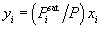
|
with
| (13.4) | 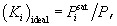
|
where  is the vapor pressure of component I, and P is the system total pressure. A number of correlations for VER have been developed for hydrocarbon systems that form relatively ideal solutions, but for most chemical systems, Eq. (13.4) must be corrected. At lower pressures (below about 5 atm), the correction factor is a liquid phase activity coefficient
  (sometimes called a "Raoult's law correction factor").
A more rigorous expression is derived by noting that at equilibrium, partial fugacities of each component are the same in each phase, that is
| (13.5) | 
|
or, in terms of fugacity and activity coefficients,
| (13.6) | 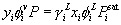
|
and the VER becomes
| (13.7) | 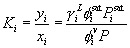
|
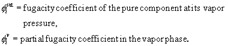
Additionally, small corrections for pressure, called Poynting factors, belong in Eq. (13.6) but are omitted here. The new terms are:
Equations for fugacity coefficients are derived from equations of state or are approximated from activity coefficient charts as functions of reduced temperature and pressure. Table 13.1 includes them for the popular Soave equation of state. At...


 TABLE OF CONTENTS