OpenVMS System Management Guide, 2nd Edition

This complete text details the tools, technologies and techniques that can configure, maintain, and tune computers running Hewlett-Packard's high-performance OpenVMS operating system.
 TABLE OF CONTENTS
 An OpenVMS system consists of three major resources: CPU, memory, and disk. Every application uses each of these resources to varying degrees. For example, a statistical analysis application might rely mostly on the CPU and less on memory and disk. On the other hand, a database update might perform many disk operations while requiring only moderate amounts of CPU and memory resources.
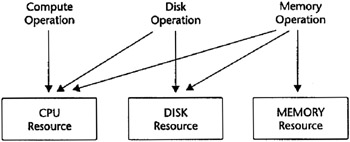
CPU, memory, and disk resources are interrelated. Disk I/O affects a physical disk, but it also requires CPU time to set up and complete the request. Similarly, requests for pages of memory require CPU time and may require disk I/O if the requested pages are no longer located in physical memory. Figure 18.1 illustrates how various application requests affect each of the major system resources.
Some performance-management approaches focus solely on monitoring each system resource, detecting when they become saturated, and tuning or load-balancing them until utilization seems acceptable. This approach relies on the assumption that as long as a resource is not overutilized, user application response time will be acceptable. Unfortunately, this is not necessarily the case. For example, an application might issue I/O requests to a dedicated disk at a rate less than 10 percent of the capacity of the drive. However, just because a drive is underutilized does not mean its response time is acceptable. Similarly, it certainly is not a good sign if the CPU of your system is always 85 percent busy, but it is...