Programmable Logic Controllers

Chapter 1: Programmable Logic Controllers

This chapter is an introduction to the programmable logic controller, its general function, hardware forms and internal architecture. This overview is followed up by more detailed discussion in the following chapters.

1.1 Controllers

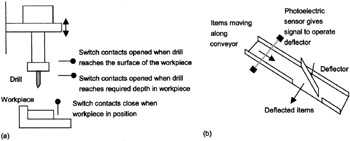
What type of task might a control system have? It might be required to control a sequence of events or maintain some variable constant or follow some prescribed change. For example, the control system for an automatic drilling machine (Figure 1.1 (a)) might be required to start lowering the drill when the workpiece is in position, start drilling when the drill reaches the workpiece, stop drilling when the drill has produced the required depth of hole, retract the drill and then switch off and wait for the next workpiece to be put in position before repeating the operation. Another control system (Figure 1.1 (b)) might be used to control the number of items moving along a conveyor belt and direct them into a packing case. The inputs to such control systems might be from switches being closed or opened, e.g. the presence of the workpiece might be indicated by it moving against a switch and closing it, or other sensors such as those used for temperature or flow rates. The controller might be required to run a motor to move an object to some position, or to turn a valve, or perhaps a heater, on or off.


Figure 1.1: An example of a control task and some input sensors: (a) an automatic drilling machine, (b) a...

UNLIMITED FREE
ACCESS
TO THE WORLD'S BEST IDEAS

SUBMIT
Already a GlobalSpec user? Log in.

This is embarrasing...

An error occurred while processing the form. Please try again in a few minutes.

Customize Your GlobalSpec Experience

Category: Drilling Units and Tapping Units
Finish!
Privacy Policy

This is embarrasing...

An error occurred while processing the form. Please try again in a few minutes.