Programmable Logic Controllers

4.3: Remote Connections

4.3 Remote Connections

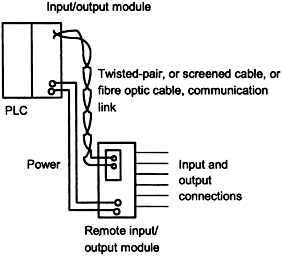
When there are many inputs or outputs located considerable distances away from the PLC, while it would be possible to run cables from each such device to the PLC a more economic solution is to use input/output modules in the vicinity of the inputs and outputs and use just a single core cable to connect each, over the long distances, to the PLC instead of the multicore cable that would be needed without such distant I/O modules (Figure 4.17).


Figure 4.17: Use of remote input/output module

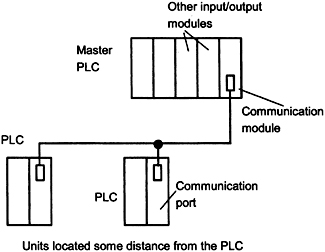
In some situations a number of PLCs may be linked together with a master PLC unit sending and receiving input/output data from the other units (Figure 4.18). The distant PLCs do not contain the control program since all the control processing is carried out by the master PLC.


Figure 4.18: Use of remote input/output PLC systems

The cables used for communicating data between remote input/output modules and a central PLC, remote PLCs and the master PLC are typically twisted-pair cabling, often routed through grounded steel conduit in order to reduce electrical noise . Coaxial cable enables higher data rates to be transmitted and does not require the shielding of steel conduit. Fibre-optic cabling has the advantage of resistance to noise, small size and flexibility and is now becoming more widely used.

4.3.1 Serial and parallel communications

Serial communication is when data is transmitted one bit at a time (Figure 4.19(a)). Thus if an 8-bit word is...

UNLIMITED FREE
ACCESS
TO THE WORLD'S BEST IDEAS

SUBMIT
Already a GlobalSpec user? Log in.

This is embarrasing...

An error occurred while processing the form. Please try again in a few minutes.

Customize Your GlobalSpec Experience

Category: Fieldbus Products
Finish!
Privacy Policy

This is embarrasing...

An error occurred while processing the form. Please try again in a few minutes.