Programmable Logic Controllers

In many control tasks there is a need to control time. For example, a motor or a pump might need to be controlled to operate for a particular interval of time, or perhaps be switched on after some time interval. PLCs thus have timers as built-in devices. Timers count fractions of seconds or seconds using the internal CPU clock. This chapter shows how such timers can be programmed to carry out control tasks.
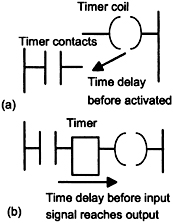
PLC manufacturers differ on how timers should be programmed and hence how they can be considered. A common approach is to consider timers to behave like relays with coils which when energised result in the closure or opening of contacts after some preset time. The timer is thus treated as an output for a rung with control being exercised over pairs of contacts elsewhere (Figure 9.1(a)). This is the predominant approach used in this book. Some treat a timer as a delay block which when inserted in a rung delays signals in that rung reaching the output (Figure 9.1(b)).
There are a number of different forms of timers that can be found with PLCs. With small PLCs there is likely to be just one form, the on-delay timers. These are timers which come on after a particular time delay (Figure 9.2(a)). Off-delay timers are on for a fixed period of time before turning off (Figure 9.2(b)). Another type of timer that occurs is the pulse