Programmable Logic Controllers

The following are the main symbols encountered.
Ladder programs
| Semi-graphic form | Full graphic form | |
|---|---|---|
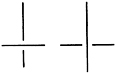
| A horizontal link along which power can flow | | |
| Interconnection of horizontal and vertical power flows | | |
| Left-hand power connection of a ladder rung | | |
| Right-hand power connection of a ladder rung | | |
| Normally open contact | | |
| Normally closed contact | | |
| Positive transition-sensing contact, power flow occurs when associated variable changes from 0 to 1. | | |
| Negative tranistion-sensing contact, power flow occurs when assoaciated variable changes from 1 to 0. | | |
| Output coil: if the power flow to it is on then the coil state is on | | |
| Set coil | | |
| Reset coil | | |
| Retentive memory coil, the state of the associated variable is retained on PLC power fail | | |
Function blocks
| Semi-graphic form | Full graphic form | |
|---|---|---|
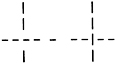
| Horizontal and vertical lines | | |
| Interconnection of horizontal and vertical signal flows | | |
| Crossing horizontal and vertical signal flows | | |
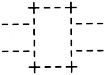
| Blocks with connections | | |
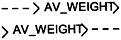
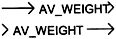
| Connectors | | |
Commonly encountered blocks:
BOOL is Boolean signal, INT is integer, REAL is a floating point number, ANY is any form of signal
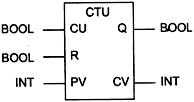
| Up-counter counts the number of rising edges at input CU. PV defines the maximum value of the counter. Each new rising edge at CU increments CV by 1. Output Q occurs after set count. R is the reset. | |
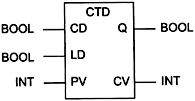
| Down-counter counts down the number of rising edges at input CU. PV defines the starting value of the counter. Each new rising edge at CU decrements CV by 1. Output Q occurs when count reaches. zero. | |
| Up-down counter. It can be used to... |