Six Sigma: Continual Improvement for Businesses: A Practical Guide

Resolve to perform what you ought; perform without fail what you resolve
Stonewall Jackson
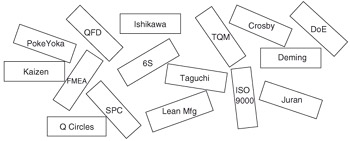
A number of improvement initiatives are, or have been at some time, in common currency. These are described at the appreciation level and compared with the Six Sigma process. It will be noted that Six Sigma adopts, and builds upon, many of the best-practice methods and practices applied in other initiatives. It is unique, however, in respect of its enabling and perpetuating infrastructure of 'Judo' belts. It also aims to combine and refocus a whole range of improvement tools that, hitherto, have been largely deployed in a fragmented manner. This fragmentation of deployment of various tools and techniques in a number of organizations is illustrated in Figure 3.1. Such organizations do not deploy these very useful methods in a cohesive manner.
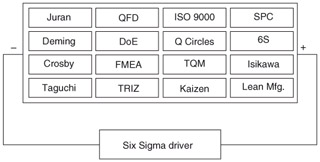
Figure 3.2 portrays the Six Sigma process as one that orientates a number of existing, seemingly disparate, practices towards a common goal. The result is seen as a cohesive set of existing practices, focused, marshalled, driven and managed by a unique Six Sigma infrastructure.
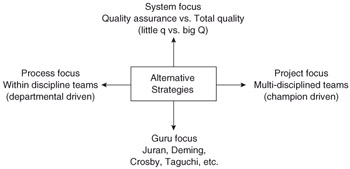
A number of different strategies can be deployed in quality-improvement processes. A selection of the principal ones is shown in Figure 3.3. It will be seen that Six Sigma embodies all four approaches to a greater or lesser degree.