Six Sigma: Continual Improvement for Businesses: A Practical Guide

If a system is made up of a number of elements and it is necessary for all those elements to operate for the system to operate, we then have what is termed:
a series or 'AND' system.
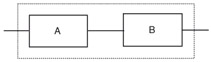
Such a system is displayed in its simplest form in Figure A1 by two elements, A and B, in series. This denotes that it is necessary for both A and B to operate for the system to be functional.
The 'product rule' applies to such a series or 'AND' system. System reliability is determined by multiplying together the reliabilities of all the series elements. If, in Figure A1, the reliability ( R) of A is 0.9 (90%) and that of B is 0.8 (80%).
Then System reliability = R system = R A R B = 0.9 0.8 = 0.72 (72%)
If, on the other hand, both elements had the same reliability, say 0.7 (70%), the system reliability = 0.7 0.7 = 0.49 (49%). This could alternatively be expressed as
System reliability = 0.7 2 = 0.49 (49%)
The principle is now applied to quantifying the sensitivity of:
number of CTQCs (critical-to-quality characteristics) on product performance;
Sigma level on product performance.
The effect of the difference in number of CTQCs in a product are portrayed in Scenarios 1 and 2.
Scenario 1: Product with 1000 CTQCs,...