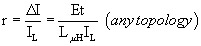
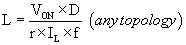
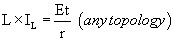
We know that current swing is voltseconds per unit inductance. So we can also write
Here ' Et' is defined as the (magnitude of the) volt ?seconds across the inductor (either during the on-time or off-time both being necessarily equal in steady state), and L ?H is the inductance in ?H. The reason for defining Et is that this number is simply easier to manipulate than voltseconds because of the very small time intervals involved in modern power conversion.
Therefore, the current ripple ratio is
Note also that from now on, whenever L is paired up with Et in any given equation, we will drop the subscript of L, that is, " ?H." It will then be "understood" that L is in ?H.
Finally, we have the following key relationships between r and L
Incidentally, the preceding equation, that is, the one involving V OFF, assumes CCM, because it assumes that t OFF (the time for which V OFF is applied) is equal to the full available off-time (1 - D)/f.
Conversely, L as a function of r is
In subsequent sections we will often use the following easy-to-remember form of the previous equations. We are going to nickname this the "L I' equation (or rule)
But perhaps we are still wondering why do we even need to talk in terms of r why...


 TABLE OF CONTENTS