Switching Power Supplies A to Z

It can be shown that, in terms of overall stresses in a converter and size, r ? 0.4 represents an "optimum" of sorts. We will now try to understand why this is so, and later we will try to point out exceptions to this reasoning.
The size of an inductor can be thought of as being virtually proportional to its energy-handling capability (the effect of air-gap on size will be studied later). So for example, we probably already know intuitively that we need bigger cores to handle higher powers. The energy-handling capability of the selected core must, at a bare minimum, match the energy we need to store in it in our application that is,
L I PK 2. Otherwise the inductor will saturate.
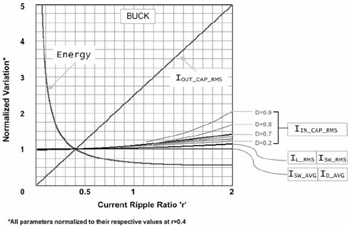
In Figure 2-6, we have plotted the energy, E =
L I PK 2, as a function of r. We see that it has a "knee" at around 0.4. This tells us that if we try to reduce r much lower than 0.4, we will certainly need a very large inductor. On the other hand, if we increase r, there isn't much greater reduction in the size of the inductor. In fact, we will see that beyond r ~ 0.4, we enter a region of diminishing returns.
In Figure...