Switching Power Supplies A to Z

Note that in the previous section, we said nothing explicitly about what the inductance was we just talked about the size of the inductor. We know that in theory, we can put almost any number of turns on a given core, and get almost any inductance. So inductance and size of inductor are not necessarily related. However, we will now see that in power conversion they often do turn out to be so, though rather indirectly.
Looking at Figure 2-6, we can see that a smaller r will require a higher energy-handling capability, and thus a larger inductor. Let us now formally go through all the possible ways of reducing r.
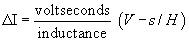
Since we are assuming our application conditions are fixed, the load current and input/output voltages are also fixed. Therefore, I DC is fixed too. The only way we can cause r to decrease under these circumstances is to make ?I smaller. However, ?I is
But we know the applied voltseconds is fixed too (input and output voltages being fixed). So the only way to decrease r (for a given set of application conditions) is to increase the inductance. We can therefore conclude that if we choose a high inductance, we will invariably require a bigger inductor. It is therefore no surprise that when power supply designers instinctively ask for a "large inductance," they might...