Switching Power Supplies A to Z

There are certain things we may do unintentionally at the input of the converter that can have a major impact on the performance of the EMI filter, and also the converter itself. If we don't know the rules of the game, we can end up saturating our filter chokes and even inducing instability.
Part of the designer's average "EMI troubleshooting day" may involve taking a core from the shelf and placing some turns on it. But the temptation of winding a few more turns (to increase the inductance) may just do it the core could start saturating, rendering it less and less effective. But how could we have known that?
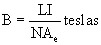
The simplest equation to check if a core is saturating or not is
where L is the measured inductance in H, N the number of turns, and A e is the effective area of the core in m 2. Note that A e is simply the normal geometric cross-sectional area of the core. If it is an E core, we would take the area of the center limb (or twice the area of each side limb, whichever is smaller, though usually, either way we get the same result). So if we plug in the peak current we can calculate the peak B-field in the choke. If we know the material of the core, we probably already know its saturation flux density B SAT Then we can easily check if...