Switching Power Supplies A to Z

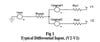
In Chapter 1 we had discussed a simple series resistor-capacitor (RC) charging circuit. What we were effectively doing there was that by closing the switch we were applying a step voltage (stimulus) to the RC network. And we studied its "response" which we defined as the voltage appearing across the terminals of the capacitor.
Circuits like these can be looked upon as a "black box", with two terminals coming in (the input, or the excitation) and two leaving (the output, or the response). One of the rails may of course be common to both the input and output, as in the case of the ground rail. This forms a "two-port network". Such an approach is useful, because power supplies too, can be thought of in much the same way with two terminals coming in and two leaving, exposed to various disturbances/stimuli/excitations.
But let us examine the original RC-network in more detail first, to clarify the approach further. Let us say that the input to this RC network is a voltage step of height 'v i'. The output of this network is taken to be the voltage across the capacitor, which we now call 'v o' here. Note that v o is a function of time. We define the ratio of the output to the input of any such two-port network, i.e. v o/v i in this case, as the...