Switching Power Supplies A to Z

We now present the main mathematical analysis and tools needed to finally cap a successful filter design. First we should recall our hazy Fourier series class. Fourier analysis is often avoided by power supply engineers, but it can go a long way toward understanding and tackling several key issues like EMI/noise, transformer proximity losses, PFC (power factor correction), and so on.
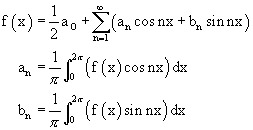
Collecting some of the basic definitions first:
For a function f( x) with the time period expressed in terms of an angle ( 2 ?) , we can write
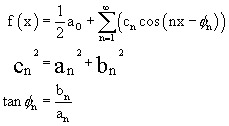
Alternatively,
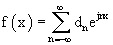
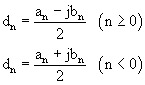
Alternatively,
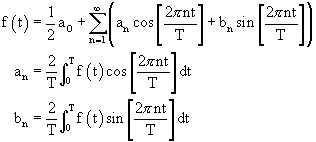
For a function f(t) with a time period 'T (units of time):
In most math school books, the time period is expressed as 2 ?. However, in power supplies we know that the period we are interested in is in units of time not angle, that is, T = 1/f. The normal way to convert angle ? to t is to use the equivalence ?/2 ? ? t/T, that is, ? ? 2 ?t/T.
| Note | The designer should not get confused by the fact that the first term in the expansion is sometimes called "a O/2," sometimes "a O," or sometimes something else altogether. Either way, in any Fourier expansion of any arbitrary periodic function, the first term is always the area under the waveform calculated over one time period (i.e. its arithmetic average). |
| Note | If the waveform is "moved"... |