Supply Chain Strategies: Customer Driven and Customer Focused
According to Prahalad and Hamel (1994) core capabilities and competencies differentiate a company from its competitors leading to a competitive advantage. Organizational learning has been defined as the capability of an organization to adapt to its environment (Hedberg, 1981). Garvin (1993) identified organizational learning as a capability required by all firms.
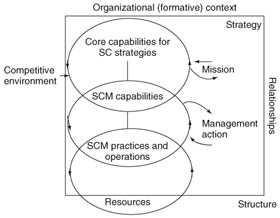
The model in Figure 2.8 is a conceptualization involving three learning loops that develop a firm's capabilities and core capabilities in relation to managing supply chains beginning with resources, routine operations, work practices and taking account of external environmental conditions and mission. Resources at the firm's disposal determine supply chain structure. Mission and management actions can affect resources and determine supply chain strategy. Relationships link both supply chain strategy and structure, and connect the firm with its internal and external operating environment.
The first loop creates routine practices using resources. The second loop combines work practices and organizational routines determined by management action and interaction. Relationships are an important focus for learning in the context of the supply chain in this second loop. The third gives meaning to capabilities in the context of the competitive environment and mission. Management intervention aims to provide direction to learning processes (Argyris, 1991). Core capabilities are components of organizational context, radical learning means learning how to do radically new things (bottom loop), which are important in radically new ways implying activity in the top loop (Argyris and Schon, 1978).
Individual competence and organizational...