Theory of Beam Columns: Space Behavior and Design, Volume 2

A three-dimensional space structure is often treated as a collection of two-dimensional planar structures; that is, structures with all their members lying in a single plane and with all the loads applied in the same plane. This procedure is equivalent to setting a number of secondary interaction bending moments and torques equal to zero. The beam-columns in a planar frame are, therefore, designed to resist bending moments acting in the plane of the frame. The theory of in-plane beam-columns is presented in Vol. 1 of this book.
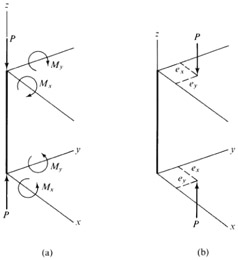
While this idealization has resulted in satisfactory designs in the past, it does not necessarily represent the true loading condition existing in a space structure and may not give the optimum design. In an actual building framework, the beam-columns are frequently subjected to bending moments acting in two perpendicular directions in addition to an axial compression (commonly called biaxial hading or biaxial bending). The obvious example is a corner column in a space building frame. The biaxial moments may result from the space action of the entire framing system (Fig. 1.1a) or from an axial load biaxially located with respect to the principal axes of the beam-column cross section (Fig. 1.1b).
Although the loading conditions shown in Fig. 1.1(a) and Fig. 1.1(b) are statically equivalent to each other and often are considered identical in terms of stress resultants, the plastic behavior of these two beam-columns may be quite different,...