Theory of Beam Columns: Space Behavior and Design, Volume 2
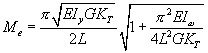
The support conditions of cantilevers differ from those of simply supported beams in that a cantilever is usually completely fixed at one end and completely free at the other. The elastic buckling solution for a cantilever in uniform bending caused by an end moment M can be obtained from the solution given by Eq. (3.21) for simply supported beams by replacing the beam length L by twice the cantilever length 2 L, whence
| (3.49) | |
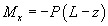
The elastic buckling of a cantilever with a concentrated end load P applied at a distance a above the shear center can be predicted from the solutions of the differential equations of minor axis bending and torsion
| (3.50) | |
and
| (3.51) | |
in which
| (3.52) | |
and
| (3.53) | |
These solutions must satisfy the fixed end ( z = 0) boundary conditions of
| (3.54) | |
and the condition that the end z = L is free to warp, i.e.
| (3.55) | |
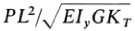
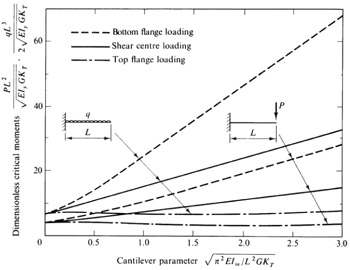
Numerical solutions of these equations are available (Anderson and Trahair, 1972, Nethercot, 1973b), and some of these are shown in Fig. 3.13 as plots of the dimensionless critical moments
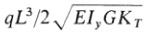
for bottom flange, shear center and top flange loading. Also shown in Fig. 3.13 are plots of the dimensionless critical moments
of cantilevers with uniformly distributed loads q.
The elastic buckling of monosymmetric cantilevers has been investigated, and many numerical solutions have been tabulated (Anderson and Trahair, 1972). Studies have also...