Theory of Beam Columns: Space Behavior and Design, Volume 2
The deflection methods described in the preceding chapter for biaxially loaded beam-columns are simple and easy to apply but the approximation is rather rough, since the deflected shapes of the member are assumed in simple functions and the equilibrium conditions are satisfied only at the mid-span for the case of symmetric loading, or at a critical point along the length of the member for the case of unsymmetrical loading. Here, an improved method called influence coefficient method is presented. In this method, a number of points are selected along the member and deflections are solved from the equilibrium conditions set up at these selected points.
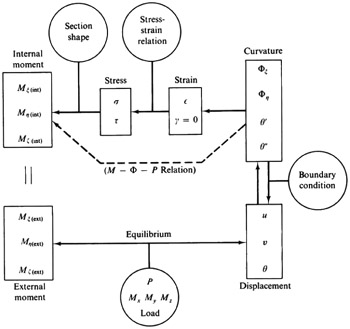
The inter-relationships among the variables used in beam-column analysis are shown schematically in Fig. 8.1. The items enclosed by the circles, such as section shape, stress-strain relationship, boundary conditions and loads, are known. The variables in the rectangular boxes are unknowns but they are inter-related to each other between groups. In obtaining the solution indirectly, one of the groups of variables has to be assumed first and then the other groups of variables are determined numerically. In this process, new values for the initially assumed group of variables are re-calculated from which successively improved solutions can be obtained. The influence coefficient method is concerned with the development of efficient numerical procedures for this purpose.
There are two different approaches in the influence coefficient method (Fig. 8.1). One is to start from a group of variables,...