Theory of Beam Columns: Space Behavior and Design, Volume 2

3.7: CONTINUOUS BEAMS

3.7 CONTINUOUS BEAMS

3.7.1 Elastic Beams

A continuous beam is perhaps the simplest type of rigid-jointed plane frame structure, and can be regarded as a series of beam spans which are rigidly connected together at supports. In general, there are interactions between adjacent spans during buckling which depend on the geometry and loading of the complete beam.

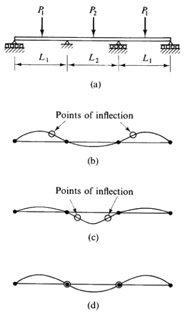
The effects of these interactions on the elastic buckling modes of a three span continuous beam are shown in Fig. 3.30. When only the end spans are loaded ( P 2 = 0), they are restrained during buckling by the center span, and the buckled shape has inflection points in the end spans, as shown in Fig. 3.30(b). When only the center span is loaded ( P 1 = 0), it is restrained by the end spans, and the buckled shape has inflection points in the center span, as shown in Fig. 3.30(c). Between these two extremes exists the zero interaction load combination for which the buckled shape has inflection points at the internal supports, as shown in Fig. 3.30(d), and each span buckles as if unrestrained in the buckling plane.


Figure 3.30: Buckling modes for symmetrical three-span continuous beam. (a) Elevation. (b) Mode 1, P 2 = 0. (c) Mode 2, P 1 = 0. (d) Mode 3, zero interaction

The corresponding effects of the interactions on the elastic buckling load combinations are shown in Fig. 3.31. It can be seen that as the loads P 1

UNLIMITED FREE
ACCESS
TO THE WORLD'S BEST IDEAS

SUBMIT
Already a GlobalSpec user? Log in.

This is embarrasing...

An error occurred while processing the form. Please try again in a few minutes.

Customize Your GlobalSpec Experience

Category: Beams, Joists, and Wall Studs
Finish!
Privacy Policy

This is embarrasing...

An error occurred while processing the form. Please try again in a few minutes.