Theory of Beam Columns: Space Behavior and Design, Volume 2
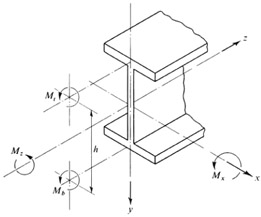
When a beam forms part of a rigid-jointed structure, the adjacent members elastically restrain the ends of the beam (i.e., they induce restraining moments which are proportional to the end rotations). These restraining actions significantly modify the elastic critical load which causes the beam to buckle. Four different types of restraining moment may act at each end of a beam, as shown in Fig. 3.14. They are:
the major axis end moment M x which provides restraint about the major axis,
the bottom flange end moment M b and
the top flange end moment M t, which provide restraints about the minor axis and against end warping, and
the axial torque M z which provides restraint against end twisting.
The major axis end restraining moments M x vary directly with the applied loads, and can be determined by a conventional in-plane bending analysis. The degree of restraint experienced at one end of the beam depends on the major axis stiffness ? x of the adjacent member (which is defined as the ratio of the end moment to the end rotation). This is most conveniently expressed by the ratio R 1 of the actual restraining moment to the maximum moment required to prevent major axis end rotation. Thus R 1 varies from 0 when there is no restraining moment to 1 when there is no end rotation. For beams which are...