UML for Systems Engineering: Watching the Wheels, Second Edition

(Camelot!) It's only a model
Patsy
Previously we have discussed the point that each system must be modelled in two different aspects. This chapter examines one of these aspects: the structural aspect of the model.
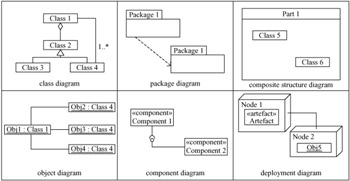
Figure 3.1 shows the six types of diagrams that can be used to realise structural models: class diagrams, package diagrams, object diagrams, composite structure diagrams, component diagrams and deployment diagrams.
In order to illustrate the concepts behind structural modelling, one of the six structural diagrams will be used to show some simple examples. The diagram chosen is the class diagram as this forms the backbone of the Unified Modelling Language (UML). In addition, the structural modelling principles shown in this section with reference to class diagrams can be applied when using any type of structural model. For more in-depth discussion concerning class diagrams and structural modelling, see References 1 3.
The class diagram is, arguably, the most widely used diagram in the UML. Class diagrams have a long history and are present in some shape or form in all of the other methodologies that were mentioned previously in this part of the book. The class diagram is also the richest diagram in terms of the amount of syntax available to the modeller. As with all UML diagrams, it is not necessary to use every piece of syntax, as experience has shown that 80 per cent of any...